
By: JDK - 11th August 2007 at 04:57
Interesting…
I should add that my notes on the SEAC roundel family was a very quick and dirty summary. Like any makings area, there’s a lot more to be said!
By: Malcolm McKay - 11th August 2007 at 01:46
Interesting that the US WWI roundel is exactly the same as one of the variations used by the Imperial Russian AF…. 😮
Ken
Not only that but the US aircraft used by Pershing in the border conflict with Mexico in 1916 had red stars as the national marking.
By: Aerodynamik - 10th August 2007 at 20:41
Thanks guys… Steve
By: Flanker_man - 10th August 2007 at 16:57
..snip…
Even more obscure is that the Americans were given the third (of possible roundel red/white/blue permutations) when they joined the war in 1918. This early US roundel is rarely seen, and rarer to recognise also.
Cheers
Interesting that the US WWI roundel is exactly the same as one of the variations used by the Imperial Russian AF…. 😮

Ken
By: JDK - 10th August 2007 at 14:03
The first friendly fire incidents in the Pacific led to the US losing the red centre dot to their roundel, and the RAF and RAAF taking the red out also. For a resonably authoritative PDF summary of the RAAF’s story see:
http://www.raaf.gov.au/airpower/html/publications/publications_catalogue_pathfinder.htm
No.27: WHY THE RED CENTRE VANISHED
An extract:
On 26 June 1942, a Catalina flying boat of 11 Squadron RAAF was about to alight on Havannah Bay, New Hebrides (now Vanuatu), to refuel. The ‘Cat’ had called in there on its way to bomb Tulagi in the Solomon Islands, and was then on the return flight to Noumea having completed its mission. Despite its presence being expected, the American ground control at Havannah Bay had, as a precautionary measure, ordered a US Marine Wildcat fighter into the air to identify the incoming aircraft.
Geoff Pentland, in his book RAAF Camouflage & Markings 1939–45 – Vol. 1, takes up the story:
This the US pilot did, but though the shape of the Catalina was no doubt disturbingly familiar, the red in the upper wing roundels [national insignia] seemed to him so distinct—as he later said—that he mistook them for Japanese markings and immediately attacked. Bullets passed through the Catalina’s main crew compartment, fuel tanks, and ailerons, but fortunately no one was hurt and the aircraft was able to land safely.
Flying Officer Robert Seymour and his crew were undoubtedly shaken by this close call, but the incident had a more far-reaching consequence. It was decided that operational and second-line RAAF aircraft were henceforth to have the large red centres of their upper-wing roundels painted out in white. This was formalised in Aircraft General Instruction C11, Issue 4, dated 31 July 1942. Within a few months, the order was extended to all roundels on all RAAF aircraft.
The issue of marking confusion and what’s now called ‘friendly fire’ dates to the early days of W.W.I (the start of air combat and ground-air recognition problems) where the RFC and RNAS abandoned the Union Flag (usually known as the Union Jack) mounted on the aircraft as, at a distance, form is more important than colour, and the Union Flag looked like a cross – an Iron Cross as worn by the German aircraft. Britain then took the French roundel and reversed the colours. Even more obscure is that the Americans were given the third (of possible roundel red/white/blue permutations) when they joined the war in 1918. This early US roundel is rarely seen, and rarer to recognise also.
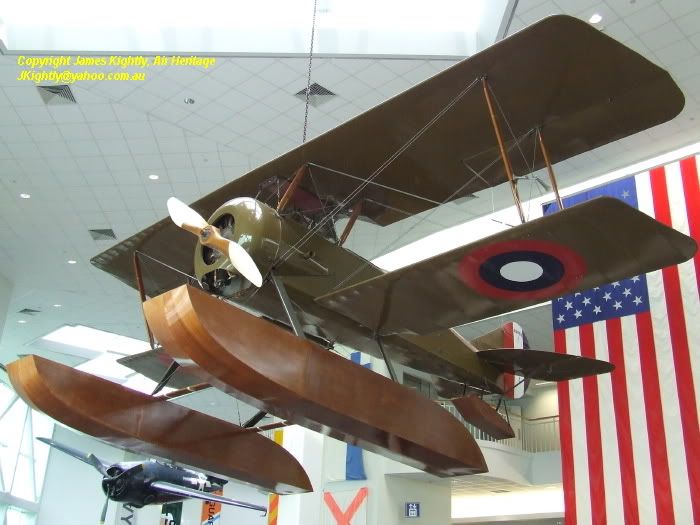
Back to the Pacific – the Commonwealth roundel became white and blue, then later light and dark blues, later still acquired a US style bar. RAAF, RNZAF and RAF marking followed each country’s independant instruction to achieve similar, but often different results – IIRC, the RNZAF retained a tiny red dot to the end.
Cheers
By: Paul F - 10th August 2007 at 13:36
So as to avoid the red centre of the standard RAF markings being confused with the red disk of the Japanese markings – especially in the heat of battle when pilots had to make snap decisions rather than have time to “double check” what they were looking at.
Paul F


 Sign In








 August 10, 2007 at 1:31 pm