Finally.
From the Post Courier (PNG Newspaper):
US bomber taken from Oro swamp
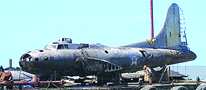
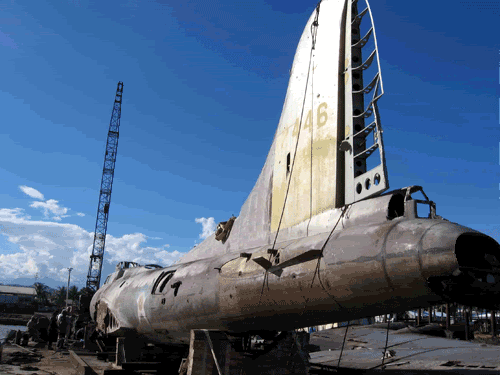
SWAMP GHOST, an American war plane that crashed into the swamps of Oro Province during World War II is about to be shipped out to the United States of America. The WWII bomber, a B17E plane is reportedly to be restored in the United States. The plane has been shifted from a swamp in Oro Province to Lae and is expected to be shipped to the USA soon. The National Museum authorities said a Fred Hagen from the US and a Robert Greinert from Australia, have been allowed to have the plane salvaged and restored in the United States at a cost of thousands of US dollars. It is believed the war relic, if sold could be worth over a million US dollars. National Museum acting director Simon Poraituk said in a letter last month that the National Museum and Art Gallery board of trustees have made a decision to let Mr Hagen salvage and restore the plane. The board was empowered by the National Museum and Art Gallery Act of 1992 to make decisions on war surplus materials that were protected by the war surplus material act (1952), he said then. The plane had remained fully intact for the last 64 years in Karaisa village of Oro Province. However, Karisa leaders Jerry Yogoni, Gilbert Yogoni, Gutari Yogoni, Colin Tom and the chairman of the Beach Head Battlefields Tourism Committee in Popondetta Joachim Olai do not want the plane to be salvaged, removed or damaged. They all agreed that the plane should be left where it was because it was “priceless” and that it could be used to attract tourist.

By: Bruce - 16th June 2006 at 13:34
There is much more to this than money. Like a BoB veteran Spitfire, a B-17 with combat history transcends mere money.
If one were financially practical, there would be no flying warbirds, or few working relics (ships, cars, trains) of any kind. People spend vast amounts of time and money simply to preserve a link to the past (and maybe have a bit of fun). A friend just sold a beautifully restored Beech Staggerwing for more than $300,000. After subtracting for parts and material costs, his labour was barely rewarded…I’m sure he could have made more per hour by cutting neighbors lawns.
You are absolutely right of course. If one is doing it entirely through ones own finances, and is not paying a commercial rate, one is unlikely to be rewarded for time expended. I was looking at it from a bit of a commercial viewpoint, as a project like this will likely be subcontracted out, at which point the costs begin to spiral upwards alarmingly!
As regards your combat veteran Spitfire, I would suggest that aircraft such as the ex Peter Cazenove machine mentioned elsewhere will have very little, if any original material left in the structure, following restoration, which kind of negates any value as a combat aircraft. Swamp Ghost isnt in this category quite, but I truly believe a restoration to fly would severely compromise its historical worth..
Bruce
By: David Burke - 16th June 2006 at 13:11
The problem with this recovery is that the wing attachments were I believe cut through for ease of dismantling with the view that new fittings would be used in her rebuild. There is no shortage of airworthy B-17’s in the U.S – as an effectively early unrestored bomber she has historically more importance . However to achieve a return to air a large amount of her structure is going to need replacement.
As for her plight in PNG – she certainly wasn’t protected there but it’s worth pointing out that the number of locals arriving in helicopters to pilage her must have been quite small. Far more likely to have been Western interests working in the country. As for the scrapping of aircraft there – there were vast numbers of aircraft in PNG circa 1950’s but the majority were very well picked clean by Australian and other nationalities in the need to make cash. The efforts of the PNG people in scrapping aircraft there have been tiny in comparison.
Regarding the value of ‘Swamp Ghost’ – as she stands the documentary that will come from the recovery will have a higher value than the sum total of the aircraft.
By: J Boyle - 16th June 2006 at 04:39
One other point – like to consider what an airworthy B17 is actually worth, and how much it would cost to restore an airframe such as this? I suspect the latter figure is far in excess of the former….
Bruce
There is much more to this than money. Like a BoB veteran Spitfire, a B-17 with combat history transcends mere money.
If one were financially practical, there would be no flying warbirds, or few working relics (ships, cars, trains) of any kind. People spend vast amounts of time and money simply to preserve a link to the past (and maybe have a bit of fun). A friend just sold a beautifully restored Beech Staggerwing for more than $300,000. After subtracting for parts and material costs, his labour was barely rewarded…I’m sure he could have made more per hour by cutting neighbors lawns.
By: DoraNineFan - 16th June 2006 at 04:26
…the surrounding jungle area should have been protected against theft and vandalism.
Tillerman.
But it didn’t.
Others’ accounts have stated that some items have been souvenired from the aircraft. The wing had been used as a landing pad for helicopters and in one or more of the recovery photos it looks to me like the rudder has been used at a stepladder to climb up and view the panorama around the wreck.
Isolated it was, protected it wasn’t.
By: DaveM2 - 16th June 2006 at 02:57
Bager
According to the team that recovered her, estimates are that it may have lasted another 10 years ( aircraft engineers inspection). We got some nice photos showing how high the water has been reaching inside the fuselage, almost to the roof of the aircraft, which obvioulsy affects the structure.
I would like to see it preserved as a relic, but at least it will be going to a (Very) dry environment in the meantime.
As Bruce says, at least one of each type should be preserved in PNG at the War Museum, some attempts have been made previously to build a facility in exchange for recovering relics, but through corruption ( or perhaps incompetence) it didn’t happen. Nevertheless two aircraft ( A-20 and Ki-61) are in waiting to return to PNG.
As far as relics ‘in situ’, there are plenty that are well beyond salvage that could be protected ( spray some sort of preservative on them), but eventually these will vanish to the scrappers, as happens every week now.
Dave
By: Bager1968 - 16th June 2006 at 01:29
Of course she should have been left in the swamp!!!
After all, there she would nicely and picturesquely have rotten into nothing in another 50 or so years… just so we could see her “in her natural state” and as a “proper war relic”… at least while she still existed!
To actually try to preserve her for more than just us and our teenage kids… How revolting!!
Our grandkids don’t deserve the privilege of seeing these beutiful machines… Let them rot in place I say!!
ARE YOU GUYS SERIOUS???
“Let it rot in place”?
I fully approve of at least properly preserving her… maybe in a manner similar to the P-40 at Anzio? That would keep her “War Relic” heritage, while insuring she is still around in 2044!
By: Bruce - 14th June 2006 at 10:11
Its a very difficult and emotive subject this one.
PNG is not like anywhere else. You cant apply 21st century Western values to a society which lives in the way they do, so you cant try and promote a heritage zone around the war relics still lying in PNG; thats a very modern way of looking at things.
Personally, I strongly believe that if the war relics are to be removed from PNG, that at least one example of each should be kept in that country, and stored until such time as they have the necessary wherewithal to display them properly (and that doesnt necessarily mean restoration, just preservation). That could be in ten years, but equally it could be in 100, or even 200!
I dont think that a statement has yet been made as regards Swamp Ghosts future. It would be a criminal act to restore it to fly, as so much of it would simply be lost. Far better that it is carefully preserved, and missing parts sympathetically replaced, to maintain the authenticity of the airframe.
One other point – like to consider what an airworthy B17 is actually worth, and how much it would cost to restore an airframe such as this? I suspect the latter figure is far in excess of the former….
Bruce
By: Tillerman - 14th June 2006 at 09:33
Swamp Ghost is no longer a war relic now. It will be just another restoration project. It should have been left where it was and as it was in PNG, the surrounding jungle area should have been protected against theft and vandalism. If they really are aware of the historical significance of this aircraft, the organisations which sponsor the recovery surely could have made a suitable donation instead and assist the local people in setting up a proper ‘heritage site’ or whatever you would like to call it? That’s the only way of letting a historical relic intact. Not by taking it away and transport it over half the globe back to the US because some people think it belongs there. In this case it doesn’t. It belongs in the Papua New Guinean Jungle.
It appears to me they are not really bothered about the historic significance of the whole crash site, I think they just wanted to have another B-17 restoration project which will be worth big bucks when it is finished.
I’ve lost my interest in this aircraft now; I would have loved to taste the local atmosphere and see it lying in its original resting place. If I want to see it now I would have to travel to an air-conditioned hangar or museum building in the US. And that makes an essential difference to me.
In my opinion, this recovery to bring the Swamp Ghost “home”, is an act of severe historical vandalism.
Tillerman.
By: gordonpagecolor - 14th June 2006 at 02:42
Who is going to restore??
Anyone know where this plane is going? Any thoughts on the amount it will take to restore?
By: B-17 Buff - 13th June 2006 at 22:57
Doc stirling,
I had the same sentiments when i first heard about the recovery as i have been fasinated by the aeroplane for a long time.. dreaming of visiting it in the swamp!! Mixed feelings. I have too say though i think it probably is about time she moved on… 64 years in a swamp is a long time! Look forward to seeing more of her in the future. Here’s to Swamp Ghost and her preservation!
By: Whitley_Project - 29th May 2006 at 11:24
Bit late, but thought I would add a hearty hooray for the recovery of old swamp ghost.
Definately better off out of the swamp.
By: XN923 - 25th May 2006 at 09:43
XN923–
I concur with that. Further to it (though it likely doesn’t apply in the case of a B-17), such study affords the opportunity of “xeroxing” the design in great detail,
S.
You’d be surprised… there was a lot that came out of the FAAM Corsair ‘archaeology’ project that revealed a number of things that weren’t known about the build of this aircraft despite it being well documented… for example, the ‘spoiler’ on the starboard wing to encourage a predictable stall was found to be a factory addition rather than the ‘field mod’ it was assumed to be. Small things, but worth knowing. Even knowing the composition of the paint used, or the grease in the oleos is worth knowing.
By: Steve T - 24th May 2006 at 16:27
XN923–
I concur with that. Further to it (though it likely doesn’t apply in the case of a B-17), such study affords the opportunity of “xeroxing” the design in great detail, enabling the building of replicas–viz that glorious-looking Me262 whose flying debut is making the rounds of the fora at the moment…I’d love to see something like that happen with the NMNA Brewster 339. At least, at last word anyway, that aircraft was slated to be conserved, rather than restored. Might be an emergent trend…NASM P-38 and P-61; FAAM Corsair…hope so.
S.
By: XN923 - 24th May 2006 at 15:11
[QUOTE=Fouga23]Papua New Guinea
You know what is sad about this is just how much material will be reused in the restoration?[/QOUTE]
who cares? As long as it’s restored!
…because then you might as well build a replica. It will probably cost less and take less time. This is a real aircaft with a real history, and heavy handed ‘restoration’ might end up getting rid of some of that. It needs to be preserved – that means no modern finishes or materials, no destroying original features to make it look shiny and new, and preferably just enough work to prevent further degradation. During the preservation process, masses can be learned about the history of the aircraft and the type that might not otherwise be recorded.
By: Peter - 24th May 2006 at 13:55
over on wix it says the govt has put a halt on her export until an inquiry set for july.. doesnt look good..!
By: DaveM2 - 24th May 2006 at 13:02
I know this is going to sound a bit perverse – and goes contrary to what we all stand for when it comes to saving old aeroplanes and displaying them for our heritage etc. etc. – but I was actually a bit disappointed to hear they had ‘rescued’ the Swamp Ghost. There was something quite unique about this plane, not just which model it was, but its whole ‘environment’.
Imagine the effort it must have taken to get out to PNG, to travel into the jungle, then the thrill of coming across this old warbird, resting in the swamp where it has lain for 60 years? The originality of this as a ‘live exhibit – in the wild’ has now been lost.
She will be renovated and will act as a suitable memorial to those airmen who died in the Pacific, but I still feel saddened that no one will be able to make that trip out to her in the swamp again. I know there are many here who enjoy visiting a crash site, and I think this site was something special.
I was lucky enough to dive the B17 ‘Bessie the Jap Basher’ and the experience has never left me. With time, all that will remain of her will be collapsed and unrecognisable metal. But I would not have wanted to see her in a museum – even flying – if it had meant I could not have dived upon her. That may sound selfish, but plenty of others have seen her too. Is it an elitist experience? Maybe – there are other B17’s around. Not enough, I grant you. Some you can see in the air, but underwater……? In the jungle….?
DS
And how many people can make that trip to the swamp?…not many. The aircraft was also being slowly scavenged, according to one of the salvage team, major sections of the structure are gone, so eventually it would disappear anyway, to scrappers and the elements.
There are other wrecks that can be visited, including a complete B-17 on a hillside, so there is no lack of ‘wild warbirds’ for visitors…..the only thing that is a threat is the uncontrolled destruction of them by the ‘metal merchants’ Get the substantial wrecks out before it is too late, not only to ‘Western’ Museums, but to the National museum in PNG.
The US Navy has a similar policy..’preserve them for future generations’ where they lay…mostly at the bottom of a lake :rolleyes:
Sea wrecks abound and are in the main not worth recovering, so little threat to them except time and tide.
my .02 worth
Dave
By: DocStirling - 24th May 2006 at 12:31
I know this is going to sound a bit perverse – and goes contrary to what we all stand for when it comes to saving old aeroplanes and displaying them for our heritage etc. etc. – but I was actually a bit disappointed to hear they had ‘rescued’ the Swamp Ghost. There was something quite unique about this plane, not just which model it was, but its whole ‘environment’.
Imagine the effort it must have taken to get out to PNG, to travel into the jungle, then the thrill of coming across this old warbird, resting in the swamp where it has lain for 60 years? The originality of this as a ‘live exhibit – in the wild’ has now been lost.
She will be renovated and will act as a suitable memorial to those airmen who died in the Pacific, but I still feel saddened that no one will be able to make that trip out to her in the swamp again. I know there are many here who enjoy visiting a crash site, and I think this site was something special.
I was lucky enough to dive the B17 ‘Bessie the Jap Basher’ and the experience has never left me. With time, all that will remain of her will be collapsed and unrecognisable metal. But I would not have wanted to see her in a museum – even flying – if it had meant I could not have dived upon her. That may sound selfish, but plenty of others have seen her too. Is it an elitist experience? Maybe – there are other B17’s around. Not enough, I grant you. Some you can see in the air, but underwater……? In the jungle….?
DS
By: QldSpitty - 24th May 2006 at 07:51
Gotta remember these planes had a limited life expectancy so having iron bolts,washers through Ally alloy members was rife.Double drill holes,bent over rivets,chop marks etc all were passed to get them into the war.Good to see the old girl go to a good home.She has a rich history too I believe..Wonder how many chickens the natives got for it.Still plenty of stuff in PNG just laying there at peace just waiting to be found again under the jungle canopy.
By: HP57 - 23rd May 2006 at 19:18
Yes but…as individual sheet metal and pre-drilled/dimpled items, not as riveted assemblies and sub-assemblies I trust.
It is the electrolyte between the surfaces that does the damage.
Mark
Ahh, my thoughts exactly Mark,
My pet subject, Halifax W1048 at the RAF Museum. Remember the general state of thought by the museum that it is best to preserve as is. But what about the areas where you cannot reach such as the joints, steel against aluminium etc. Good to see the Fortress being treated as she should. Now do the same thing to W1048 and any other recovered airframe. An airframe that is recovered cannot be expected to last fifty to hundreds of years or indefinately. It will crumble into a nice pile of dust before your kids go to university. 😎
There is but one way to do it. The right way.
Just my thoughts of course
Cees
By: Fouga23 - 23rd May 2006 at 18:42
Good to see it recoverd. I hate that planes is left to disepeer. But where is Oro Province?
Papua New Guinea
[QUOTE=Peter]You know what is sad about this is just how much material will be reused in the restoration?[/QOUTE]
who cares? As long as it’s restored!


 Sign In








 May 23, 2006 at 1:37 am