Many years ago, I think 1980 or there-abouts, when I was a kid, I went with Dad to a fly-in at Te Kowhai which was held by the microlight or homebuilders or something like that. There were stands there from SAANZ, EAA, and CAF, giving away photos from old calendars to the kids. Myself and siblings each grabbed a pile, and when we got home Dad decided to barter some off us for his model workshop wall.
The following one was one I got, and he paid big to get it off me (about 20 cents!). Since then it has been on the wall, and it wasn’t till later years i really got an interest in such aircraft. But this one has long stuck in my mind as being unusual.
I’ve never seen another photo of this aircraft or other Zero replicas in the same colour scheme. I wondered if anyone else has any idea when and where this was taken (I suspect it could be an Oshkosh show as that featured in several of the other photos we were given). And Was this a CAF operated example? Is the scheme based on a real camouflage used by the Japanese or was this simply made up for fun? Or racing perhaps?
Any info would be appreciated.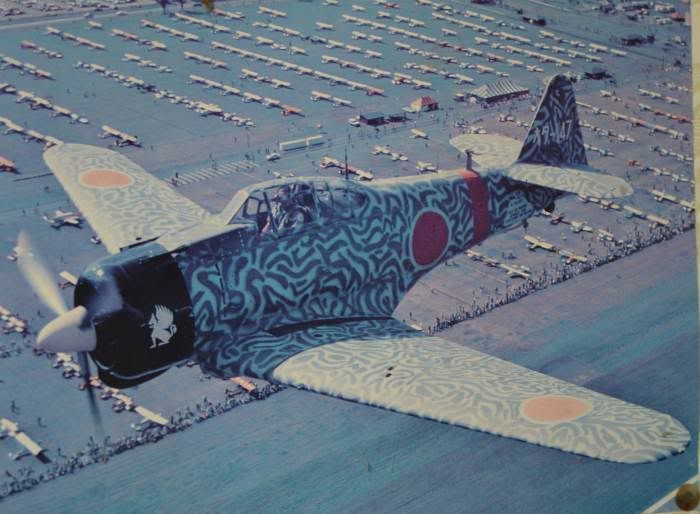

By: Harald - 7th March 2006 at 04:31
The camouflage is certainly unlike anything that might have participated in the Pearl Harbor attack. From everything I have read, the JNAF did not start using “land-based” camouflage until they had essentially run out of aircraft carriers. As the war progressed, however, I believe that a lot of camouflage was applied in the field, in which case there would certainly have been varying degrees of care and artistry in the application, and not a lot of uniformity from one airplane or one unit to the next. Here is what a fellow named Richard M. Bueschel had to say in a booklet entitled “Japanese Aircraft Insignia, Camouflage and Markings” (1966):
“During the war years the coloration of Army aircraft went through a series of evolutionary changes. Most Army fighters serving in China in 1937/1942 were silver-grey or natural dural with insignia and markings providing bright touches to the monotone aircraft. Sand-and-spinach green and brown camouflage with sky blue or light grey undersurfaces; all separated by blue lines, appeared on some bombers in 1938/39. Many of the Army aircraft were still in natural finish at the time of Pearl Harbor and remained so until replaced by newer types. As the scope of JAAF operations expanded throughout Asia and the Pacific various types of camouflage were adopted. The early forms used in 1941 and 1942 consisted of olive upper surfaces and natural dural, light grey or light blue undersurfaces. In late 1942 and 1943 a stippled or snake-weave form of camouflage was applied by spray painting light green, dark green, olive or brown in patches and snaky lines over natural dural. Undersides were left natural dural or sprayed light grey. Black or dark blue anti-glare panels were later added forward from the cockpit and yellow inboard leading edges were added for IFF identification. Most of the aircraft in JAAF use in the last year of the war again reverted to the solid drab upper surfaces with black anti-glare panels, natural undersurfaces and colored spinners, the latter usually red. A growing number were left in natural dural all-over with anti-glare panels and orange or yellow leading edges.”
Regarding JNAF aircraft, he had this to say: “Japanese naval aircraft underwent a fundamental change of mission during the Pacific War years, and the change was reflected in the colors and camouflage applied to these aircraft. When war began most JNAF aircraft were in the “Sea Colors” used in China consisting of black or blue and red cowling and vertical tail markings on natural dural or light gull grey aircraft. Some of the land based bombers and attack planes, such as the D1A2, G3M2, and G4M1 types made use of olive camouflage with light grey undersurfaces, but the fighters and carrier attack planes remained all dural. The exceptions to this rule were the float aircraft operating out of camouflaged inlets in the South Pacific which were painted sea blue or light olive with light blue or grey undersurfaces. After the battle of Midway, the JNAF fighters and attack aircraft were used more and more from land bases, until the standard JNAF dark green “Land Colors” and black radial cowlings were ultimately used on all Navy combat aircraft. In some cases dark green stippled camouflage was applied to “Zeke” land-based fighters. Under-surfaces were natural dural or sprayed light grey. This standard coloring appeared in 1942 and continued throughout the war. A natural dural cut-out was left on the fuselage just forward of the stabilizer to allow room for the stenciling of the serial number, makers name and aircraft type number in black on each side. Trainers, ordiginally painted a vivid orange/yellow, were also camouflaged in the same manner in the later years of the war.”
There is one photograph of an Oscar in stippled camouflage, but it is so poorly reproduced that I don’t think you would learn much if I scanned it.
Hope this helps.
Harald
By: Dave Homewood - 3rd March 2006 at 22:40
Thanks James
It looks rather striking though and I like it
By: JDK - 3rd March 2006 at 22:30
Hi Dave,
It’s not an ‘authentic’ scheme. The green squiggle over grey was used on Japanese aircraft, but it’s a very rough aproximation to one of the most difficult trypes of camoflage pattern to apply. The other markings I’d guess are fake – it’s rather like painting your Spitfire in car paints green, brown and blue and wacking your own initials as the Sqn codes… Why does that sound familiar? 😀
Cheers
By: Dave Homewood - 3rd March 2006 at 22:13
Yes I was aware it wasa conversion for Tora, Tora, Tora as that’s the only sort of Zero that flew back then. The full history has now been kindly supplied on WIX for me, but I still wonder whether the scheme has authenticity or if it’s made up
http://warbirdinformationexchange.org/phpBB2/viewtopic.php?p=54599#54599
By: taylorman - 3rd March 2006 at 20:00
Maybe they’re repainted
By: DazDaMan - 3rd March 2006 at 08:32
It is a Tora! T6-conversion, and I’ve seen a photo of this same aircraft in a book somewhere. Had a brief Google for photos of similarly-marked Zeros, but most of the pics turn up the usual green or grey examples.
By: Archer - 3rd March 2006 at 08:21
Looks like a T-6 conversion. Interesting photo but I’m no Zero expert I’m afraid.


 Sign In








 March 3, 2006 at 7:20 am