I have posted this already on Plane Talk but will try here too.
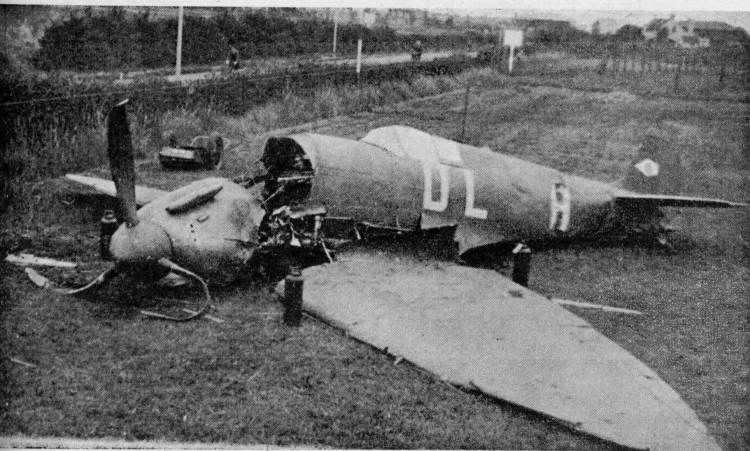
In a 1941 issue of Contact (RNZAF magazine) there’s a photo of a Mk 1 or Mk II Spifire, crashed in a field. It’s wings are broken off and it’s nose is broken off at the firewall. But all the broken off bits are on the ground in the right places next to the fuselage so I assume they were picked up and reassembled for the picture as it looks a little staged.
The caption says it was flown by a New Zealand pilot in the Battle of Britain, and he’d attacked a squadron of Me110’s, destroying four before running out of ammunition. He then aimed his plane at a fifth and rammed it, and the 110 plummetted into the sea.
So, apparently it destroyed five aircraft in this action, before it crash landed, and the pliot was ok.
The aircraft itself looks odd, it wears a dark roundel, perhaps the early red and blue type. It looks more like just one colour in this printing, like a blue circle. No white and yellow at all.
The tail fin flash is missing and instead a light coloured (white?) symbol is on the tail. An odd shape, like pointy forward then going circular then squared off against the rudder. That in turn has a slightly darker circle on it, maybe in yellow.
It carries the codes DL-A, or it may be DL-H as the airframe’s a little crumpled. I’m told on Plane Talk that DL is No. 91 Squadron, Hawkinge.
Does any of ths register with anyone?
The more I think about it, the more the story seems a crock of rubbish. The pilot must be an ace if he destroyed those five planes in one action, but I can’t find any reference to this action on any WWII ace page on the New Zealand Fighter Pilot Museum pages. The very weird markings is beyond me too, though the photo does not look like it has been doctored. But I dont think it’s an RAF machine.

By: paulmcmillan - 10th February 2006 at 13:59
I am unable to identify the pilot.
Go back a few posts on this thread to the 3rd Feb 2006..
Pilot was Sgt T. Davis (Service Number 590709)
By: VoyTech - 10th February 2006 at 11:38
A further report from Andy Thomas:-
“Having had a closer look at things, I am inclined to say with a fair degree of certainty that it is K9897.”
Mark
Exactly. The sort of markings were in force for ca. half a year in 1939. The only Spitfire accidented by 54 Sqn during that time in circumstances matching this photo was K9897 when she undershot landing at Hornchurch on 4 July 1939 (SOC 15 August 1939). “Hornchurch Scramble” doesn’t mention that and I am unable to identify the pilot.
By: Mark12 - 8th February 2006 at 14:22
A further report from Andy Thomas:-
“Having had a closer look at things, I am inclined to say with a fair degree of certainty that it is K9897.”
Mark
By: Malcolm McKay - 7th February 2006 at 22:39
Thanks everyone for the input and theories on this. I have learned a lot about the prewar Spitfire schemes i never knew. Are we agreed there are no wing roundels on it? I note none are seen on the uderside in the profile Neil posted either.
There would be upper wing roundels – they would be the same size as the fuselage ones. I think the photo angle has washed them out. The small blue/red roundels were often difficult to see on the film used, which in that photo is pan not ortho.
In that period – early 1939 – there were no under wing roundels. The underside of the aircraft was painted in the black/white scheme, divided along the centre-line of the fuselage. This was the scheme Fighter Command adopted so that its aircraft would be highly visible to anti-aircraft batteries to prevent then from taking potshots at British aircraft. By the BoB it had been replaced with the sky and its variations underside colour. The black/white scheme was reintroduced for a short time post BoB when FC was beginning the sweeps into France. Again so that British aircraft would not be find upon by British AAC batteries.
Similar distinctive schemes are the D Day stripes, the black and white ID markings applied to Typhoons and more bizarre the red with white stripes applied to the Focke-Wulf 190Ds of JV44 which was protecting the bases of Me262s in Germany in 1945.
The airman’s greatest problem is often his own side’s AAC. 😀
By: DazDaMan - 7th February 2006 at 22:32
Thanks everyone for the input and theories on this. I have learned a lot about the prewar Spitfire schemes i never knew. Are we agreed there are no wing roundels on it? I note none are seen on the uderside in the profile Neil posted either.
Dave, a lot of the pre-war Spits had very small roundels on their wings and fuselages. I can’t recall the exact size, but there are pics of them around.
By: Dave Homewood - 7th February 2006 at 21:41
Thanks everyone for the input and theories on this. I have learned a lot about the prewar Spitfire schemes i never knew. Are we agreed there are no wing roundels on it? I note none are seen on the uderside in the profile Neil posted either.
By: DazDaMan - 7th February 2006 at 20:30
Similar to that, but with a different crest on the fin.
By: TMN - 7th February 2006 at 19:50
These any use, guys?
The Cosford MK1 in 1939 camo. and early style canopy.
By: Neil Medcalf - 7th February 2006 at 17:46
profile
Here’s the profile of DL-N K9843
By: Neil Medcalf - 7th February 2006 at 17:37
Did some searching throughout my Spitfire books and came up with a colour profile. In the Arco-Aircam series on the Spitfire MkI-XVI is a profile of a DL-N Spitfire. It quotes it to being a MKIa of No 54 Squadron at Hornchurch in early summer of 1939. The profile has the early two colour fuselage roundel and the fin arrowhead. What I found interesting however is the profile shows a wire aerial as the example in the photo has, and not a larger wood faired aerial…. The profile also has the aircraft in the white/black underscheme.
– Just my 2 cents Canadian….
Neil Medcalf
Ps- I’ll try and post the profile later but I have to run now…
By: Mark12 - 7th February 2006 at 16:21
A quick note to Andy Thomas, author of ‘Combat Codes’, has elicited the following response.
DL carried in 54’s Gladiators circa 9.38-3.39 then moved onto Spits eg K9883/DL-T. The sqn badge in the white fin arrowhead is exactly as auth by the Air Min. Interestingly, 54 used KL from 9.39 but when moved to Oz (Darwin) used DL again from circa 9.42 on Mk Vc & VIII!
Many thanks Andy.
Mark
By: Mark12 - 7th February 2006 at 14:14
Well, what have we here? A very interesting image.
1939 livery, possibly showing evidence of the down size in Type B roundel in mid 1939.
It appears to have the early front windscreen without the external armour glass.
The tail ‘arrowhead’ is the same as seen on Spitfires of 72 Squadron, but it does not necessarily follow the aircraft is associated with this unit.
No question the code is DL but there is no DL code recorded for 1939 Spitfires in either of the two printed works on Squadron codes. DL is usually associated with 91 Squadron but it was not equipped with the Spitfire until January 1941 with its Mk IIs.
I think the edge of the airfield also. I go for a ground loop and gear failure as the prop is not bent back, or forward depending on power setting, as in a set up belly landing or failure to lower the u/c.
The failure mode and damage to the cowlings is bizarre.
More to run on this for sure.
Mark
By: DazDaMan - 7th February 2006 at 13:55
The wings look a bit pointy to me and the canopy is strange looking – could it be a mock up made with some genuine parts?
It’s probably just the angle of the photo. Why would they make mock-ups when a damaged/crashed example of the real thing would be easier to get hold of?
By: JDK - 7th February 2006 at 13:31
Most odd.
What’s the Trolley Acc (I think?) doing in the background? Yes, it might be the edge of the airfield, but it would be put away or in use…
Could it be a hand-fire truck?
I think we’ve seen the photo enough times, so I won’t insert it again… 😉
By: Malcolm McKay - 7th February 2006 at 12:54
At last, here is the photo. It did scan reasonably ok in the end without wrecking the 65 year old binding.
That is a pre-war Spitfire that has crashed, but not at the site where it is. Note the lack of disturbed ground. It has a De Havilland propellor. It almost looks like it has been taken from the crash site and has been prepared for salvage.
Alternatively it could being prepared for a fire drill – note the three fire extinquishers placed close by.
Of course I could be completely wrong about its placement. 😀
By: DazDaMan - 7th February 2006 at 09:13
At last, here is the photo. It did scan reasonably ok in the end without wrecking the 65 year old binding.
Yeesh! Looks like an ‘H’, not an ‘A’ on the fuselage.
By: Dave Homewood - 7th February 2006 at 09:04
At last, here is the photo. It did scan reasonably ok in the end without wrecking the 65 year old binding.
By: paulmcmillan - 3rd February 2006 at 14:20
Maybe… A big maybe……
K9897 54 Sqn Hornchurch Cat C. Patrol. Undershot & crashed into Army hut on edge of aerodrome (Hornchurch) on 4.7.39, Sgt T. Davis (Service Number 590709).
By: Dave Homewood - 3rd February 2006 at 00:27
http://hsfeatures.com/features04/spitfiremkilr_1.htm
Could it be in the early scheme as worn by the model in the link above, without any white in the roundal.
Also the link below shows a ‘tail symbol’ similar to that described on the 54 squadron Gladiator.
I would say yes to both those. The camouflage scheme looks similar, though the fuselage roundel is slightly larger, and no wing roundel can be seen present. No serial can be seen either.
The tail emblem looks very similar, definately the shape for the white bit, though in this picture it’s difficult to make out if that rearing horse (or whatever it is) is the detail on the white.
The propellor has three bades, all very bent. I’m no technophile when it comes to Spitfires so haven’t a clue who made the prop but it’s metal, and feathered, and the spinner is the more roundy type, not very pointy. The spinner looks to be red perhaps. Not as dark as the black blades by any means.
Also I’ve had a PM from a higher Spitfire authority who says the markings are not unusual, and are early 1939 54 Sqn markings. He states the RAF Museum’s Mk 1 is in similar markings.
So yes, the picture does not fit the story as told, and the story does not fit the records of any NZ ace. So I now believe it’s total fabricated propaganda, which I had part suspected upon the first reading of it.
I will attempt to scan it next week as there’s now such interest but cannot promise anything because the binding of the volume of magazines may prevent detail being seen.
The main point of the article makes me laugh – it’s going on about how good the British Construction of planes is, and it shows a plane with the wings fallen off, engine fallen off, the wheels fallen off… cracks me up.
By: Malcolm McKay - 2nd February 2006 at 23:22
I think that’s what we have here – an early MkI Spitfire with early 54 Squadron markings. There is a small colour profile inside the front cover of Spitfire – The History. It looks as though the one in the book has its serial painted at the top of the fin, above the pennant, if that makes any difference.
Couldn’t find any photos of any similarly-marked Spitfires, however.
Spitfires in the 38 – 39 period often either had no serials on the fuselage, or the serial was painted at the top of the fin. Those schemes were all quite shortlived.
HTH


 Sign In








 February 2, 2006 at 1:21 pm