Hi, this is my first post here so be gentle with me… 😉
How would one go about finding one that had ditched at sea?
Below is a map of Whirlwinds that ‘ditched’ under reasonable pilot control and it is hoped were still all in one piece when they eventually sank.
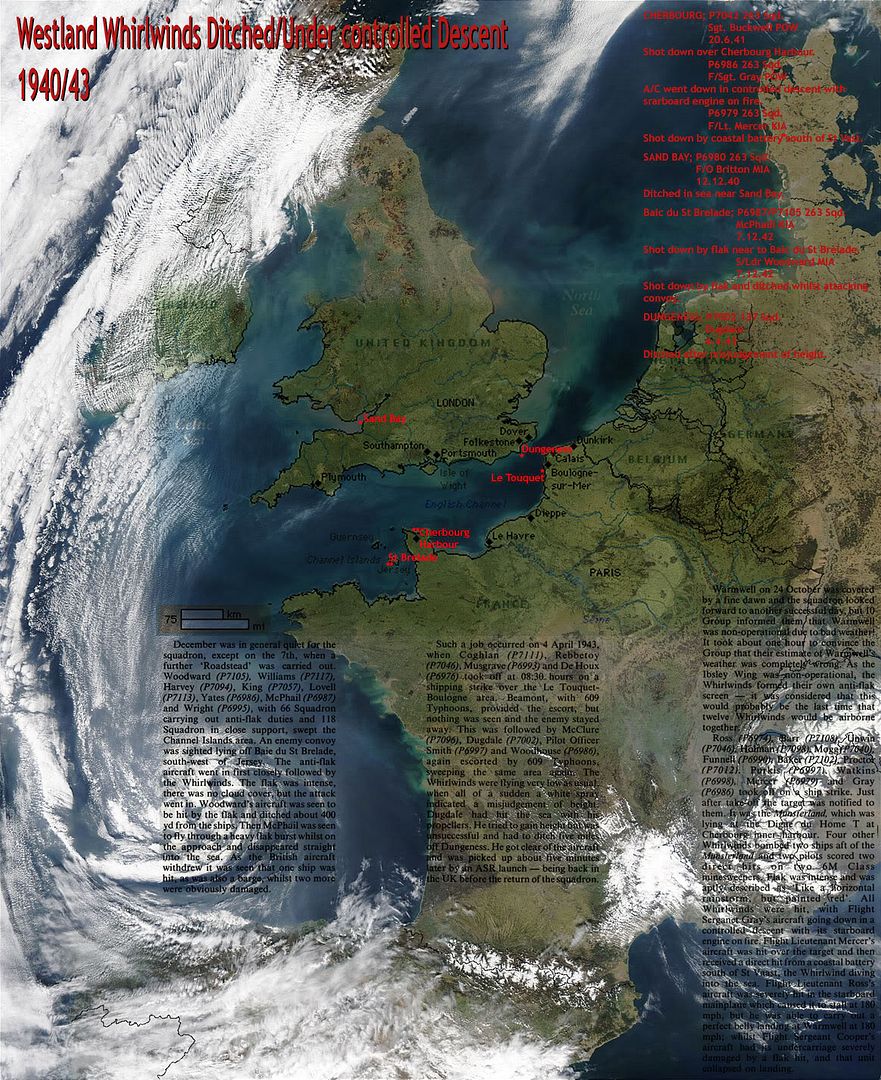
Where in heavens name would you get copies of the accident report and would it give the accidents general position?
I know it’s sounds like looking for a needle in a haystack, but wouldn’t it be fabulous to find one…
What do you reckon?

By: brewerjerry - 23rd January 2006 at 21:17
Hi
‘ Unless the USA example miraculously turns up in a Pensacola scrapyard’
I contacted someone who did some local research which seemed to imply that the scrapyard was cleared in the late 60’s/early 70’s, but that’s not to say there isn’t the remote possibility it went to another yard.
I personally think it more likely that the ‘P6994’ peregrines will turn up in the power boat given the USA enthusiasm for the racing… or an old boat yard…
forgot another two , Hunter P7009 went down off eddystone light & P7091 Clarke off lands end i think.
I still think the Smith / Vine / Crooks a/c would yield the best parts, ( if permission were even to be allowed ), especially as the recorded crash locations are wrong which has preserved the sites from wreck hunters.
Other options maybe Brown’s a/c P7095, this or substantial parts went to Rechlin for investigation, and then probably local scrap.
And the rumoured captured a/c seen in late 44 at chateufort (?) a/f france, this would likely have gone to a local scrapyard.
Cheers
Jerry
Cheers
Jerry
By: oz rb fan - 23rd January 2006 at 14:04
Unless the USA example miraculously turns up in a Pensacola scrapyard.[/QUOTE
oh i wish!! 😎
paul
By: Charley - 23rd January 2006 at 08:53
I would be very interested in seeing a rebuilt Whirlwind but I think that so few remains still exist that it would be much more realistic to consider the building of a replica, such as the Boulton-Paul museum’s excellent Defiant replica. Unless the USA example miraculously turns up in a Pensacola scrapyard.
By: EN830 - 22nd January 2006 at 21:35
It appears that Uffz. Karl Nowak of 9./JG 2 also claimed two Whirlwinds North of Cherbourg at 16.07 4 September 1941.
By: EN830 - 22nd January 2006 at 21:31
Hptm Siegfried “Wumm” Schnell of 9./JG 2 claimed two Whirlwinds off of Cherbourg at 16.04 on 4 September 1941
By: EN830 - 22nd January 2006 at 21:23
Also lost north of Sark was P/O Max Cotton (15 June 1943) and in the sea near to Cap de la Hague P/O Blacklock (or was it Blackwood, in the UK at the moment and don’t have my records to hand. Ironically I’m 8 miles east of Sand Bay in Somerset)
Edited to say my dates are out, Blacklock was lost in a Typhoon in 1944
By: NiallC - 21st January 2006 at 22:20
Ross: you posted this valuable piece of info about the RNLI search a while back on another board 🙂 and I meant to reply at the time, but didn’t because of some distraction or another. (Probably called “work”). There is however a problem or two with it: It’s quite clear that the other pilots in the section had no idea at the time where Alan Britton or P6980 had gone – either into the sea or on land. Why else would land and sea searches be mounted for the aircraft?
What we know is this:
1. The aircraft were firing on sea markers (at a location that Jerry and I think may be debatable)
2. The 2 other pilots in the section did not see, at the time, what happened to him or his aircraft.
3. Despite the above, the Sqn ORB cites the words of “the master of a ship who witnessed the affair” (but not, explicitly, the crash) noting that one of the pilots “seemed to go through his own spray”. This presumably testimony available later when the ORB was typed up – not necessarily the same day (or even week). The ORB also notes that “his aircraft was seen to dive straight into the sea” (Obviously not by the pilots. Possibly by the “master of a ship”. Who knows?). And “Neither the aircraft nor the body of the pilot was recovered”.
4. Hugh Saint, Westlands’ Technical Representative with the Sqn at the time reported the accident on the 12th in a letter to Westland (dated that day) giving no more detail than that the aircraft were practicing air firing “over the sea”.
5. Saint on the 13th reported to Wesland that the aircraft had still not been found and that the Observer corps were looking, aircraft were searching and that ground parties were also looking. (My own conclusion is that, a day after the accident, no-one is sure what has happened to the aircraft)
6. In a letter of the 14th Saint reports to Westland that the aircraft had been found in the sea and that it is believed that “the wreckage is to be salved”. The body of the pilot has not been found.
7. There is no record of a funeral for Britton
8. Britton is still listed as effectively “missing” by CWGC and, therefore, commemorated at Runnymede.
9. Form 78 for P6980 records it as “FA Ops Missing”. Not Scrap/RTP/Cat Anything. Just “Missing”.
I would generally not rely on any one or two or even three of these in isolation, but, on the balance of evidence, my best guess is that the aircraft went into the sea and was not recovered.
Bearing in mind the date given by Saint for the discovery of the wreck, this doesn’t actually contradict the RNLI report. If, on the 12th, the RNLI were told that the wreck had been found on land, perhaps the report was a miscommunication. Or a misidentification – i.e. that an aircraft rather than the aircraft had been found on land. Neither would be the first or the last of its type.
Interesting that the report comes from the Weston-super-mare Boat/Station though. That would support the location being Sand Bay rather than Sandy Bay since I’m sure a boat from there would not be working off Exmouth.
Ross: a couple of questions for you: Is there anything in the Weston-super-mare records for the 13th and 14th that might throw light on this, in view of Saint’s assertion that the wreck wasn’t discovered ’til then? Is there anything in the records that specifically identifies the aircraft believed down in the sea was Brittons’ Whirlwind? (I’d imagine not, but don’t know). And lastly, what of the records of the boat/station covering the Exmouth area at the time – just in case the Jerrys’ and my theory might be more than just that?
Jerry: As for Paul Mercer and P697, both the Sqn. ORB and the A Flight Diary record Mercer going into the sea just off Cherbourg. “B Flight lost F/O Mercer whose aircraft disintegrated on hitting the sea” according to the A Flt Diary. However that part of the coast is renowned for tidal action and shallow beach inclinations, so it’s entirely possible that the sea that Mercer hit was exposed sand a few hours later. Or that the Germans pulled the wreck out. In this area the changes in coast and estuary outline with changing tides were on more than one occasion cited by squadrons as reasons for some spectacular navigation errors. Either way, as you note, Mercer is still “Missing”, but, again, it would not be the first time a pilot got out of an aircraft within a mile or so of shore and still was not recovered. I’m asuming that the photo you have originates from that side of the Channel. If there’s anything in the context of the photo that indicates it was taken in England then that would of course be a whole different story.
NiallC
By: Ross_McNeill - 21st January 2006 at 09:34
Hi Gents,
Did some work on the loss a few years ago and discounted it as a loss on land.
From the RNLI Records of Service 1939 to 1946.
DECEMBER 12TH. – WESTON – SUPER -MARE, SOMERSET.
An aeroplane was reported to have come down in the sea, but nothing could be found, and later it was learned that it had crashed on the shore.- Rewards, £12 1s. 6d.
Regards
Ross
By: brewerjerry - 21st January 2006 at 09:13
more whirlwind ramblings
Hi,
Thanks for the reply, glad to think someone else had similar thoughts on P6980.
Forgot to add
The list of sea sites is missing P6969 off Dodman point cornwall,
and P6979 ( Mercer ) might not have been in the sea, I have a poor copy of a photo of the damaged a/c on land, but Mercer is listed on the runnymede memorial. ( more research needed ? ) or did he bail out over the sea ?
Cheers
Jerry
By: NiallC - 21st January 2006 at 00:24
I’ve been thinking along similar lines re the loss of P6980. It doesn’t seem entirely logical that they would trek all the way to Weston-super-mare for firing practice on sea targets when there were closer alternatives to Exeter. In terms of it being an assumption on the part of post war researchers that the crash site was Sand Bay (Weston-super-mare) this probably stems from the statement in the ORB that the firing practice was being carried out “in or near Sand Bay”. But that wouldn’t be the only typo or error in 263s ORB. Also that during the period when 137 was forming and 263 was operating more or less as an OTU for it, much firing practice was carried out at Sand Bay (but then that would make more sense when they were both at Charmy Down).
The search for Alan Britton and P6980 continued on land and water for 2 days (the a/c not being found ’til the 14th December 1940) and involved Coastguard/RNLI/Observer Corps so I suspect the best clue to the real location will be found in the records of those bodies. Which, as yet, I’ve not had time or opportunity to trawl through.
NiallC
By: brewerjerry - 20th January 2006 at 23:16
whirlwind rambles
Hi
As we have a topic which mentions the loss of P6980 & F/O Britton,
I would like to add a theory, 263Sq were based at Exeter at the date of the crash and there were local firing ranges at sandy bay in 1940 ( see link for location of sandy bay http://www.newhols.com/how-to-find-us.asp ) , 😀
I have often wondered if F/O Brittons crash location is just an assumption made post war researchers, ( like the theory of P6994 never having reached the USA 😉 ) unfortunately, I can’t locate any local records that would prove/disprove the theory of P6980’s location. :confused:
It seems odd to me to fly all that way, when there are firing ranges just ‘ down the road ‘, ( of interest the GRU were also stationed at Exeter )
Secondly, I think the well known land sites 😉 will yield more parts for a rebuild , than any sea site, ( although true, a nacelle of P6969 was brought up many years ago now.) but realistically only when sufficient technology / cash is available for land recovery, will a whirlwind then be re-built.
It would be nice to see steve vizard whirlwind re built, but being realistic again , it has been out of it’s crash hole for about 26 years ……
I often wonder if anyone has investigated the crash sites in France.
Cheers
Jerry
By: NiallC - 20th January 2006 at 18:31
As HP57 has said, the only Magnesium alloy in the Whirlwind is the rear fuselage plating (just over 31 pounds of Mg according to Directorate of Production figures). That of course will have gone within months in salt water and there’s precious little other structure in the rear fuselage (just 3 formers) to keep the rest of the rear of the airframe together once that skinning has gone. Production Whirlwinds did not use magnesium prop blades although the 2nd prototype was equipped with Rotol (rather than de Havilland) magnesium bladed props during its evaluation. They were changed to the standard DH type shortly before its transfer from 25 to 263 Sqn.
As Ian has said the biggest problem is that they are all in very tidal water which may well have broken them up over the years and most of them went in at high speed to start with.
There are no accident reports for operational losses and, apart from Alan Britton’s aircraft in Sand Bay (which he may well still be in), all of the ones in the water are op losses. Aircraft Movement Cards (Held at MOD AHB with copies at RAF Museum, not at The National Archives in Kew) do not record the circumstances or location of losses, just the date and Category of damage. There are a handful of RAE accident investigations covering Whirlwinds, but, by definition those relate to aircraft that were recovered (and investigated) at the time. Other non-op losses are described on Accident Record cards (held by the MOD AHB with copies at the RAF Museum), but most, were recovered during the war.
One exception being the remains of P6966 recovered by Steve Vizard in the late 70s from a crash site in Scotland which seems to me like the only slight chance we have of seeing a Whirlwind in the flesh again – albeit largely a replica. Unless of course someone finds exactly where Westland tossed the remains of P7048/G-AGOI in 47.
NiallC
By: HP57 - 20th January 2006 at 17:53
I have extensively researched both McPhail and Woodward’s loss as well as two other Whirlwinds that came down in the general area of the Channel Islands. I know the relative locations though there are strong tidal influences which would effect where the aircraft finally came to rest. However I am reluctant to release the information over the net as these sites are effectively war graves and should not be intentionally disturbed.
One thing to remember is that the Whirlwind was constructed of a magnesium alloy, little of which would survive in a salt water environment. I have seen the remains of one prop from McPhails aircraft, which basically bears this out.
AFAIK the rear fuselage used magnesium allow skinning, the rest of the aircraft was of aluminium construction, as Ian said salt water can do nasty things to aircraft structures, a fresh water location would be better. Steve Vizard is quoted as having a wish to reconstruct a Whirlwind, there are drawings about. We only need the opportunity to start such a project (how about funds allocated to a certain tin triangle)
Cees
By: EN830 - 20th January 2006 at 17:13
I have extensively researched both McPhail and Woodward’s loss as well as two other Whirlwinds that came down in the general area of the Channel Islands. I know the relative locations though there are strong tidal influences which would effect where the aircraft finally came to rest. However I am reluctant to release the information over the net as these sites are effectively war graves and should not be intentionally disturbed.
One thing to remember is that the Whirlwind was constructed of a magnesium alloy, little of which would survive in a salt water environment. I have seen the remains of one prop from McPhails aircraft, which basically bears this out.
By: TEXANTOMCAT - 20th January 2006 at 17:02
Needle and haystack interface issues i think…. notwithstanding saltwater corrosion!
The place to start would be the Aircraft Movement Card for each machine which can be obtained from the PRO Kew….
TT


 Sign In








 January 20, 2006 at 3:54 pm