I have just come across this awesome piece of artwork. I don’t know who painted it. But it surprised me to see the white diagonal stripes on a Japanese aircraft. THe RNZAF and RAAF P40’s had to paint very similar white diagonal stripes on their wings and tails to stop the Americans shooting them down.
So why has this Oscar got the stripes? Is it a deception? Note there is no Hinimaru (red dot) on the fuselage. Does anyone have any ideas?
Also does anyone have info on the painting? Who was the artist and what was the incident? I haven’t heard of RAF Blenheims in the Pacific arena.

By: Rob Mears - 30th August 2004 at 04:25
Not sure about the configuration of the one in the photo. The various wartime photos I’ve seen of them have shown them to be a rather attractive machine. It would definitely make a nice flying model IMO.
By: Rob Mears - 29th August 2004 at 18:03
Someonw needs to reproduce the Ki-46 Dinah (3rd picture in Dave’s post above). That’s by far the most attractive machine the Japanese ever produced for the war. “Dinah with the fine linah” as the Allied pilots once called it. 😉
By: KIGAS - 29th August 2004 at 15:56
At least two RCAF Bolingbroke Sdns served in the Aleutian Islands against the Japanese
alongside the USAAF.
By: GDL - 29th August 2004 at 13:16
Koike does GREAT work at least as good as any other aviation artist…saw a coffee table book of his work once, incredible stuff (loved the Corsair)…
Maybe Google him and see what you get for images…Mark
Was it this Corsair?
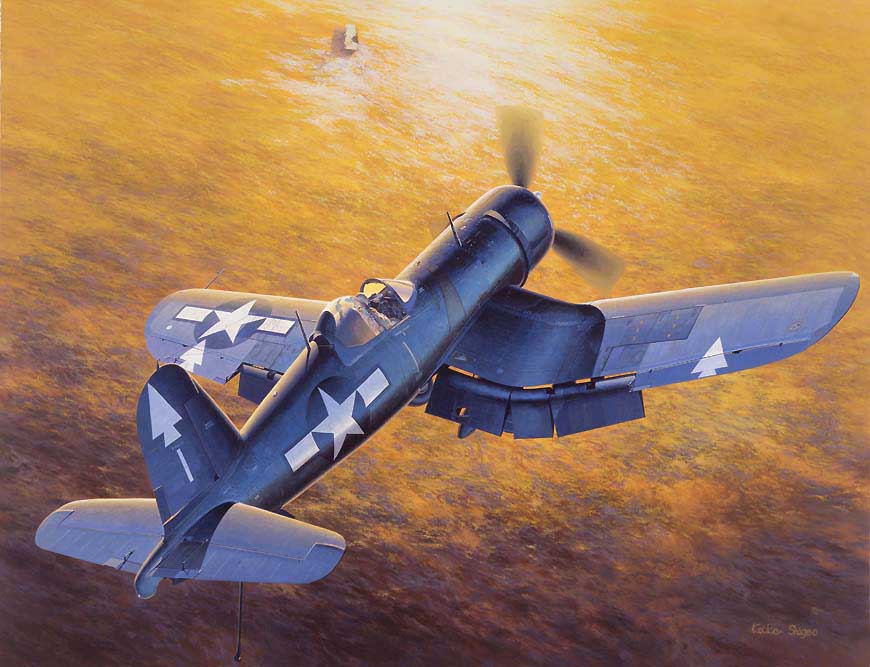
By: Chad Veich - 28th August 2004 at 17:41
Very interesting episode! Sounds like FS McLuckie was more good than “Luckie”! 🙂 I notice the gear is down on the Blenheim, evasive tactic?
By: tbyguy - 28th August 2004 at 14:15
Henry Sakaida’s book on JAAF aces illustrates Kato-sans’ Ki-43-I as having the markings of the Oscar in the painting posted (Note the thin, blue borders on the white stripes and arrow).
I botched Kato-sans’ rank in my previous post: He had already achieved Lt. Col. in spring , 1942.
My tired, myopic eyes also make out “Z9808” on the tail of the Blenheim.
I guess the following kind of confirms the episode…
From Asansol nine Blenheims of 60 Squadron flew to Dum Dum on 22 May in preparation for an attack on Akyab airfield. Initially it was planned that six bombers would fly up-river to attack targets there, while three others would attack the airfield. In the event, only the latter three finally prepared for take-off, but one suffered engine trouble and did not get away, while a second returned early with other technical problems. Only Blenheim Mk.IV Z9808 of 60 Squadron flown by Warrant Officer Martin Huggard managed to reach the target. The Blenheim dropped its bomb from low-level and sped off out over the Bay of Bengal at wave-top height.
Despite their element of surprise the Blenheim crew had spotted a number of 64th Sentai Ki-43s scrambling after them as they flew over Akyab. First off in pursuit of the enemy bomber was 10-victory ace Sergeant Yo****o Yasuda, who soon caught up with the Blenheim and dived in to attack. Fortunately for the three-man Blenheim crew, their turret gunner Flight Sergeant ‘Jock’ McLuckie proved to be a crack shot, despite having never before fired his guns in anger (the third member of the crew was the navigator Sergeant Jack Howitt). McLuckie hit Yasuda’s Ki-43 in its first pass, and the Japanese pilot was forced to return to Akyab.
Captain Masuzo Otani then took up the attack, but he too fell victim to a well-aimed burst from the gunner and had to retire back to Burma. Finally, after almost 30 minutes of constant attack, three Ki-43-I-Heis appeared on the scene, with Lieutenant Colonel Kato in the lead fighter. However when Kato pulled up after making his first diving pass on the Blenheim, McLuckie raked the fighter’s exposed belly with a long burst and the Ki-43 started to burn. Realising that he would never make it back to Akyab, Kato half-looped his stricken fighter and purposely dove into the sea to perish with it. He had advised his pilots on numerous occasions in the past to perform just such a manoeuvre if hit badly over the water. The remaining two Japanese pilots immediately returned to Akyab to report the terrible news (they also reported that Kato has shot down the bomber, which obviously wasn’t true).
The Blenheim returned to India unscathed by the Japanese attacks, and once British Intelligence had ascertained just who was flying the Ki-43 downed by McLuckie, 60 Squadron received the following signal from Air Officer Commanding Burma, Air Vice-Marshal D. F. Stevenson, on 2 August 1942:
“Please convey my congratulations toward Warrant Officer Huggards, Sergeant Howitt and Sergeant McLuckie on the successful action they fought against four enemy fighters which took place over Akyab on 22 May, and which resulted in Lt Colonel T. A. Keo Kato [sic], leader of the Japanese fighter force being shot down.’
By: GDL - 28th August 2004 at 13:51
A good collection of Koike’s work.
By: Dave Homewood - 28th August 2004 at 02:59
Thanks to all. A very informative response.
Cajun21, well done – a chocolate fish for you. 🙂
Yes I had wondered if this was the work of Koike. He does indeed do some lovely work, mostly of Japanese subects which is great because no-one else seems to up to that standard. He’s done some lovely box-art paintings.
Here are a few more of his finest:
By: GDL - 28th August 2004 at 00:40
I noticed that the Blenheim carries what appears to be “MU” for markings. Not being familiar with RAF bomber squadron markings, I’m wondering if perhaps the painting portrays the final combat action of 64 Sentai legend Major Tateo Kato. Kato-san intentionally dove his Ki-43 into the Bay of Bengal as a result of its being damaged in combat with a lone 60 sqdn Blenheim.
Try this for more detail:
Judging by the height they are at and the aspect of the OSCAR, it looks like the Japanese pilot is about to do just that; crash.
By: Corsair166b - 27th August 2004 at 20:39
Koike does GREAT work at least as good as any other aviation artist…saw a coffee table book of his work once, incredible stuff (loved the Corsair)…
Maybe Google him and see what you get for images…
Mark
By: tbyguy - 27th August 2004 at 20:11
Could it be this?
I noticed that the Blenheim carries what appears to be “MU” for markings. Not being familiar with RAF bomber squadron markings, I’m wondering if perhaps the painting portrays the final combat action of 64 Sentai legend Major Tateo Kato. Kato-san intentionally dove his Ki-43 into the Bay of Bengal as a result of its being damaged in combat with a lone 60 sqdn Blenheim.
Try this for more detail:
By: Cajun21 - 27th August 2004 at 18:40
If you look in the lower left corner you will see it was signed by S.Koike. Just a observation. Cheers
By: Arabella-Cox - 27th August 2004 at 16:26
Blenheims were indeed out there in the Far East; Snapper’s mate George told me at Legends that he was standing under the wing of one when he got bombed on 7th December 41…
Although I look at that painting and something says “Beaufort” to me… can’t really say why though…
By: GDL - 27th August 2004 at 14:40
duvec is right.
The art work looks very much like that of Shigeo Koike. He has done a lot of work for Japanese model box art. Hasegawa (my favourite brand) I believe.
More on the man:
Shigeo Koike, a resident of Tokyo, is the premier box art artist for models produced by Japan’s Hasegawa Seisakusho Co. Ltd. He has completed over 200 pieces of box art, including these two F-16 pieces, for Hasegawa in his twenty years of painting for the company. His work also appears on the beautiful calendars of Fuji Heavy Industries. A collection of Koike’s aviation paintings has been published by Sony Magazines, Inc., under the title Flyover: The Works of Shigeo Koike.
Now, that would be a good book. 🙂
By: Whitley_Project - 27th August 2004 at 13:56
The website where I found the pic puts 64 Sentai in Malaya where they were deployed at advanced bases for approx 8 weeks. There were 4 Blenheim squadrons operating in the defence of Singapore at that time. (http://www.raf.mod.uk/history/blen8.html)
—
Allan
Allan is spot on – the 64th sentai spearheaded the japanese rampage through SE Asia in 1942. There were many clashes with Blenheims, Hurricanes and other RAF types stationed out there. Sadly, for the commonwealth forces, the Oscar was superior – even the Ki-27s bested the Hurricanes at times.
Shame on the person who called it a Bollingbroke!
By: Steve Bond - 27th August 2004 at 09:16
Joining the “I could be wrong” brigade, such a meeting between an Oscar and a European-theatre camouflaged Blenheim (or any other Blenheim come to that), is pure invention.
By: duvec - 27th August 2004 at 08:37
Box Top Art?
Well, what a sight! A Blenheim/Bolingbroke with an Oscar. I suspect a fantasy painting putting together a possible Canadian/Japanese action in the Pacific North West. The quality of the painting leads me to suspect the artist is used to painting illustrations on the box tops of the Japanese manufacturers of plastic kits. Tamiya, Hasegawa or Fujimi.
I am, of course, likely to be wrong!
Chris
By: STORMBIRD262 - 27th August 2004 at 06:04
Nice painting
Great Painting Dave, I agree 🙂 , Not sure whats happening in it but about the stripes, Most of what I have seen with jap planes of the war were very basic, That looks like their ceremoney markings, White flag, white scarfes that sort of thing, Very proud the Japs were on that sort of thing, A friend of mine as a boy watched a huge Jap bombing force fly over him in Darwin in 42 and all he could think about was how beautiful the formation looked 😮 , Shone like the sun was what he said, Never Broke, Bombed and flew back in this way the direction they had came from, Impressed the hell out of him 😀 , Said he was way to excited to worry about that they were the enemy or that bombs were falling :p , Already loved anything that flew, Cheers Dave, Tally Ho! Phil 😉 . (p.s. their army airforce did a bit of in field camo stuff on their planes)


 Sign In








 August 27, 2004 at 4:32 am