Hi Keith:
The following information ties into your story of the de Haviland constant speed propeller conversions:
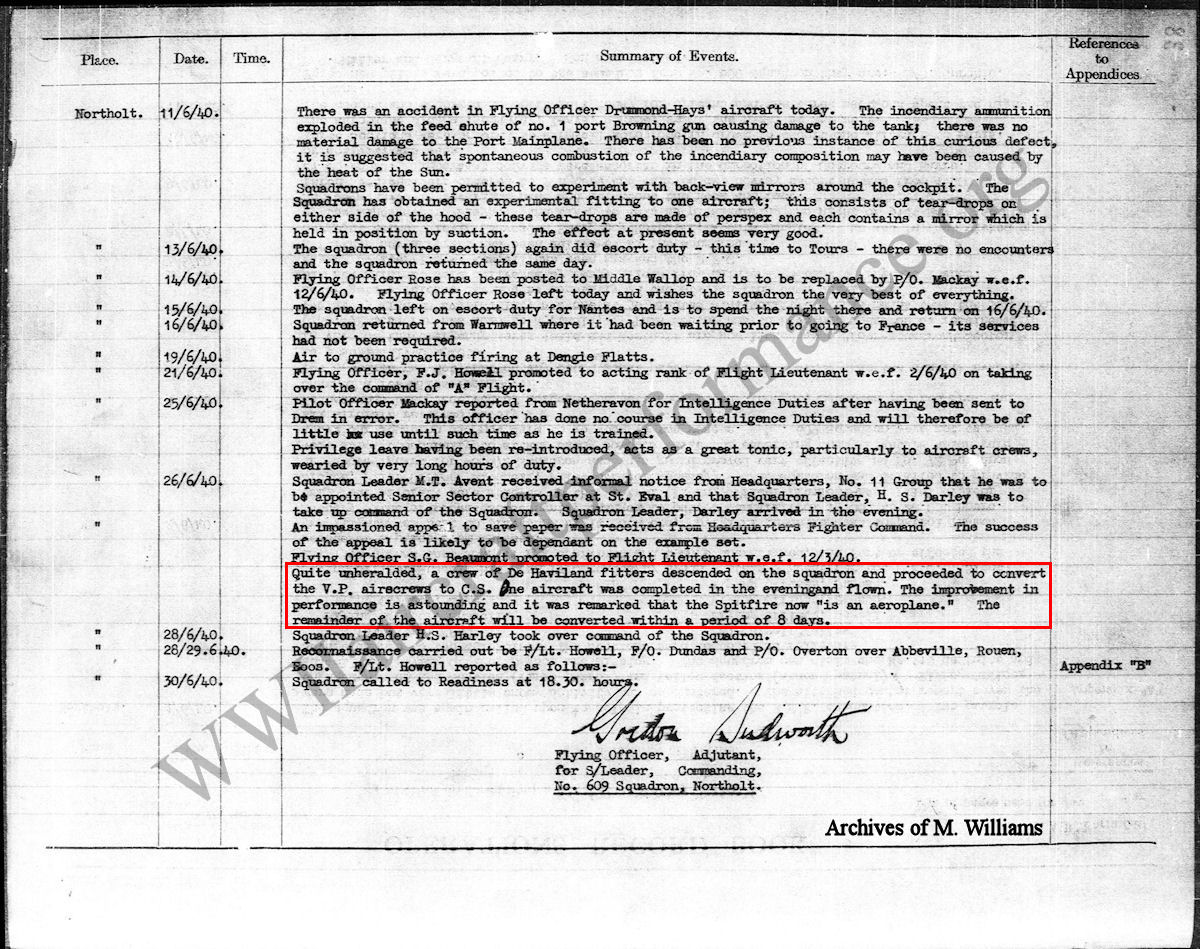
609 ORB, 26/6/40: “Quite unheralded, a crew of De Haviland fitters descended on the squadron and proceeded to convert the V.P. aircrews to C.S. One aircraft was completed in the evening and flown. The improvement in performance is astounding and it was remarked that the Spitfire now “is an aeroplane.” The remainder of the aircraft will be converted within a period of 8 days.”
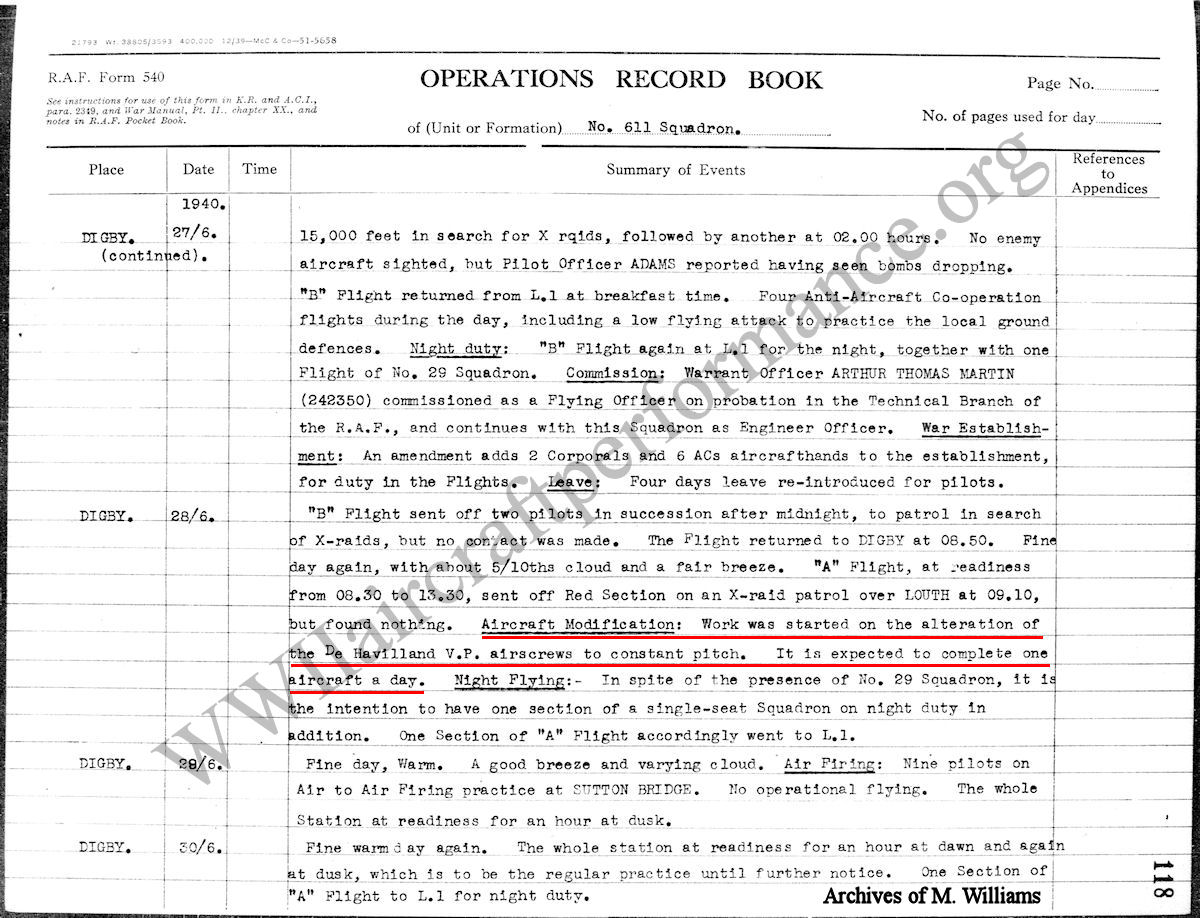
611 ORB, 28/6/40: “Aircraft Modification: Work was started on the alteration of the De Havilland V.P. airscrews to constant pitch. It is expected to complete one aircraft a day.”
611 also recorded on 3/7/40 that “Air tests of the new constant speed airscrews have proved very satisfactory. One pilot reports that he can now turn inside a Rotol Hurricane. The same pilot reached 35,000 feet (indicated) on a height test.” I have my doubts about a Spitfire turning inside a Rotol Hurricane, however, this statement is interesting none the less in that it implies that a Spitfire equipped with the constant speed propeller turned better than one without.
I think D. Ross got the Spitfire I development leading up to the Battle of Britain story pretty well right in his book on 603 Squadron. Its more than I have time to type out so See Here
>Reading between the lines of the permission of +12 lb emergency boost in March 1940 A.P.1590B/J.P-W http://www.spitfireperformance.com/ap1590b.jpg would indicate that its use was intended to be pretty limited. Fuel use, already at a premium would have been increased by a further 40% and there would probably have been a significant increase in engine wear, not to mention the disincentive to pilots of having to report it and enter it into the engine log.
Dowding is on record complaining that “some pilots pull the plug with little excuse on every occasion”. My research leads me to believe that use of +12 lb/sq.in. emergency power was so frequently and freely used as to justify Dowding’s complaint.
>I suspect that +12 lb boost was hardly ever used in climbing to altitude and the chart http://www.spitfireperformance.com/s…-rae-12lbs.jpg would suggest that it also had less effect on performance at common combat altitudes of 15,000 to 25,000 feet than we might hope to think.
For the Hornchurch squadrons you need look no further than Deere and Gray with 54 Squadron, Vigors with 222 and Quill with 65 Squadron as to why there was a need. For example from Gray: “54 Squadron, take off, take off, for Christ’s sake take off”, followed by section leaders ordering the Pilots to: “…press their emergency boost **** (giving double take off power)”.
Increasing boost increases climb and level speed performance up to full throttle height. Increasing RPM from the ½ climb limit of 2600 RPM to the 5 minute Emergency limit of 3000 RPM will increase climb performance up to the aircraft’s ceiling. I estimate this increase in climb rate to be somewhere in the order of 400 ft/minute from sea level to ceiling. As your initial post noted, however, it is difficult to pin down the performance figures for the Spitfire I. As I previously noted, in my opinion, this is more of an issue with climb rate than with level speed.
Keith, yes the Rotol Spitfire serial numbers come from 54 Squadron’s ORB. It turns out I have a copy of a portion of 65 Squadrons’s ORB which I forgot about, but they recorded too little to be of any value. Where did you get your information about 65 squadron’s conversion to the DH CSP? Oh, btw, Quill didn’t report to 65 Squadron until 5 August, so I’m not sure to what extent he would have been involved directly in the discussions at Hornchurch. I expect 65 squadron had already converted to CSP’s by the time Quill arrived.
Regards, Mike


 Sign In