http://www.warbirdz.net/largepic.php?ID=2808
A MkXVI (obviously) at Wigram, Christchurch, NZ.
Either the real McCoy with no visible serial, or a damn convincing replica (I suspect the latter).

By: OFMC Fan - 6th January 2008 at 07:24
In Malcolm Lairds Ventura Publications book ‘D-Day To Victory’, He illustrates in a colour plate that the serial to the Spitfire XVI is TB625. To further complicate matters.
Also the the individual code letter ‘V’ is painted in white ,and not the same colour ast the ‘OU’ . The Wigram guy’s missed that one too.
OFMC Fan
By: Alan - 27th November 2007 at 01:50
Thanks for that photo VoyTech, much better than the one I have.:D
By: Alan - 27th November 2007 at 00:26
Seems straight forward enough to me Mark12..:confused:
The Grace spitfire was coded OU-V while serving with 485. (But I’m sure you know that…)
I don’t think Dad ever flew ML407. I’ll have to check his log.
I know his good mate (and partner in many dubious wartime adventures) Pete Humphrey did though. Not sure if Pete is still alive. I’ll have to check.
Is there a 341 Sqdn association or website active?. It would be pretty cool to locate a photograph of TB675 coded as NL-P.
By: Mark12 - 24th November 2007 at 11:19
ID this Spit in 2004.
Try identifying it in 2050 as a new young enthusiast/researcher poring over old images from the 1945/2005 period.
1) You have the real TE288 mounted on a plinth at the Brevet Club at Christchuch NZ.
2) You have its replacement, a beautifully crafted GRP replica, painted as ‘TE288’ and mounted on the same plinth. It was lost to vandals.
3) You have the further replacement replica again painted as ‘TE288’.
4) You have a further GRP replica from the same tooling and plinth mounted at Perana Park Hamilton NZ…..also painted as ‘TE288’.
5) You have yet a further GRP replica, same tooling, at the shopping centre at Westgate, Auckland NZ….you have guessed it, painted as ‘TE288’.
6) You have the real TE288 at RNZAF Museum, Wigram, coded OU-V of 485 Squadron (this just happens to be the same code currently on the Grace Tr IX), ostensibly representing ‘Rongotea’, that carried the partially over painted genuine serial of TB675. For reasons of manpower, so the museum advised me, the aircraft carries neither the alias serial, ‘TB675’, nor its genuine serial TE288.
7) By a quirk of coincidence the original TB675 carried the codes of two units it served with OU-V of 485 Squadron and 4D-V of 74 Squadron.
8) RW393, a low back Spitfire XVI of the RAFMus roving fleet, is currently painted as ‘TB675’ 4D-V
9) TE311, a low back Spitfire XVI restoration in progress by BBMF, currently carries the codes 4D-V.
Confused?
Wigram – Surely time to get the stencil and spray unit out and rectify your ‘orphan’.
Mark
With thanks to Dave Homewood on some of the finer points.
By: Mark12 - 23rd November 2007 at 10:23
Cheers Mark,
Gerard’s book does not list 675 as one of the aircraft recieved from 74 Sqdn. (No fault of Gerard’s I’m sure. A wonderful book and throughly recommended)
Dad was adamant that “Rongotea” was left on the Continent when they returned to England. He could not remember the Sqdn number but was adamant that it’s code letters were NL and they were part of 145 Wing. This would correctly identify 341 Sqdn, (which tallys with the RAF service record that it passed to 341 on 16/08/45).
TB625’s record states “74/485/BAFO C Wg/164/603/609. Collided with Anson NK715 while taxying at Manston, 23.7.48; DBR”Any info gratefully received.:)
One of the reasons why Gerard Morris may not have referred to TB675 in his book, and I was a contributor, is that TB675 is not listed in the Morgan/Shacklady ‘Spitfire the History’ book, most people’s first port of call. It is a lone Mk XVI serial surrounded by Mk IX’s.
Helmut Terbeck’s research advises the following for TB675.
29.MU 25/02/1945
84.GSU 13/03/1945
4.Sqn 22/03/1945
74.Sqn 03/05/1945 4D-V
485.Sqn 17/05/1945
341.Sqn 16/08/1945 NL-P
84.GDC 22/11/1945
29.MU 21/12/1945
census 21/03/1946
(41.Grp)
34.MU 31/08/1949 loan
29.MU 05/09/1949
102.FRS 16/04/1951
103.FRS 16/05/1951
45.MU 23/10/1951
2.CAACU 14/10/1952
FA/4 11/12/1953
recat.5c 17/12/1953
SOC
Mark
By: VoyTech - 23rd November 2007 at 09:51
No worries VoyTech, happy to post them!:D
Thanks.
Here is a better copy of the 4D-V shot. Original picture from Douglas Tidy, I got the scan of it via a friend.
By: Alan - 22nd November 2007 at 23:30
Firstly Alan welcome to the forum and thank you for posting these wonderful photos.
Thanks MarkV. Pleasure to be here. 😀
By: Alan - 22nd November 2007 at 22:57
Cheers Mark,
Just trying to trace TB625 also.
The reason I’m doing this is to establish the correct identity of “Rongotea”
Gerard Morris’ book identifies it as TB625, Dad’s log identifies it as TB675. Gerard’s book does not list 675 as one of the aircraft recieved from 74 Sqdn. (No fault of Gerard’s I’m sure. A wonderful book and throughly recommended)
Dad was adamant that “Rongotea” was left on the Continent when they returned to England. He could not remember the Sqdn number but was adamant that it’s code letters were NL and they were part of 145 Wing. This would correctly identify 341 Sqdn, (which tallys with the RAF service record that it passed to 341 on 16/08/45).
TB625’s record states “74/485/BAFO C Wg/164/603/609. Collided with Anson NK715 while taxying at Manston, 23.7.48; DBR”
Any info gratefully recieved.:)
By: Mark12 - 22nd November 2007 at 20:37
No worries VoyTech, happy to post them!:D
With reference to the sheild dating from 74 Sqdn, This is something I have wondered and would like to find out if my suspicions are true. Sadly most of the people who would know for sure have now passed away. (Why did it never occur to me to ask Dad when he was alive??)
I am aware that this a/c was flown by S/L AJ Reeves whilst with 74 Sqdn. Is it possible this is the reason behind the sheild?Another question, What is BAFO? in the context of Aircraft service records?
British Air Forces of Occupation (Germany)
Mark
By: Alan - 22nd November 2007 at 20:09
Alan, thanks for the wonderful images!
That’s interesting. I have seen similar application of the aircraft letter on a shield on Polish Spitfires, and that was solely on Mk XVIs post-war in Germany. Perhaps some local fashion? Anyway, this may have dated back to TB675’s service with No. 74.Mark, I think Alan may have referred to the portion of the yellow outline where it has been partly oversprayed while overpainting the previous codes.
No worries VoyTech, happy to post them!:D
With reference to the sheild dating from 74 Sqdn, This is something I have wondered and would like to find out if my suspicions are true. Sadly most of the people who would know for sure have now passed away. (Why did it never occur to me to ask Dad when he was alive??)
I am aware that this a/c was flown by S/L AJ Reeves whilst with 74 Sqdn. Is it possible this is the reason behind the sheild?
Another question, What is BAFO? in the context of Aircraft service records?
By: VoyTech - 22nd November 2007 at 10:46
Here’s the others that I have.
Alan, thanks for the wonderful images!
Anyone have any knowledge on both the reason for the sheild with the letter code in it?
Or the colour?
That’s interesting. I have seen similar application of the aircraft letter on a shield on Polish Spitfires, and that was solely on Mk XVIs post-war in Germany. Perhaps some local fashion? Anyway, this may have dated back to TB675’s service with No. 74.
You can plainly see where the yellow roundel has been oversprayed here.
Was there a reason for over-spraying here? – it was not uncommon for the Yellow paint to fail in this area giving the impression that it had been over-sprayed. Any paint spraying was likely to be confined to the rear fuselage to obliterate the 18″ tail -band as has clearly happened. The fuselage roundels were retained as they were with the wing roundels being modified to C1 type.
Mark, I think Alan may have referred to the portion of the yellow outline where it has been partly oversprayed while overpainting the previous codes.
By: Mark V - 22nd November 2007 at 08:32
Anyone have any knowledge on both the reason for the sheild with the letter code in it?
Or the colour?
Firstly Alan welcome to the forum and thank you for posting these wonderful photos. It was fairly common practice to repeat the aircraft code letter under the nose often on a black (Night) circle to aid in identifying the individual aircraft from the front. As your Dad clearly enjoyed adding a bit of interesting artwork and personalisation (which looks great) to his aircraft it seems to me that this was another example of that.
You can plainly see where the yellow roundel has been oversprayed here.
Was there a reason for over-spraying here? – it was not uncommon for the Yellow paint to fail in this area giving the impression that it had been over-sprayed. Any paint spraying was likely to be confined to the rear fuselage to obliterate the 18″ tail -band as has clearly happened. The fuselage roundels were retained as they were with the wing roundels being modified to C1 type.
By: Alan - 22nd November 2007 at 01:38
You’re welcome Dave. 😀
Here’s the others that I have.
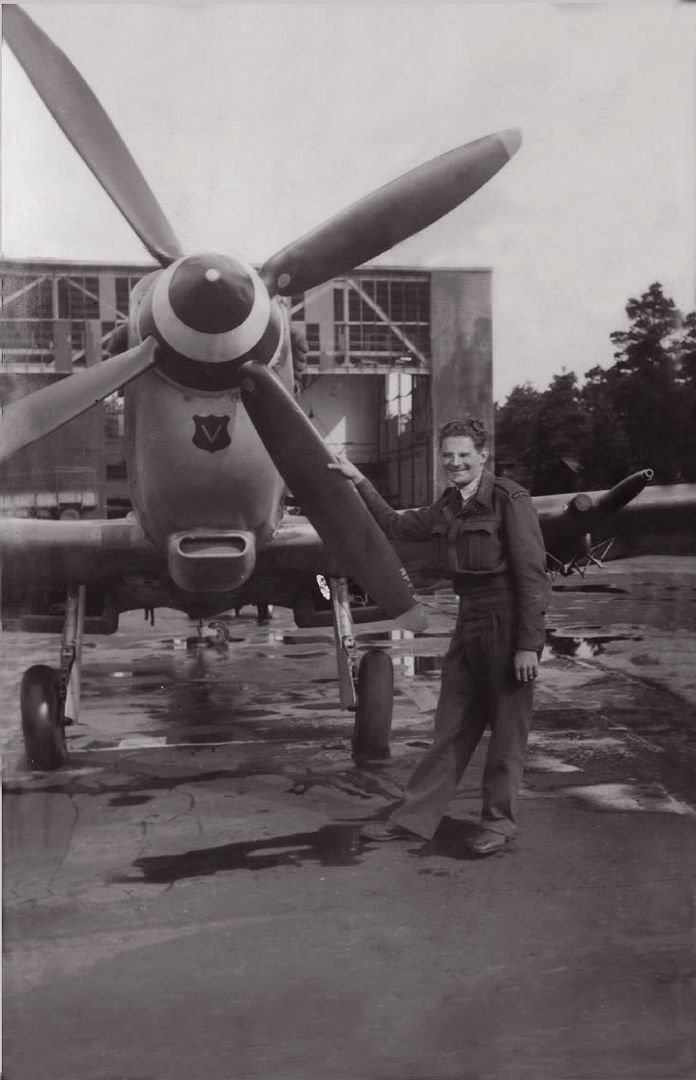
Anyone have any knowledge on both the reason for the sheild with the letter code in it?
Or the colour?
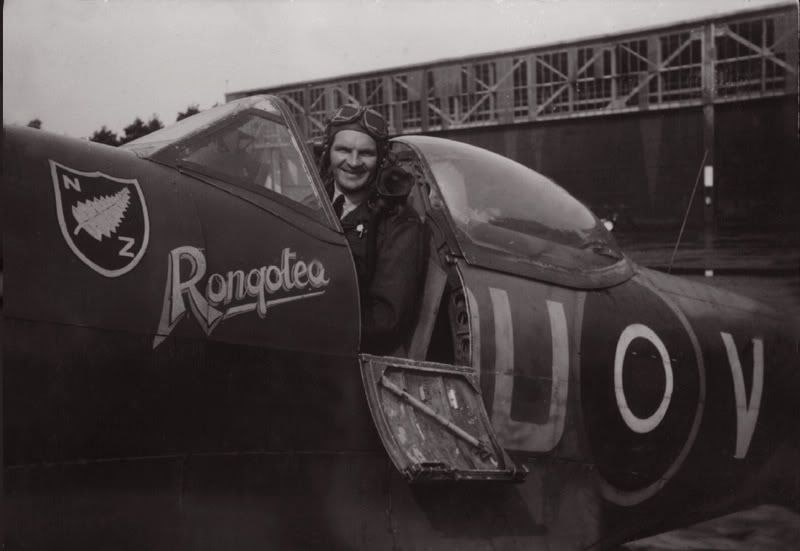
You can plainly see where the yellow roundel has been oversprayed here.
For the Non NZ’ers out there, Rongotea was Dad’s home town. A small farming community about 5km south of the present day Ohakea Air Force base.
The Silver Fern Sheild was copied from a tin of “Silver Fern” tobacco which was popular with Kiwi pilots. A number of 485 Sqdn a/c had this logo.
By: Dave Homewood - 22nd November 2007 at 01:22
Great photos Alan. Thanks for posting them. That’s the best version I’ve seen of your father’s aircraft, Rongotea.
By: Alan - 21st November 2007 at 22:59
Better quality photo
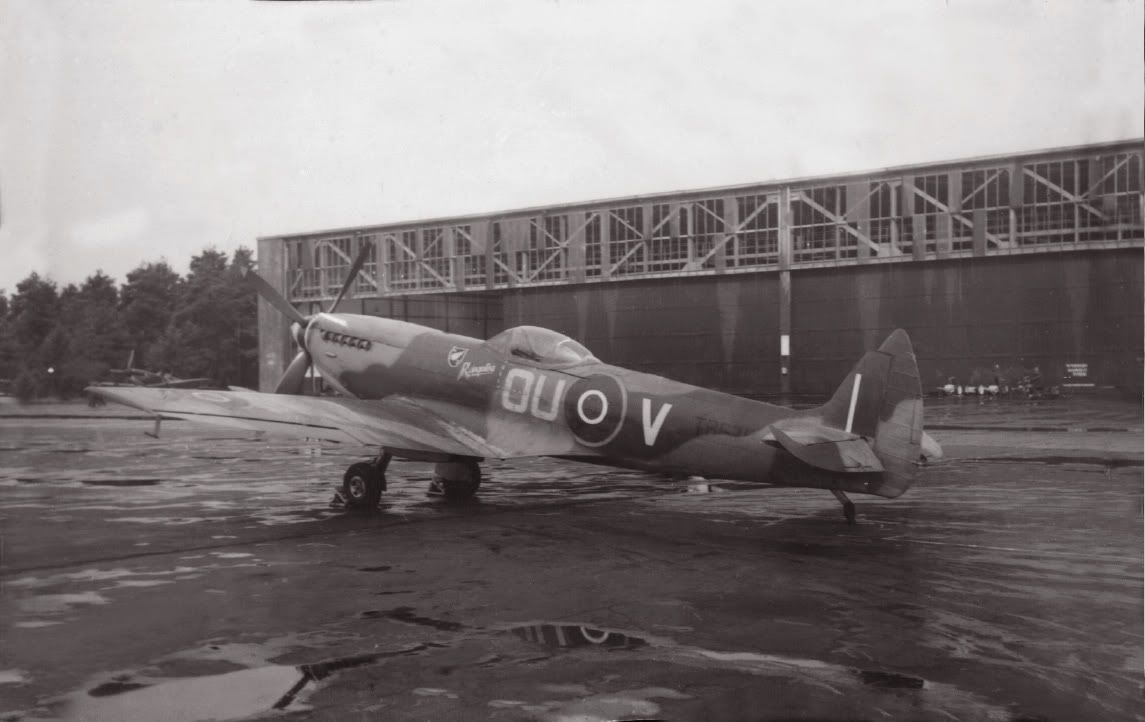
You can see where the yellow band has been oversprayed when changing squadron codes.
This a/c is often refered to as TB625, but I really can’t see that they would have re-coded the a/c any more than was necessary.
Besides, Dad recorded it as TB675 in his log book.. 😀
By: Mark12 - 21st November 2007 at 22:56
Just a local re-spray to paint out the tail band as per orders?
Mark

By: Alan - 21st November 2007 at 22:46
I guess you guys have seen this photo
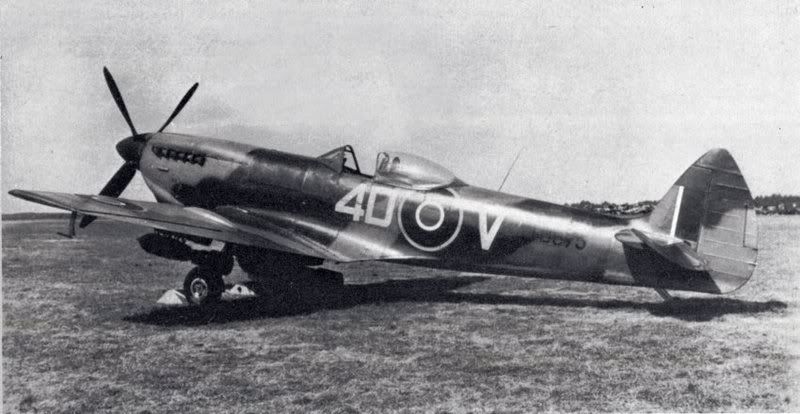
TB675, Drope, May 1945.
It must have been taken before 17/05/45 because that’s the date the 74 sqdn a/c were handed over to 485.
By: Eddie - 21st November 2007 at 20:55
That would be 3 survivors, wouldn’t it Voytech? Isn’t RW393 also painted in that scheme?
By: VoyTech - 21st November 2007 at 13:39
Yep. TB675:D
TB675? Used by No. 74 Sqn before No. 485, and coded 4D-V.
Now, have we not seen those codes somewhere quite recently, Fluffy?
That would make two survivors painted to masquerade as one and the same original Spitfire, albeit in two different liveries!
By: Alan - 21st November 2007 at 01:03
Does anyone have any idea what the real serial of the Mk XVI OU-V was? I wonder if the whole Sqn were painted without serials, at the time. Maybe it was simply taken during a field respray?
Cheers
Dave
Yep. TB675:D


 Sign In








 June 16, 2004 at 8:27 am