The ARM as: AGM-88E, Kh-31PD, R-27EP…. use mechanisms seeking RF emissions source and attack it (eg: APG-77)
Purple Doppler, PESA, AESA and other radar always emits a certain emissions. Temporarily ignoring determining emission range radar, here I want to say, ARM is a weapon against the most effective AESA radar. LPI, frequency hopping or polarity entirely without prejudice to the ARM
An anti-radiation missile (ARM) is a missile which is designed to detect and home on an enemy radio emission source
AESA radars replace the traditional radar RF sources which usually require extremely high operating voltage and power, with multiple solid state RF sources operating at low voltage (40 to 60 volts).
http://en.wikipedia.org/wiki/Active_Electronically_Scanned_Array
AESA radars also offer less emission “leakage” beyond their scanning cone, and can spread their signal emissions over a broad set of frequencies. Most people don’t think of the radar as part of a platform’s stealth level, but it is. Less side-lobe leakage improves the radar cross-section directly. “Agile beam” radars can both spread and switch frequencies as they go, which makes the radar very hard to detect, even when it’s on. Previous generation radars haven’t had that advantage, and turning on your fighter’s radar was kind of like the policeman who turns a flashlight on to find bad guys in a big warehouse. In all likelihood, they can see the light source before the policeman can use the beam to see them. Modern infantry solve this problem by using invisible infrared lights, which work with their night-vision goggles and allow them to see without being seen. Agile beam AESA radars offer the same advantage for a modern fighter jet.
https://www.defenseindustrydaily.com/new-apg79-aesa-radars-for-super-hornets-0411/
U.S. radar designers insist that the latest AESA radar models are all frequency-hopping and therefore they do not emit a signal long enough at a specific point on the bandwidth for such a seeker to lock on to them. But Russian specialists reply that the threat model used by the U.S. to develop these radars relies on older versions of the 9B-1032 seeker. The new version for export, they claim, employs a number of new-generation components that are more sensitive and process signals faster.
One(advantage) is that, unlike a radar homing missile that emits a signal that alerts an enemy to one’s presence, an antiradiation missile is a silent killer. Homing in on the radar emissions of an enemy aircraft, it gives almost no warning of its approach.
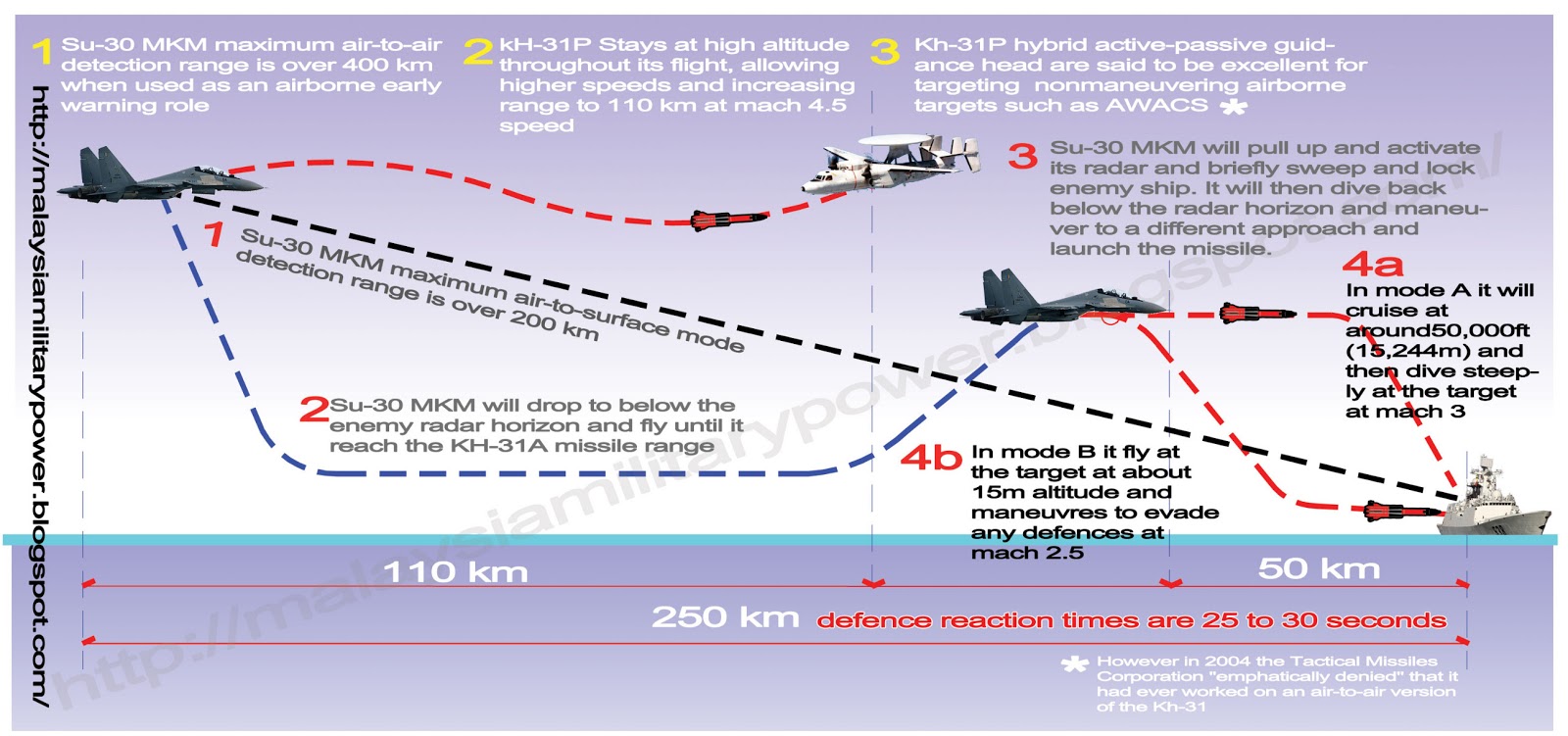
Kh-31PD using engagement all model radar, including E-2D with AESA radar


 Sign In








 December 14, 2015 at 11:38 am