AS 565 Duaphin/Panther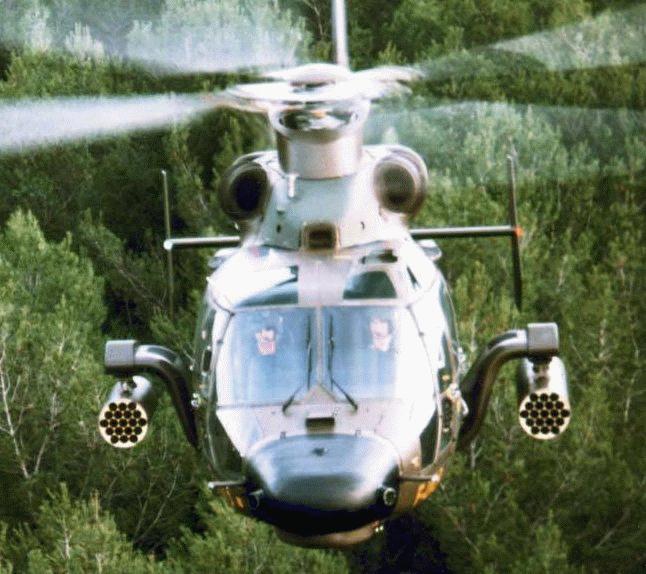
The series of helicopters built around the twin-engine AS 365 Dauphin design include civilian transports, naval utility and dedicated gunship helicopters and are in use within Navies, Coast Guards and Armies around the globe.
sh-2f seasprite landing
French Dauphin maritime utility helicopter.
China builds a clone of the Dauphin, known as the Harbin Z-9 which is flown as an anti-submarine helicopter.
AS 565 Panther
Primarily a Naval helicopter, but also in use with several Armies, the Panther can be fitted with a range of equipment and weapons to suite its role. One of the key design features of the Panther is survivability, with crash-resistant seats and fuel system. The enclosed ‘fenestron’ tail rotor helps with stability when operating against cross-winds – a real advantage when operating from ships.
AS 565 Panther Variants
The AS 565 UA/UB is a transport and utility version, usually unarmed and able to carry up to 10 fully-equipped troops.
The AS 565 MA/MB is the maritime variant, featuring the ‘Harpoon’ device which enables deck landings regardless of wind direction. Radio-guided AS.15 anti-ship missiles, Exocet sea-skimming missiles and a selection of sonar-homing torpedoes give the naval Panther its teeth.
AS 565 CA Panthers are the Army gunship variant, armed with GIAT 20mm gun pods, HOT wire-guided anti-tank missiles, Mistral air-to-air missiles or 68mm rockets. Countries that fly the Panther as a gunship include Brazil.
Specifications (AS365 MB Panther)
Dauphin-helicotper-schema.png
Data from {Eurocopter.com}
Cockpit systems
The helicopter is fitted with a two-pilot Thales Avionics navigation system. The military secure communications system can be fitted to suit the country’s operational requirements. The crew seats are rated to withstand impacts to +20g.
The electronic warfare suite includes a Thales TMV 011 Sherloc radar warning receiver, 2×2 multifunctional displays (MFD), torpedo control box, OTHT joystick, 10.4in colour tactical display (radar, navigation and FLIR), an infrared jammer and Alcan Elips chaff and flare decoy dispensers.
The helicopter is also equipped with advanced automatic flight control systems (AFCS).
Armaments
The AS 565 helicopter is armed with Giat M621 20mm cannon pods, 68mm and 70mm unguided rockets. It also carries Matra Mistral air-to-air missiles, AS 15 TT anti-surface missiles, HOT anti-tank missiles, and mk46 or Whitehead A.244/S anti-submarine warfare torpedoes missiles.
“The AS 565 Panter is designed for troop transport, logistic support and medical evacuation.”
Turboshaft engines
The AS 565 Panther is equipped with two Turbomeca Arriel 2C turboshaft engines, each rated at 635kW, for reliable performance in hot and high conditions. Full authority digital engine control (FADEC) provides fully automatic engine starting and ensures engine operation is maintained within the acceleration, torque and temperature operational limits. The hover ceiling within ground effect is 2,600m and the never exceed speed is over 285km/h.
Four underfloor tanks and one centre fuselage tank provide a total fuel capacity of 1,130 litres. For extended range the helicopter can be fitted with an auxiliary fuel tank and a ferry tank. The range with standard fuel is 820km
Tricycle-type landing gear
The helicopter has hydraulically retractable tricycle type landing gear, with a twin wheeled nose unit and single wheeled main units. The main and nose units are equipped with oleopneumatic shock absorbers. The nose unit retracts rearward and the main wheels retract into wheel troughs in the fuselage.
Performance
The AS565 helicopter can climb at a rate of 8.9m/s to 792km range. It can fly at a maximum speed of 287 – 306km/h. The ferry range and service ceiling of the helicopter are 827km and 5,865m respectively. The endurance of the helicopter is 4.1 hours. The maximum take-off weight of the helicopter is 4,300kg.
vs
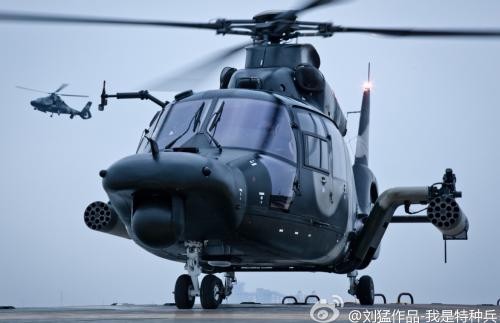
Z-9 Harbin
Design
The Z-9 is generally identical to the AS 365N Dauphin. The helicopter is of light aluminium alloy (28%) construction with extensive use of composite materials (59%), such as glass fibre, and Nomex for added strength and for weight reduction. The helicopter has a four-blade main rotor, with two turboshaft engines mounted side by side on top of the cabin with an air intake on side of motor hump and exhausts at the rear of the hump. The teardrop-shaped body features a tapered boom to the tail fin, a rounded nose and stepped-up cockpit.
The tail flats feature swept-back tips forward of the swept-back and tapered fin with a blunt tip. The Z-9B variant features a modified 11-blade Fenestron faired-in tail rotor with wider-chord, all-composite blades instead of 13 all-metal blades as in AS 365N1.
The helicopter has hydraulically-operated retractable tricycle type landing gear. The nose unit is twin-wheeled and retracts rearward. The main units are single-wheeled and retract into wheel troughs in the fuselage. All three units of the land gear are equipped with oleopneumatic shock absorbers.
As a tactical troop transport, the Z-9B has the capacity to transport 10 armed soldiers seated in two rows behind the pilot seats. Some Z-9Bs in the PLA service have the back-row seats removed to accommodate additional equipment for communications relay, artillery direct, and electronic countermeasures roles.
Cockpit Systems
The helicopter can be fitted with a BG-06 radio altimeter, Type 150 single-sideband radio, and KJ-13 autopilot, and can choose the KDF-806 radio compass, KTR-908 radio, and TB-31 intercom as optional.
For search and rescue missions, the helicopter can be fitted with a 250kg-capacity hoist with winch and scoop fitted externally above the starboard side cabin door and a search light.
The electronic countermeasures variant is fitted with an ECM suite consist of a radar warning receiver, a jammer, and chaff and flare decoy dispensers.
Engines
The Z-9B is powered by two 550kW (739hp) Turbomeca Arriel-IC1 turboshaft, which is produced by SAEC at Zhuzhou as Wozhou-8A (WZ-8A). The fuel capacity is 1,140 litre, with option for a 400 litre ferry tank.
The HAMC is developing a new variant H410A/425/450 powered by two improved 635kW (851hp) Arriel-II turboshaft engines.
Variants
The naval version introduced in the 1990s is known as the Z-9C. As well as SAR and ASW duties, the Z-9C can be fitted with an X-band KLC-1 surface search radar to detect surface targets beyond the range of shipborne radar systems.[5]
Harbin Z-9W (WZ-9)
Z-9
Chinese license produce of the French AS.365N1.
Z-9A
Chinese kit-built version of the AS.365N2.
Z-9A-100
Prototypes for domestic market versions with WZ8A engines. First flight 16 January 1992, approved 30 December 1992.
Z-9B
Initial version based on Z-9A-100. Multi-role.
Z-9C
Chinese license produce of the Eurocopter AS.565 Panther given to the PLA Naval Air Force.
Design
The Z-9C is generally identical to the Z-9B / SA 365 N2 Dauphin-II. The helicopter has a four-blade main rotor, with two turboshaft engines mounted side by side on top of the cabin with an air intake on side of motor hump and exhausts at the rear of the hump. The teardrop-shaped body features a tapered boom to the tail fin, a rounded nose and stepped-up cockpit. The nose of the Z-9C is slightly stretched to accommodate the surface search radar antenna. A pair of weapon pylon for carrying torpedoes are attached to the lower part of the fuselage.
The tail flats feature swept-back tips forward of the swept-back and tapered fin with a blunt tip. Like the Z-9B, the Z-9C also features a modified 11-blade Fenestron faired-in tail rotor with wider-chord, all-composite blades instead of 13 all-metal blades as in AS 365N1.
The helicopter has hydraulically-operated retractable tricycle type landing gear. The nose unit is twin-wheeled and retracts rearward. The main units are single-wheeled and retract into wheel troughs in the fuselage. All three units of the land gear are equipped with oleopneumatic shock absorbers. Some Z-9Cs are equipped with a landing assistance system.
Cockpit Systems
The helicopter can be fitted with a BG-06 radio altimeter, Type 150 single-sideband radio, and KJ-13 autopilot, and can choose the KDF-806 radio compass, KTR-908 radio, and TB-31 intercom as optional.
Mission Equipments
The Z-9C carries an indigenous KLC-1 surface search radar developed by the Nanjing Electronic Research institute (14 Institute). The X-band radar was designed to search and track surface vessels, with a maximum detection range of 92km against fishing boat-sized targets and 118km against small- to medium-sized surface vessel.
ASW equipments onboard the Z-9C include a Type 605 (Chinese copy of the U.S. AN/AQS-13) dipping sonar, a box of 12 passive sonobuoys, four active sonobuoys, a temperature buoy and a maritime environment buoy. The helicopter is equipped with a radio receiver, allowing it to receive the signal of sonobuoys at 10km range when flying at 120km/h speed.
For search and rescue missions, the helicopter can be fitted with a 250kg-capacity hoist with winch and scoop fitted externally above the starboard side cabin door, an FLIR unit and a searchlight.
Z-9EC
ASW variant produced for the Pakistan Naval Air Arm. Configured with pulse-compression radar, low frequency dipping sonar, radar warning receiver and doppler navigation system, it is also armed with torpedoes for use aboard Pakistan Navy’s F-22P Zulfiquar class frigates.
Z-9W (WZ-9)
Armed version with optional pylon-mounted armament and gyro stabilised, roof-mounted optical sight. Export designation Z-9G, roof-mounted sight optional. First flown in 1987, with the first weapons tests in 1989.
Z-9WA
A newer night-capable versions have been built with nose-mounted FLIR. July 2011, Xinhua News Agency released a photo of Z-9WA firing ADK10 air-to-ground missile. Incorporates a domestic Chinese helmet mounted sight that is compatible with anti-tank missiles such as HJ-8/9/10, as well as light anti-ship missiles such as C-701/703 and TL-1/10 when they are used as air-to-surface missiles, air-to-air missiles such as TY-90 and other MANPAD missiles for self-defense.
H410A
Version with 635 kW WZ8C turboshaft engines. First flight September 2001, CAAC certification 10 July 2002. One is currently being fitted with a new Mast-Mounted Sighting (MMS) system.
H425
Newest VIP version of the H410A.
H450
Projected development.
WZ-19
Stealthy attack helicopter development with tandem seats. AVIC Group’s WZ-19 shares the same power plant as WZ-9WA. Media reports said the WZ-19 attack helicopter in May 2010 completed its first flight. Photos had merged in Chinese internet forums early 2011.
Specifications
Z-9C/D
Data from [sinodefense]
Weapons
The Z-9C is fitted with a pair of external pylon to carry 1~2 Chinese indigenous ET52 anti-submarine torpedoes. The ET52 was a Chinese copy of the Italian Whitehead A244/S, using active/passive acoustic homing to a maximum range of 9.5km.
The latest Z-9D can carry two Hongdu TL-10 lightweight anti-ship missiles under its weapon pylons. The missile uses active-radar homing and has a maximum range of 15km. The warhead is 30kg and flying speed is Mach 0.85.
Engines
The Z-9C is powered by two 550kW (739hp) Turbomeca Arriel-IC1 turboshafts, which are produced by SAEC at Zhuzhou as Wozhou-8A (WZ-8A). The fuel capacity is 1,140 litre, with option for a 400 litre ferry tank.
Z-9W/G
Cockpit Systems
The helicopter can be fitted with a BG-06 radio altimeter, Type 150 single-sideband radio, and KJ-13 autopilot, and can choose the KDF-806 radio compass, KTR-908 radio, and TB-31 intercom as optional.
For search and rescue missions, the helicopter can be fitted with a 250kg-capacity hoist with winch and scoop fitted externally above the starboard side cabin door and a search light.
The electronic countermeasures variant is fitted with an ECM suite consist of a radar warning receiver, a jammer, and chaff and flare decoy dispensers.
Engines
The Z-9B is powered by two 550kW (739hp) Turbomeca Arriel-IC1 turboshaft, which is produced by SAEC at Zhuzhou as Wozhou-8A (WZ-8A). The fuel capacity is 1,140 litre, with option for a 400 litre ferry tank.
The HAMC is developing a new variant H410A/425/450 powered by two improved 635kW (851hp) Arriel-II turboshaft engines.
Avioncis
The helicopter’s cockpit can be fitted with a BG-06 radio altimeter, Type 150 single-sideband radio, and KJ-13 autopilot, and can choose the KDF-806 radio compass, KTR-908 radio, and TB-31 intercom as optional.
The improved Z-9WA is fitted with an electronic countermeasures suite consisting of a missile approach warning system and chaff/flare decoy dispensers. The system can detect infrared signature of incoming missiles, alert the pilot and automatically trigger the chaff/flare dispensers to counter the threat.
Fire-Control
Early basic variant Z-9W has an optical sight unit mounted on the roof of the cockpit directly above the weapon operator. The unit is used to search for targets and guide the HJ-8 missile in a semi-automatic command line of sight (SACLOS) mode. The weapon operator aims at the target through X12 sight of TV goniometry, and keeps the cross hairs of the sight on the target until the missile hits the target.
The improved Z-9WA has an under-nose observing and tracking unit developed by Luoyang Electro-Optics Technology Development Centre (EOTDC). The unit comprises a low-light TV and an infrared search and track (IRST), which enables the missile to engage target in all-weather, day/night conditions.
Weapons
The helicopter has a pair of weapon pylons to carry 4 (or 8 on the Z-9WA) HJ-8 wire-guided anti-tank missiles. Alternatively, the helicopter can carry two 12.7mm machine gun pods, or two 57mm or 90mm unguided rocket pods, or four TY-90 IR-homing air-to-air missiles (6km range).
Engines and performance of the Chinese helicopter
The Z-9W is powered by two WZ-8A turboshaft engines. The WZ-8A is a license-built version of Turbomeca Arriel-IC1 engine. Each engine develops a power output of 632kW.
The helicopter is equipped with hydraulically-operated retractable tricycle type landing gear. The two single-wheeled main landing gear units retract into the fuselage. The twin-wheeled nose unit also retracts rearward into the fuselage. Each unit is equipped with oleo-pneumatic shock absorbers.
The Z-9W helicopter can fly at a maximum cruise speed of 238-305km/h, (238km/h) while carrying external weapons. The ferry range with internal auxiliary tank is 1,000km. The helicopter has an endurance of 3.35 hours.
Z-9C/D
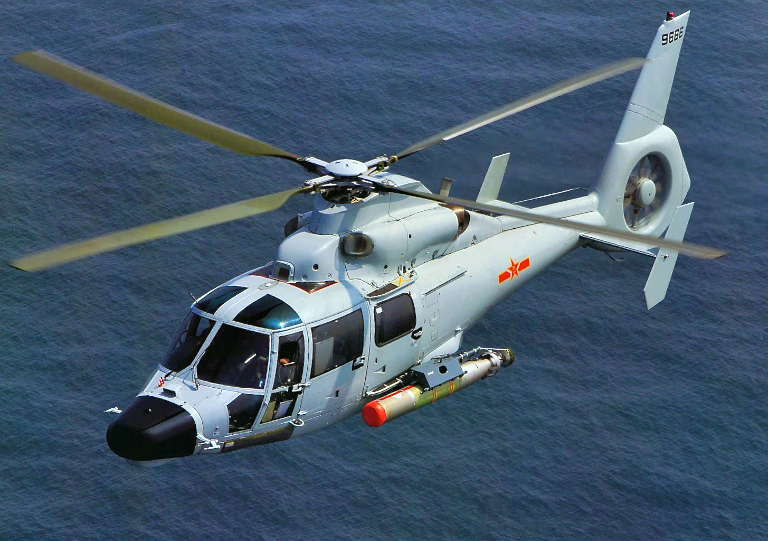

Z-9 is considered to be better than AS 565 Panther by its multitasking capabilities (Because Z-9 has so many variations), even though the French might sometimes be able to do the same
The AS565MB firing the AS 15TT anti-ship missile.



 Sign In








 August 24, 2013 at 7:22 am