June 1982 Newly elected PM Hawke knows the RAN needs a new carrier, Hermes is offered to us be we turn it down because Australia wants to move away from ties to Britain and strengthen ties with the US.
President Regan offers Australia a pick of the fleet, most of the carriers are far to large for our needs and require more manning than the navy can muster. However there is one vessel, though old, has been kept up to date with most modern equipment and is due soon for retirement from the USN. Hawke calls the navy top brass and gets them to put a team together to check out the offer, they report favorably and a signature is cast.
The price- Au$200M, The RAN takes charge of the former USS Bon Homme Richard CV-31
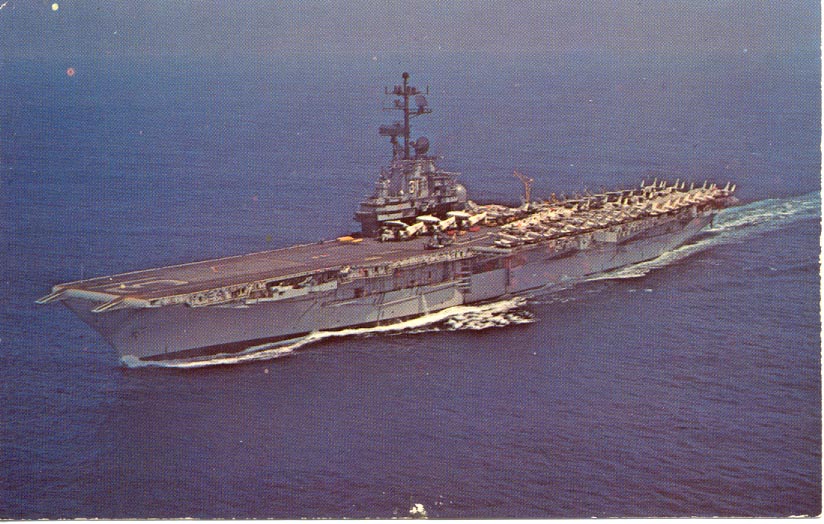
After a refit at Cockatoo Island, HMAS Australia III takes to the water and sails for Jervis Bay in order to pick up her new compliment of aircraft,
[INDENT]
[/INDENT]
First cruise- Op8503 Rimpac 85, Ships in company
[INDENT]
[/INDENT]

By: ADMK2 - 15th January 2011 at 04:51
The problem for RAN as far as a Carrier replacement went was at that the same time as the Carrier needed replacing RAN also needed a new fleet of ASW helicopters (S-70B9’s) an additional 2 FFG Frigates and a new submarine fleet and a replacement for the River class Destroyer Escorts.
RAN ended up getting – 16x S-70B9 Seahawks, 8x ANZAC Class FFH’s, 6x Adelaide Class FFG’s and 6x Collins Class submarines. In addition RAAF got extra P-3C Orions in the 1975-1980 era, that probably wouldn’t have occurred if RAN got her carrier.
On top of this the F-111, Oberon class subs, FFG’s, P-3C Orions and F/A-18 all had the Harpoon anti-ship missile integrated and brought into ADF service a significantly increased maritime strike capability.
It is likely that virtually all of that (bar the initial 4x FFG’s) would have had to be sacrificed in order to acquire the carrier and a new airwing as there was precious little money for defence in those (and these unfortunately) days…
Personally I think the ADF actually profitted by not getting a carrier.
By: Bager1968 - 4th January 2011 at 06:49
What about a derivative of the little italian STOVL carrier Garibaldi?
It costed, Garibaldi I mean, new and with all the bells and whistles less than 200 million USD in the late 70’s, and sported 4 LM2500 for 60 MW propulsion power on two axis, 7000 nm range, long range 2D radar, long range 3D radar, surface radar, two eight cells launchers for Sparrows or Aspide missiles and much more….
If Australia got up to 450 millions AUD for the whole project, they could even got some ad hoc change, even an enlarged/elonged hull.
Or maybe Australia could got two brad new of them just keeping the very same general configuration of the original one.
This is the first part of a long article written by a poster on another board, that was posted on that other board in 2006…
Most of this info has probably been on other threads, but here goes.
In 1977 the Australian govt. issued a requirement to replace the HMAS Melbourne, a modified Majestic class light aircraft carrier that had been in service since the mid 50s. Some of the replies were for existing designs, but most were concepts that were never built.
Type length beam depth displ. speed load
Invincible 206m 27.5m 6.38 19500t 28k 14 helos & Harriers.
Spanish SCS 195m 29m 6.63 14814t 24k 16 helos & Harriers.
Garibaldi 180m 23.5m 8.28 13238t 29.5k 16 helos & Harriers.
LHA [Tarawa] 249.9m 31.8m 7.9m 39900t 25k 30 helos & Harriers.
PH75 209m 28.3m ? 18100t 28.4k 20 helos & Harriers.
MACSHIP 181m 32.5m 6.0m 12500t 28k 14 helos & Harriers.
Harrier Carrier 135.65m 21.2m 6.5m 7200t 25k 10 helos & Harriers.
Gibbs&Cox SCS Same as Spanish SCS
Mod.LHA [Tarawa] ~290m 32.2m 9.9m 53800t 24k 50 helos & Harriers.
DD963AC [Spruance Hull] 172m 24.4m 7.44m 12500t 29k 8 helos & Harriers.
McMullen 193.85m 26.82m 7.63m 20801t ? 22 helos & Harriers.
Rosenblatt SCS [var.Sp.SCS] 178m 24.4m 6.7m 14000t ? 16 helos & Harriers.
Protean [3designs] (min) 198.2 27m 6.8m 20000t 25k 14 helos & Harriers. (max) 245m 32m 7.5m 32000t 27.5k 20 helos & Harriers.
LPH [Mod.Iwo Jima] 198m 28.7m 8.7m 21407t 24k 22+ helos & Harriers.Some of these figures are a bit loose, as the breadth of some are wl. & some are oa.; also some of the loads are a bit off, but overall they are reasonably OK.
Three were shortlisted: Spanish SCS, Garibaldi, & mod.Iwo Jima.
The Navy liked the Spanish SCS but there was some doubts over who owned the design.
The three designs shortlisted were costed at $AUD 700million+.
The Garibaldi class proposal was dropped during 1980/81. In January and February 1981 design studies contracts were placed with Ingals (LPH) and Gibbs and Cox (SCS). A Joint RAN/USN project office (PMS 308) was opened in March 1981, the overall cost of the design studies and US project office being $Au 8 million. PMS308 developed Top Level Specifications for the LPH and SCS based on RAN agreed Ship Characteristics.
The initial design studies were completed in July 1981. In August 1981 the Defense Force Development Committee agreed with the baseline characteristics and agreed that construction of the vessel in Australia was not viable.
Final Administrative approvals proceeded during 1981. The Force Structure Committee examined the need for a carrier during August and September. The “Aircraft Carrier Project Evaluation Board Report” was presented to the DSDC. 5 Cabinet submission prepared during November 81. Carrier acquisition formally supported by the Chief of Defence Force Staff, Chief of Naval Staff and Chief of General Staff (Army). A Carrier was formally opposed by the Secretary of the Department of Defence and the Chief of Air Staff.
However, the UK decided to sell the Invincible, and sent a team to brief Australia on the characteristics of the Invincible and the details of any deal in September 1981. The total cost including mods., spares, training etc was to be $AUD478 million.
On the 25th of February 1982 the minister announced that the Invincible was to be acquired by the RAN, but shortly after that the Falklands War started, & the UK kept the Invincible.
In the March 1983 election, there was a change of Govt in Australia & the whole idea was scrapped.
In Combat Fleets 1982/83, under the Australian entry it mentions the U.S. proposal for the replacement of HMAS Melbourne which was based on an Iwo Jima class LPH. The major difference listed was the replacement of the steam single shaft machinery with a gas turbine twin shaft of 50,000shp.
By: 19kilo10 - 4th January 2011 at 00:32
My opinion is that the Italian ship would be too small. A PdA would probably have been most cost effective. Cant see an “Essex” due to double manpower requirements over Mel. And I think all the available Essex class ships were pretty much worn out.
By: verbatim - 3rd January 2011 at 21:29
What about a derivative of the little italian STOVL carrier Garibaldi?
It costed, Garibaldi I mean, new and with all the bells and whistles less than 200 million USD in the late 70’s, and sported 4 LM2500 for 60 MW propulsion power on two axis, 7000 nm range, long range 2D radar, long range 3D radar, surface radar, two eight cells launchers for Sparrows or Aspide missiles and much more….
If Australia got up to 450 millions AUD for the whole project, they could even got some ad hoc change, even an enlarged/elonged hull.
Or maybe Australia could got two brad new of them just keeping the very same general configuration of the original one.
By: EdLaw - 3rd January 2011 at 20:58
The acquisition of a modified Principe de Asturias would make the most sense; the only concern was that, although the PdA was launched in ’82, it didn’t enter service until ’88. This may be a problem, since Melbourne really needed replacement before then. If this could be avoided, perhaps by using an existing command system (perhaps a transplant of the Perry class systems?), then this would help a lot. One or two PdA class carriers would make things a lot more interesting, and would allow the RAN to maintain a very forward-looking strategy.
The Sea Harrier is probably the only game in town if you want a radar equipped Harrier, since the AV-8A was never air-defence oriented. An order for, say, twenty to thirty Sea Harriers would be more than enough to provide an air wing for both carriers. The Sea King AEW would then enter service as soon as possible, with the carrier air wing probably consisting of around 8-12 Sea Harriers, 3-4 Sea King AEW and possibly a couple of Sea King ASW helos. As a regional deterrent, this would have been pretty potent from the ’80s right through until today, with a simple switching over to the AV-8B+ during the ’90s.
The RAN may have been able to retire the three Perth class in favour of an extra pair of Adelaide class frigates. This would leave a force of two carriers and eight air-defence frigates. This may alleviate some of the manning issues as well, and reduce operating costs by retiring the steam-driven Perth class in favour of a common LM2500 fleet.
By: Pioneer - 28th December 2010 at 23:51
Fine by me…
You are a gentleman Bager1968!!
Finished reading your info at 1:30 in the morning (it had me hooked!)
It reiterated to me that the proposed ‘Oz’ Iwo Jima class would have been a big and not so effective compromise!
There were some very interesting snippets of information regards the ‘Oz’ modifications to HMS Invincible – ie:
The Invincible class ships themselves were fine units, and probably superior platforms to either of the final ships selected. However the major problem with the ships was the completely unique (for the RAN) ship systems and weapons on board the Invincible. The RAN by that time had standardised on US systems like the Naval Tactical Data System, the LM2500 gas turbine and an entire range of subsidiary system. Entering the Invincible class ships into the RAN would require the establishment of a complete and separate logistical, training and support infrastructure that would be expensive and difficult.
This is a serious and valid consideration which had to be taken into into account!
On its side the Invincible class ship 2nd hand was much cheaper, with a total project cost, $Au475 roughly half the other options, and the ship would be available for service in the early months of 1984.
“The acquisition of the Invincible should not be seen merely as a replacement for the Melbourne. The Invincible is a very Modern ship with a wide range of capabilities quite beyond those which are available to us now. Firstly the ship is particularly suited to operating and maintaining large numbers of anti submarine helicopters. Investigations have shown that that to counter submarine threats a combination of weapons platforms is necessary. The combination includes land based aircraft, ASW helicopters and warships. Secondly there is a need for a ship capable of planning, commanding and co-ordinating operations by a large group of ships and aircraft. Thirdly the ship has a capacity to carry for a short time a Royal Marine commando – the equivalent of an Australian battalion group. This should be a very useful adjunct to our amphibious ship; HMAS Tobruk. Further the ship is capable of operating short take off and vertical landing aircraft of the Harrier type, although at present it is intended only, I repeat only to embark ASW helicopters. The decision of whether to aquire this type of aircraft will be made at a later date”
Again very valid points, and a lot of flexibility offered, when compared to HMAS Melbourne, it was intended to replace!
The modern C3 facilities/capabilities of the Invincible alone would have been a huge shot in the arm for the RAN!
Whether the Sea Dart system would have been retained? (I doubt it! – on the grounds of cost)
The question of Sea Harrier or AV-8B at a later date, would probably aquired – although it would probably have been the Sea Harrier, rather than the AV-8B, due to its combat proven record, its radar capability and the fact that the AV-8b (let alone the AV-8B Plus was some years off being put into production – let alone operational service!
I can not but think of the likes of HMAS Invincible off the coast of East Timor, with her Sea Kings providing Vertical Replenishment in support of the army, and its Sea Harrier FSR.2’s flying Recon and CAP 🙂
“A limit of cost of $50m is to be allowed for RAN modifications. These will include adding 450tonnes of fuel to increase the ships range to meet our basic requirements”
Hell after seeing the distances that the British Task Force covered to get from Britain to the Falklands, one has to appreciate the range that the RAN required! Out of curiosity to those in the ‘know how’ to gain that 450tonnes of fuel, what had to be sacrificed? and what additional range would this have gained?
Thanks once again Bager1968!!
Regards
Pioneer
By: Bager1968 - 27th December 2010 at 08:59
I would be most interested in your generous offer Bager 1968😀
I will PM you my email if that’s ok!Regards
Pioneer
Fine by me…
By: benroethig - 27th December 2010 at 00:49
And at a very reduced max takeoff.
By: swerve - 27th December 2010 at 00:42
I don’t know about that. Foch was retired early because it was unable to operate rafales. It operated Crusaders far beyond their obsolesce because it really couldn’t operate anything much larger. To operate anything modern, like second hand hornets, would have probably required a reconstruction with a a change to the angled deck and longer, more powerful cats.
It was determined in trials in the 1980s that Foch & Clemenceau could have operated F-18 without such modification, & the MN lobbied to be allowed to buy some, but was forced by the government to upgrade its F-8s instead. The F-18s would have operated in the air-air role only.
This would have meant that the MN would received Rafale after the AdlA, instead of before.
F-18E would have been too big.
By: benroethig - 27th December 2010 at 00:10
In the 1965 assessment, the RAN mentions buying a new-build Foch repeat from the French, but immediately dismisses it without comment, preferring either buying a new-build (and far more expensive) CVA-01 or rebuilding an old Essex (at least as expensive as buying the French aircraft).
In my view, a Foch-type would have been the best option… it would be in service until ~2000, and would be capable of operating decent numbers of high-quality aircraft until it was retired!
I don’t know about that. Foch was retired early because it was unable to operate rafales. It operated Crusaders far beyond their obsolesce because it really couldn’t operate anything much larger. To operate anything modern, like second hand hornets, would have probably required a reconstruction with a a change to the angled deck and longer, more powerful cats.
Would the Aussies have bought Sea Harriers? Or gone with AV-8Bs?
Considering that air defense woud have been their primary mission, SHARs would have been preferred. That being said, acquiring AV-8B+s to replace the SHARs wouldn’t be out fo the question.
By: 19kilo10 - 26th December 2010 at 23:47
Would the Aussies have bought Sea Harriers? Or gone with AV-8Bs?
By: Pioneer - 26th December 2010 at 23:22
Spain proved with one vessel that the Sea Control idea does work, so for Australia to buy two vessels of this type, our needs are met very easily and cheaply
Agreed!!
The problem about replacing HMAS Melbourne had to be realistic and not a wet dream! It’s a great pity the federal government did not knock the services internal rivalry on the head quick smart!
I personally would prefer the operational flexibility (and realistic) notion of two smaller SCS sized ships to one Essex / Eagle or Ark Royal type ship, which we could ill afford to man, let alone maintain and equip!
I still think we should have kept our Trackers in service and yes upgrade them to Turbo Trackers
If we were to have a fixed-wing ASW element, I strongly agree with a Turbo Tracker option (with modernised avionics – some possibly from the S-3 Viking’s suit!!) as being the most sensible and realistic one! The notion of being able to afford the likes of the S-3 Viking would be prohibitive (Do not get me wrong I would love the capability of the Viking any day!!)
Regards
Pioneer
By: Pioneer - 26th December 2010 at 23:10
Or go for the cheap and chearful solution of Seaking AEW, it would effectively of been a new and welcome capability for the RAN. They already operated the Seaking so it wouldn’t of been a significant logistic pressure to introduce the type.
I like it Fedaykin!
It makes financial and operational sense!
The threat within the region (bar that of the Soviet’s Badger’s, Bear’s at Vietnam bases!) in the 1980’s and early 1990’s would have made the Sea King AEW feasible!
Regards
Pioneer
By: Pioneer - 26th December 2010 at 22:59
I’ve got a shed-load of stuff on various proposals and evaluations for Melbourne replacements from 1960 through 1982… most of which was gleaned from discussion boards.
I can send it to anyone interested (I don’t have anything set up to post them on-line… they range from PDFs to Word documents to images of various formats).
I would be most interested in your generous offer Bager 1968😀
I will PM you my email if that’s ok!
Regards
Pioneer
By: Bager1968 - 26th December 2010 at 20:27
In the 1965 assessment, the RAN mentions buying a new-build Foch repeat from the French, but immediately dismisses it without comment, preferring either buying a new-build (and far more expensive) CVA-01 or rebuilding an old Essex (at least as expensive as buying the French aircraft).
In my view, a Foch-type would have been the best option… it would be in service until ~2000, and would be capable of operating decent numbers of high-quality aircraft until it was retired!
By: F-111buff26 - 26th December 2010 at 13:15
while some of these ideas make the heart grow fond, the most realistic would have been a 4th invinvible with SHars and sea kings(and some awesome secondhand aquisitions over the last ten years!):D
but the coolest would have been hornets/phantoms on a essex with turbo trackers for ASW, AEW, COD and AAR, similar to Brazil is doing now, and sea kings for SAR, with the skyhawks as light attack/aggressors/hacks:cool:
By: Obi Wan Russell - 18th December 2010 at 14:59
Searchwater will fit into a Gannet, the airframe is large enough. There were a number of Gannet airframes available from the early 70s (circa 30 AEW3s, which had their AN/APS-20 radars removed to put into 12 RAF Shackletons), and of course the last seven operational airframes were available from 1979 onwards following 849NAS being disbanded. Indeed one of these airframes was used between 1982 and 1984 in development work for the Sea King AEW2, though it retained it’s original radar for comparison tests.
Searchwater is less suited to the E-1 Tracer than the S-2 Tracker as the radome extends downwards, and the Tracker is already designed with a downward extending radome, albeit a smaller one. The Tracer was extensively redesigned from the original Tracker in order to carry the radome on top of the airframe, including a new tailplane, and if the radome is no longer required for the radar (in this case Searchwater) then it becomes easier to adapt the original Tracker airframe for the task. The Tracer’s Radome was fixed as well, not rotating like the Hawkeye or Sentry.
By: 19kilo10 - 18th December 2010 at 14:33
An E-1 Tracer airframe would have been interesting to upgrade with turboprops and modern avionics. Would Searchwater have fitted in its radome? Also, what of Britain’s AEW Gannets? Could they have been purchased and upgraded with Searchwater?
By: Obi Wan Russell - 18th December 2010 at 13:32
Or go for the cheap and chearful solution of Seaking AEW, it would effectively of been a new and welcome capability for the RAN. They already operated the Seaking so it wouldn’t of been a significant logistic pressure to introduce the type.
I did mention earlier the possibility of upgrading some Trackers to Turbo Tracker configuration then installing the same Searchwater AEW radar as the Sea Kings. Second hand Trackers from US stocks (if you don’t want to use up the limited numbers in RAN service, ie retaining the ASW mission) were still cheap an plentiful in the late 70s/early 80s. Better altitude/range than a Sea King, further justifies retaining CATOBAR over STOVL if that is the choice of the Government. If forward planning is truly joined up in the Late 70s then the purchase of RAN F/A-18A/Bs can be added to the RAAF aquisition generating further saving through economies of scale (logistics/training etc). Going with the Turbo Tracker ASaC option saves a small fortune in this context when compared to Hawkeyes (much as I love ’em, they ain’t cheap then or now and they don’t like small decks, whereas the Hornet can be flown from medium sized decks a little easier). Replacing the Trackers with Hawkeyes twenty years later becomes a possibility (financially) but buying them at the same time as the new carrier AND the Hornets would probably break the bank. Better to stagger these things, spread the cost. Buy the Carrier first (late 70s, commission 1984 ish), initially operating the existing Melbourne air group of Skyhawks, Sea Kings and Trackers, then in the late 80s begin the aquisition of Hornets and Turbo Tracker conversions (into the 90s) a timescale probably leading to the RAN getting C/D model Hornets instead of te RAAFs A/Bs.
By: Fedaykin - 18th December 2010 at 13:04
Or go for the cheap and chearful solution of Seaking AEW, it would effectively of been a new and welcome capability for the RAN. They already operated the Seaking so it wouldn’t of been a significant logistic pressure to introduce the type.


 Sign In








 December 17, 2010 at 5:13 pm