In the first decade of the 21th century it became clear that, although having served well, the Tomahawk cruise missile needed a replacement. Even with the upgrade of the basic missile to the TacTom configuration (Tactical Tomahawk) the missile was becoming obsolete. With its slow speed and reaction time the Tomahawk became an increasingly easy target for defense systems, and in a modern war it simply couldn`t be launched fast enough (requiring extensive planning to program its flightpath). The new missile would have to be much more flexible, and be capable of reaching its target much faster.
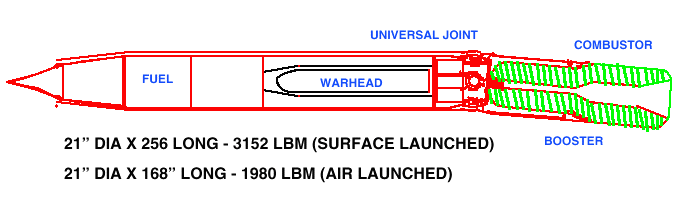
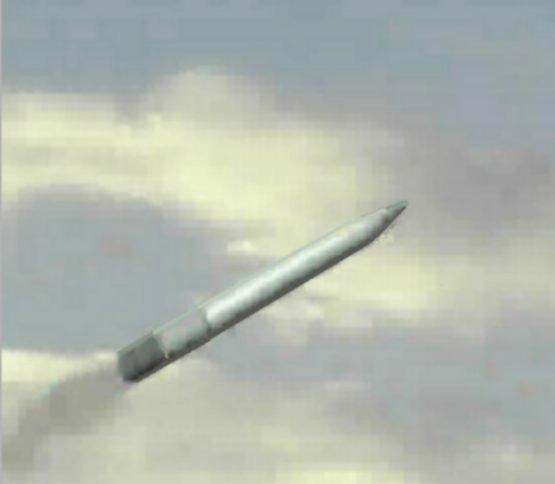
Enter the Fasthawk, the product of almost a decade of work by the Boeing corporation. Just like the Tomahawk it replaced the Fasthawk was designed to fit into the existing Strategic-length MK-41 vertical launch system. The missile as taken into production was a hypersonic missile powered by a airbreathing ramjet. Since the missile moved at extreme velocity there was no need for wings: the round body supplied all the lift that was needed to keep the missile airborne. Steering was done by means of a movable nozzle, which made up the entire tail of the Fasthawk.
Guidance and flightpath were dependant upon the chosen mission. For ground strikes the Fasthawk would usually follow a very high flight profile, nearly that of a ballistic missile. This enabled the missile to reach extreme speeds, and in its terminal phase the missile dived almost vertically down upon its target. The missile can be fired ballistic at Naval targets but usually is fired in the surface skimming path. For anti ship purposes the missile normally follows a surface skimming attack profile but can follw this path against ground targets as well. Since in this mode of flight the missile encounters a great deal of air resistance both range and speed were markedly decreased from the ground strike flight path.
In both cases the initial guidance was by Inertial Navigation, which merely served to get the missile into the general target area. From there active guidance in the form of a millimeter radar and LIDAR took over. There was no provision for infrared guidance, as the missiles nosecone became nearly as hot as its exhaust plume during its high speed flight.
The choice of warheads was somewhat limited when compared to the old Tomahawk missile, with only three options available. The most common of these was a general purpose blast-fragmentation warhead which could be optimized for several different burst modes. The first was Airburst, for for destroying vehicles, light material and troops. In this setting the warhead would explode a few dozen feet above the targets, spraying them with (preforged armor penetrating) fragments. The second burst mode was contact burst, which was normally used in the anti ship mode. In this setting the warhead exploded on impact. The final setting was delayed contact burst, in which the incredible kinetic energy of the missile (moving at mach 5+) was used to penetrate deeply into hardened targets like bunkers. Up to a hundred feet of sand or nearly thirty feet of hardened concrete could be penetrated before the warhead exploded.
The other available warheads were a medium and a heavy fusion warhead, but these came at a significant higher price.


Source: http://www.kitsune.addr.com/Rifts/Rifts-Equipment/Fasthawk.htm
HyStrike will begin the development of an operational hypersonic weapon that will be fielded in the 2005 to 2012 time frame. A Low-Cost Missile with reduced radar cross-section is to be demonstrated by the US Navy. The surface-launched system could hit underground targets to a depth of 12 meters after flying at beyond Mach 4. The wingless missile would change direction in flight by using a bending body joint. The LCMS concept comprises a fin-less, bending body airframe, fixed geometry annular inlet, and a slip-out booster/ramjet engine. It demonstrates through a series of ground and flight tests the technologies required to deliver a 700-pound payload to a range exceeding 700 nautical miles at a speed of Mach 4.0.
The Office of Naval Research sponsors the Hypersonics Weapons Technology (HWT) and the Low-Cost Missile (LCM) programs. The HWT Program is investigating technologies necessary for effective weapon-system operation in the hypersonic realm. The LCM Program – commonly known as Fast Hawk – is developing an entry-level capability for a Mach 4 hypersonic weapon. Both of these ONR programs will feed into the Hypersonic Strike (HyStrike) Program sponsored by the chief of naval operations (N88; N87; and N86).
A unique aspect of this Navy programs is that the goal is a single hypersonic strike weapon that will be launchable from air, surface and subsurface platforms. This is a first-time collaboration between these three communities to develop a common weapon system for time-critical and deeply buried targets. It is intended to produce increased operations effectiveness as well as life-cycle cost saving.
When fielded, the hypersonic strike weapon is intended to have a major positive impact on battlespace management. The weapon’s greatly decreased time to target will give the command, control, communications, computers and intelligence (C4I) components more time to search for and identify time-critical threats. Powerful kinetic penetrators will defeat the enemy’s tactic of burrowing deeper or building stronger bunkers. And the ability to take out threat weapons before they are launched will increase US and allied survivability, efficiently, cost effectively – and soon.
The hypersonic weapon’s immense destructive power results from kinetic energy. An object striking a target at Mach 8 will generate 64 times the force of an object of the same mass striking the target at Mach 1. This phenomenon makes hypersonic weapons well suited to attacking hardened or deeply buried targets such as command bunkers or biological-weapon storage facilities.
Aerothermic heating, caused by the friction of air passing the weapon body, is one area of intensive research. At Mach 4, as the hypersonic weapon passes through the lower atmosphere in the terminal phase of its flight, its surface reaches about 1200 degrees Fahrenheit. This level is within the tolerance range of new titanium and inconel materials. At Mach 6, however, the surface temperatures exceed 2800 F and at Mach 8 over 5600 F; skin materials, as well as internal temperature control, become a much larger issue.
On 25 March 1997 The Boeing Company received an $8 million contract from the US Navy for the Low Cost Missile System (LCMS) Advanced Technology Demonstration (ATD) program, called Fasthawk. The 36-month program will demonstrate technologies applicable to a next-generation, ship-launched, land attack missile system. The LCMS ATD program is conducted jointly with the Naval Air Warfare Center, China Lake, CA.
The compliance of this system with various bilateral arms control treaties remains an unresolved issue.
Mission: Attack, Destroy, & Hold at Risk Short Dwell and/or Time-Critical Targets at Long Standoff Ranges
Range: up to 600 nmi / over 700 nmi
Average speed: Mach 3.5 to Mach 7
2600 mph – 5200 mph
Features:
* High weapon survivability
* Penetration of 18-36 feet of concrete
* Reactive SEAD
* Day, night, adverse weather operation
* Family of Hypersonic Cruise Missiles
* Neckdown to 1 type of Weapon vice 6 currently
* Minimize cost of ownership
Operational 2010 IOC
Platforms: Navy/Shipboard compatible F/A-18 E/F, JSF, F-22, F-16, F-15E, B52, B-2,B-1, MLRS, Surface ships, & submarines

Source: http://www.fas.org/man/dod-101/sys/smart/hystrike.htm
This cruise missile is far superior to the Russian-made SS-N-22 Sunburn, SS-N-26 Yakhont and SS-N-27 Sizzler supersonic cruise missiles and cheaper than its predecessor, the Tomahawk.
What do you think?

By: SOC - 23rd July 2009 at 08:15
Old info. The latest test program was HyFly.


 Sign In








 July 23, 2009 at 7:54 am