Anyone got anything to add to this???
http://news.bbc.co.uk/1/hi/business/6198002.stm
http://news.bbc.co.uk/1/hi/business/6200778.stm
Paul

By: coanda - 18th January 2007 at 23:01
it is a totally new wing.
By: bring_it_on - 18th January 2007 at 04:11
If we must compare A to B, time will tell if it will be easier for boeing to prouduce theoretical 787-11 than it will be for airbus to produce a theoretical 350-700.
The Golden middle for the design of the A-350 is bigger then that of the 787 and therefore the 787-8 varient is more optimized for its PAX and size count then any theoretical A350-7 ie. unless airbus opts for a totally new wing in which case it would be an all new aircraft anyways , Ditto with the 787-11 , the A350-10 will most likely be more optimized then the 787-11 . Currently boeing is having huge success with the 787-8 however even when comparing the larger models it would be very hard for airbus to match or beat ( and this is PAX count to PAX count and not the tricky per passenger , i’ll compare to a smaller boeing varient……) an aircraft which practically uses the same engines , has some advantage of using bleedless engines , and is narrower then their product !!
By: totoro - 17th January 2007 at 13:14
Some new data concerning 350 (new to me) has been published on press centre section of aribus site. It was always said how 350 series is too large, and i, too, used to believe it basically leaves the 330 series without a true replacement. But…
-800 will achieve the stated 270 pax in following configuration of 3 classes: 16/44/206.
-900 will achieve its 314 pax with following class breakdown: 18/50/246.
Now, what is interesting to me is this:
a330-200 is 59 m long (1,5 meters shorter than -800), with a cabin of 45 meters. In 3 classes, it holds 253 pax in following arrangement: 12/36/205.
When we take 350-800 and, out of average of 22.9 economy class rows, assume there is 20 full rows to be downsized from 9 abreast to 8 abreast, we get a figure 250 pax total but more importantly, 186 seats in economy class. Of course, there will probably be a margin of error of several seats but this is good enough for comparison.
With 186 economy seats, that is clearly less than 332’s 205. Then again, looking at class arrangement and 1.5 longer plane, it is clear 350’s pax numbers include something like a row more of first class and row more for business class, perhaps even more.
Basically, smallest 350 is gonna be in a very similar pax class as 330-200, when configured for 8 abreast. If it used the same number of first and business class seats as 330s, it would have around 266 seats or around 13 more than 330-200 and around 30 less than 330-300.
I guess i didn’t say much here…but it was just me thinking aloud how airbus has, in fact, covered the whole range from over 330-200 capacity to just over 340-500’s capacity. No, it doesn’t really compare to 787 series, as that is even a bit shorter than 330-200, but in terms of old airbus to new airbus generation comparison – it covered all the bases.
If we must compare A to B, time will tell if it will be easier for boeing to prouduce theoretical 787-11 than it will be for airbus to produce a theoretical 350-700.
By: totoro - 7th December 2006 at 11:41
That is weird, how can a 64 m long plane seat 314 and 63 m one seat 280? It would mean that airbus’s 314 figure included fewer 1st class seats and more economy seats. Once again, without precise 3 class cabin layout including seat pitch info – we have nothing.
Weight and number of passengers are a non issue here. Yes, you can cram only so many people before you overload a plane but you will much, much sooner hit the barrier of not having enough space to fit those people inside the plane.
If 64 m is indeed length of 900, i would think 800 is around 58 meters and 1000 is around 69 meters.
By: bring_it_on - 7th December 2006 at 11:21
I know you can’t really cram in 10 abreast on 350, i was asking for floor space figure to get the cabin length, since we have the width figure.
Airbus said that the only thing that has changed since the last time (XWB launch) was the wingspan and that all other specs have pretty much remained the same . In the past (farnborough) airbus said that the length of the A350-900 was supposed to be 64 m’s ( he said the same thing in his press breifing as well) and that the -800 would be a shrink (decrease in size) . Now the A350-900 is a 314 seater so the -800 should be smaller . In comparison the 290 seater boeing 787-9 is 63m in lenght of the aircraft . Airbus did not disclose (either at farnborough or at this confrence) the length/lengths of the A350-1000 or the A350-800 however it is safe to assume that the 1000 is longer and the 800 shorter. I think this could simply be the case of the equivilant varient of the 787 being lighter therefore being able to seat few more PAX on accounts of –
– Monolithic CFRP structures requiring only 5-6 Circumfrential joints as opposed to the XWB requiring 4 Circumfrential joints aswell as 16 Longitudenal joints
– The 787 being narrower in cross section therefore saving on material
– A hoopy type of frame (not the primary weight bearing structure) instead of a dedicated Aliminium frame used on the XWB
– Weight savings obtained from removing the Bleed air circulating ducts and related equipments * ( one of the reasons for using bleedless engines was that once every duct used and equipemt used was removed there was positive weight savings when compared with the weight of an added generator)
My gut feeling tells me it’s B
If the A350-8 seats something like 40-50 less PAX then the -900 varient then I dont think the difference on the two models will be less then or equal to 1m therefore making the 787-9 a tad bit longer .
For example the seat difference on the 787-8 and the 787-9 is something like 40 seats type the diff. in lenght is 6m
By: totoro - 7th December 2006 at 10:39
Thank you for your info. I coulnd’t find boeing’s airport compatibility brochure but i did find the pdf in press centre section of airbus’s site.
I know you can’t really cram in 10 abreast on 350, i was asking for floor space figure to get the cabin length, since we have the width figure.
Also, it looks to me airbus and boeing are using same seat pitch, 32 inch. At least airbus uses it on their website for all the older models. So, if the pitch is the same, and if airbus has constant width of cabin throughout its whole length like they said (unlike 787’s last few rows which are bit narrower) just how does -800 have 10 seats less than -9?
It has either A) shorter cabin, B) different ratio of various class seats C) more galley/toilet room at the expense of seats or D) slightly bigger seat pitch than airbus (and boeing’s) usual standard of 32 inch for economy class.
Since i don’t believe -800 is lighter than -9, option A seems unlikely. D seems equally unlikely as it has served them well before and they would have certainly bragged about the bigger than ‘usual’ seat pitch. My gut feeling tells me it’s B, but we need precise 3 class layouts to be sure, plus info on length of the plane wouldn’t hurt either.
By: Bmused55 - 7th December 2006 at 07:45
Actually it is exactly comparing a smaller aircraft to a larger aircraft . The 787-8 is not in the A350-8 class (10-11% smaller) whereas the A350-8 is only about 3.57% smaller the the 787-9 according to airbus’s own No.s ( lets just leave the boeing nos. out ) whereas the have similar MTOW (so boeing is in the 245t class yet seats 10 more PAX) . Airbus doesnt have a realistic competitor to the 787-8 in the A350 family (there aircraft is bigger) therefore they compare the PER SEAT economics of an A350-800 which seats 20+ with the 787-8 .
COMPARING SEAT WIDTHS –
when Airbus refers to the A350 – 8 abreast they use –
A350-800 @ 8 abreast = 19.25″ wide seats
A350-800 @ 9 abreast = 17.5″( Source – Leahy’s audio comentary available at airbus’s website)
Boeing 787
@ 8 abreast = 18.5″
@ 9 abreast = 17.2″The seat widths are immaterial as @ 9 abreast the difference is 0.3 ” which is something that airlines have to live with because the 787 is around 4″ narrower at shoulder level. (boeing uses a 18 ” aisle whereas airbus doesnt tell us the Aisle width)
I know about that, and touched upon it earlier in this thread 😉
What I meant is, when it comes to seating capacities on Airbus aircraft specs.. Airbus always use a very tight seat pitch.
I wasn’t referring to their comparisons this time, but their general tendancy to over cram their specs with seats in possible but improbable numbers.
By: bring_it_on - 7th December 2006 at 07:05
The nutshell of it all is that when quoting seat capacities, especialy in max config, Airbus use very unrealistic seat pitches.
Actually it is exactly comparing a smaller aircraft to a larger aircraft . The 787-8 is not in the A350-8 class (10-11% smaller) whereas the A350-8 is only about 3.57% smaller the the 787-9 according to airbus’s own No.s ( lets just leave the boeing nos. out ) whereas the have similar MTOW (so boeing is in the 245t class yet seats 10 more PAX) . Airbus doesnt have a realistic competitor to the 787-8 in the A350 family (there aircraft is bigger) therefore they compare the PER SEAT economics of an A350-800 which seats 20+ with the 787-8 .
COMPARING SEAT WIDTHS –
when Airbus refers to the A350 – 8 abreast they use –
A350-800 @ 8 abreast = 19.25″ wide seats
A350-800 @ 9 abreast = 17.5″
( Source – Leahy’s audio comentary available at airbus’s website)
Boeing 787
@ 8 abreast = 18.5″
@ 9 abreast = 17.2″
The seat widths are immaterial as @ 9 abreast the difference is 0.3 ” which is something that airlines have to live with because the 787 is around 4″ narrower at shoulder level. (boeing uses a 18 ” aisle whereas airbus doesnt tell us the Aisle width)
By: Bmused55 - 7th December 2006 at 06:50
Could you then please provide me with links to offical airbus/boeing pages containing information on any or all of the following:
1. how long will 350 – 800, 900 and 100 be?
2. how many seats of various classes will airbus a350 800, 900 and 1000 have? Also, same information for 787 8 and 9?
3. What the planned empty weight of a350 800, 900 and 1000? Also, same information for 787 8 and 9?
Only when we have that information can we begin to compare two planes.
Problem that i have with seat numbers that both boeing and airbus have given for their models is that they just don’t add up.
Lets take a340-500, its 68 m long, it holds 313 people in 3 classes.
340-300 is 63.6 m long and has 295 people in 3 classes.Assuming boeing would use same ratio of 3 classes, and assuming there’s max of 8 seats abreast, 787-9 should come close to 295 people in 3 classes. Yet, boeing’s own promo materials quote only 250 people in 3 classes (290 in 2 classes). To me, that is a clear sign that boeing used either different ratios of classes, with more first class seats, and/or that it used less rows of seats.
Now, airbus. Only length figure i see quoted around (but nowhere officially!) is 64 meters. Lets go with that. How on earth can 900 have 314 seats in 3 classes? That is as much as a340-500, one of longest planes in existance. Since there’s no room to use more rows per given length, only answers i see is that airbus used 9 abreast for economy class.
But, if we use a340-300, 295 seats, plus 30 more rows of extra seat, it amounts to 325 seats, not 314. Are ratios of diff class seats different? Or is -900 closer to 62.5 in length? Still, even if it is, how do we explain smaller number of seats in 787-9 of comparable length? But why on earth would boeing use low end figures???
In the end, without floor space figures or at least accurate cabin length figures, it is impossible to compare the planes. I hope airbus will publish some additonal figures by the beginning of the next year. 🙁
The nutshell of it all is that when quoting seat capacities, especialy in max config, Airbus use very unrealistic seat pitches.
By: bring_it_on - 7th December 2006 at 05:33
how many seats of various classes will airbus a350 800, 900 and 1000 have? Also, same information for 787 8 and 9?
In a typical 3 class configuration @ 9 abreast the Boeing 787 has the following PAX count –
– 787-8 = 242
– 787-9 = 280
In 3 class 8 abreast the boeing nos are as follows –
787-8 = 224 (12 first class @ 61″ pitch , 42 buisness class @ 39″ pitch and 170 Economy class @ 32″ pitch)
787-9 = 259 ( 13@61″ , 48″ at 39″ pitch and 198 @ 32″)
( Source – boeing and airbus , The boeing source i wasnt able to locate ( however look at randy’s chart however Widebodyphotohog who is one of the most highly respecte A.net members has all the information) , The other source on the 787-8 and 787-9 is Airbus itself when they compare the A350 with these models you need to register with airbus and then access their media page and download the A350 PDF where 9 abreast 3 class configurations are given. ANother source is a boeing pamphlet which has been circulated at airshows)
In a typical 3 class configuration@9 abreast the A350 has the following PAX count-
– A350-800 = 270
– A350-900 = 314
-A350-1000 = 350
(source is again Airbus’s own PDF on the A350XWB released 2 days ago)
What the planned empty weight of a350 800, 900 and 1000? Also, same information for 787 8 and 9?
I dont think they have listed the OEW (let alone the MEW) on the A350 (atleast not for this XWB model) however the MTOW are known and they stack up as –
A350-800 MTOW 245 Tons
A350-900 MTOW 265 tons
A350-1000 MTOW 295 tons
This compares to the boeing –
Boeing 787-8 = 218 tons (rounding off)
Boeing 787-9 = 245 tons
Boeing’s OEW for the 787 are as follows –
787-8 = 109 T
787-9 = 118 T
( source boeing , airbus (from their PDF) and the aviationspecialist through widebodyphotohog)
Problem that i have with seat numbers that both boeing and airbus have given for their models is that they just don’t add up.
What do you mean that they dont add up ? Airbus knows that the 787-8 seats 242 (like boeing claim) in 3 class @ 9 abrest (hence they include these results in their A350 presentation) however they still use it as a benchmark to compare the A350-800 to instead of using the 787-9 which seats 280.
Assuming boeing would use same ratio of 3 classes, and assuming there’s max of 8 seats abreast, 787-9 should come close to 295 people in 3 classes.
No you are not correct . The boeign 787-9 seats 280 in 3 class @ 9 abreast and only upwards of 290 in 2 class . Airbus knows this and boeing has included this many times in their presentation (randy claims it aswell) . This is the figure airbus uses as a standard for boeings 787-9 ie. they use 787-9 @9 abreast 3 class to seat 280 PAX when they compare it to the XWB-1000
Source – Check A350XWB Brochure
I hope airbus will publish some additonal figures by the beginning of the next year.
ACtually airbus did breifly publish length and wigspan figures on the XWB at farnborough (however they took off those figures from their website) but they claimed that the wingspan changed however all other specs remained the same ( I saw the Press launch live) so you can source it from aviation specialist or wikipedia .
REGARDING FLOOR AREAS – We cannot draw a decent conclusion about capacity as the wider crossection on the XWB distorts it a bit because although the XWB is wider then the 787 by 3-5 inches at eye level it is not enough to go 10 abreast therefore a lot of the width of the fues. for providing more ARM ROOM to the PAX ( something like 0.36 inches per PAX at 9 abreast) , it simply isnt enough for airlines to put a 10 abreast configuration ( unless you want a 16 inch seat width or lower ) .
VERIFICATION – to verify the merits of my figures i recomend that the users download the following documents –
– Boeing 787 Airport Compatibility Brochure (available on boeing’s website)
– A-350XWB media Brochure – Present on the Airbus website ( register onto the media center and download)
Some related (8 abreast) drawings of boeing –


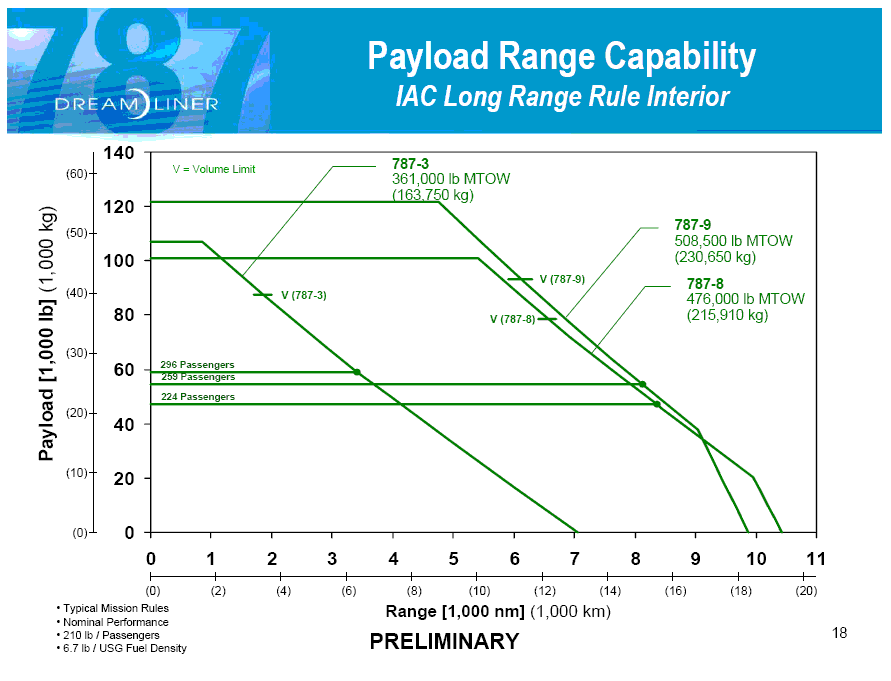
P.S. – the latest airport compatibilty brochure has the performance (range-payload) ommited due to the fact that boeing is changing/revising that due to the better then expected performance resulting from weight savings therefore the Range-payload comparisons i post are prelimenary and will be changed (for the better) once the revision is complete.
By: totoro - 6th December 2006 at 22:49
Could you then please provide me with links to offical airbus/boeing pages containing information on any or all of the following:
1. how long will 350 – 800, 900 and 100 be?
2. how many seats of various classes will airbus a350 800, 900 and 1000 have? Also, same information for 787 8 and 9?
3. What the planned empty weight of a350 800, 900 and 1000? Also, same information for 787 8 and 9?
Only when we have that information can we begin to compare two planes.
Problem that i have with seat numbers that both boeing and airbus have given for their models is that they just don’t add up.
Lets take a340-500, its 68 m long, it holds 313 people in 3 classes.
340-300 is 63.6 m long and has 295 people in 3 classes.
Assuming boeing would use same ratio of 3 classes, and assuming there’s max of 8 seats abreast, 787-9 should come close to 295 people in 3 classes. Yet, boeing’s own promo materials quote only 250 people in 3 classes (290 in 2 classes). To me, that is a clear sign that boeing used either different ratios of classes, with more first class seats, and/or that it used less rows of seats.
Now, airbus. Only length figure i see quoted around (but nowhere officially!) is 64 meters. Lets go with that. How on earth can 900 have 314 seats in 3 classes? That is as much as a340-500, one of longest planes in existance. Since there’s no room to use more rows per given length, only answers i see is that airbus used 9 abreast for economy class.
But, if we use a340-300, 295 seats, plus 30 more rows of extra seat, it amounts to 325 seats, not 314. Are ratios of diff class seats different? Or is -900 closer to 62.5 in length? Still, even if it is, how do we explain smaller number of seats in 787-9 of comparable length? But why on earth would boeing use low end figures???
In the end, without floor space figures or at least accurate cabin length figures, it is impossible to compare the planes. I hope airbus will publish some additonal figures by the beginning of the next year. 🙁
By: bring_it_on - 6th December 2006 at 14:26
Just why can’t people agree on one set of seat figures and go with that?
Its not about people agreeing to the configuration but Leahy and airbus agreeing to the configuration . As a matter of fact airbus agrees to the fact that the Boeing 787 seats 242-248 in a 3 class set up ( @ 9 abreast) and the 787-9 seats 280 (similar 3 class setup @ 9 abreast) however they continue to compare their A350-8 (which seats 270 in 3 class @ 9 abreast) to the 787-8 even though it is closer to the PAX category of the 787-9 ( Difference of 10 seats instead of 22-28 seats) .
Is that randy claims true (since he is more or less an official boeing PR person) or is what boeing official 787 product page claims true?
Boeing claim 248 seats for the 787-8 (at 9 abreast 3 class) whereas airbus claims the 787-8 has 242 seats (not much of a difference) however boeing claims that the range of the 787-8 is between 8000nm-8500nm while airbus claims that the range of the 787-8 is 7900nm . The information on boeing’s seat configuration is in a PDF format (somewhere on their site) and airbus actually uses the same information (but reduces the range from 8000-8500nm to 7900) and posts the 242PAX count on their A350XWB brochure posted at their website.
Because we now have 240 vs 250 for -8 and 280 vs 290 for -9. So just which of those is true boeing official stance on optimal seat number for their planes?
I dont know what VS refers to in this context however both airbus and boeing claim 242 (boeing claims 248 for their own aircraft) as the seating at 9 abreast in 3 class arrangment for the 787-8.
would assume that when airbus says their plane is 0.2% lighter per seat than competitor, they would use 240 seat claim for 787-8, rather than 250 one as its natural that bigger plane can carry more people with less weight per seat.
When Airbus says that the A350-800 is x% cheaper per seat (or burns less fuel per seat) they are taking 242 PAX as the 3 class 9 abreast configuration for the 787-8 and taking 270 as the 3 class 9 abreast configuration for the A350-800 . They are comparing like designations however the 787-8 and the A350-8 arent similar sized as the 787-8 is smaller and the 787-9 is more of a competitor to the A350-8 (only a 10 PAX difference in 3 class 9 abreast configuration) . There is nothing at the moment that competes with the A350-9 ( other then the members of the 777 family) however boeing has publically said on many occasions that it is only a matter of time before the 787-10 is launched as a program (hence you see Randy’s chart including the ghost 787-10) and the 787-10 will most likely be available at the same time the A350-9 is available (2013-2014) .
I am right to assume they compared -8 with 800, right? Or were they comparing -9 with 900, since 900 is their first model?
They are comparing like designations but not comparing like AIRPLANES which is more appropriate . Might aswell start comparing the A350-8 to the 737-8 as both have the “8” designation 😉
So many things we don’t know…
Actually regarding PAX configuration we know that for sure since both airbus and boeing has published the records (they are on the sites of A and B) .
By: Bmused55 - 6th December 2006 at 13:50
Cool cant wait too see it fly and who orders them.Lets hope they dont c*ck this up like the A380:D
James
Seeing as this is something like the A350s 6th incarnation and second industrial launch, its fair to say they’ve c*cked” it up already!
By: Manston Airport - 6th December 2006 at 13:37
Cool cant wait too see it fly and who orders them.Lets hope they dont c*ck this up like the A380:D
James
By: Bmused55 - 6th December 2006 at 13:22
Just why can’t people agree on one set of seat figures and go with that? Is that randy claims true (since he is more or less an official boeing PR person) or is what boeing official 787 product page claims true?
Because we now have 240 vs 250 for -8 and 280 vs 290 for -9. So just which of those is true boeing official stance on optimal seat number for their planes?
I would assume that when airbus says their plane is 0.2% lighter per seat than competitor, they would use 240 seat claim for 787-8, rather than 250 one as its natural that bigger plane can carry more people with less weight per seat. I am right to assume they compared -8 with 800, right? Or were they comparing -9 with 900, since 900 is their first model?
So many things we don’t know…
What Airbus have been doing is giving their A350s the same model numbers as the 787, however their A350 has been bigger for each variant when compared to the 787 with the same model number.
For example, to the laymen the 787-900 and A350-900 look to be the same aircraft. When in fact the A350-900 has 20 or 30 seats more than the 787-900.
The effect is the A350-900 has more seats to spread all the costs out on. Naturally making it seem cheaper. To the laymen, the A350-900 then looks to be the better craft.
Its classic PR fact bending that both sides employ. Although it must be said, Airbus have been doing a lot of fact bending with the A350.
Please note… the numbers I used above were purely representative for the example and may not reflect the actual seat count differences.
By: totoro - 6th December 2006 at 10:30
Just why can’t people agree on one set of seat figures and go with that? Is that randy claims true (since he is more or less an official boeing PR person) or is what boeing official 787 product page claims true?
Because we now have 240 vs 250 for -8 and 280 vs 290 for -9. So just which of those is true boeing official stance on optimal seat number for their planes?
I would assume that when airbus says their plane is 0.2% lighter per seat than competitor, they would use 240 seat claim for 787-8, rather than 250 one as its natural that bigger plane can carry more people with less weight per seat. I am right to assume they compared -8 with 800, right? Or were they comparing -9 with 900, since 900 is their first model?
So many things we don’t know…
By: Bmused55 - 6th December 2006 at 06:56
Dunno about anyone else, but that seems a reasonable and well evidences reply to the A350.
And he is right, Airbus do always compare their aircraft to Boeings with smaller seat counts.
By: bring_it_on - 6th December 2006 at 06:28
Will be interesting to read Randy Baslers online blog on the Boeing website this month.
Out to launch
By now I’m sure you’ve read that Airbus has gotten the official okay to go out and launch the latest version of the Airbus A350 – the 2nd industrial launch for this airplane in 14 months.
And in general, it doesn’t appear to be much different from what was announced at Farnborough. The only significant differences that we see at this point are in the areas of:
Timing
Composites
Airbus says we won’t see the first A350-900 until 2013 – which is a year later than previously announced. The first A350-800 is now scheduled for 2014, and the first A350-1000 will not be delivered until at least 2015. This makes the initial A350 delivery at least five years behind the 787 Dreamliner.And their biggest model, the -1000, which is to compete with the 777-300ER, won’t be arriving until nine years from today. Mind you, we forecast a market of 1,450 airplane deliveries in this size category (200-400 seats) between now and 2015.
Enough said about timing.
The other change we see is in the commitment to more composites. They’ve dramatically reversed course and decided to join us in building an airplane with a composite fuselage, taking the total use of composites to about 50%. (I seem to recall that in talking about the early A350 they proclaimed that the “optimum” amount of composites for an airplane was about 30%.)
We see this change as a rational and smart decision. However their fuselage – as we understand it – is going to be constructed in a traditional manner, except with composite panels rather than aluminum panels. For an airplane like the 787, we think that sacrifices some of the benefits of going with composite material.
Airbus claims it is going with composite panels because of their “repairability.” We chose to go with the barrel manufacturing approach because it is lighter and more efficient. The repairability aspects are comparable.
Airbus’ view is that panels make it easier to repair. But in fact, repairs would be made in a similar way on either airplane. As I like to think of it, if you have a hole in the wall of your house, would you take down the entire wallboard to repair it? Of course not. You’d just fix the hole.
Elsewhere, I was surprised to see in some reports that Airbus continues to muddle its comparisons between the A350 and various Boeing airplanes in order to claim a seat-efficiency advantage. As I pointed out during and after Farnborough, why would you compare a 270-seat A350 with a 240-seat 787, when you can compare it with the 787-9 which seats 280? It’s misleading when you don’t compare like sizes to like sizes
There’s still a lot to understand about the A350 family, and we’ll report more here as we learn more. But there’s nothing contained in the Airbus launch announcement that alters the Boeing product strategy. The 787 and 777 continue to be the perfect combination to cover this very broad 200-400 seat market. Keep in mind that this segment is forecasted to make up 90% of all passenger widebody deliveries over the next 20 years.
Finally, there’s a school of thought that says being second to market is good, because you can respond to whatever the competitor has done. In defense of this argument people have referenced the success of the Boeing 777 against the A340.
Well let me tell you why this is different. With the 777 we were about two years after the A340. But the key difference was a technology breakthrough – two engines over four engines, and the efficiency that came with that breakthrough.
With the A350 we’re talking five years later, at least – and with comparable technology. So where is the breakthrough in the A350 that makes being second a significant advantage?
By: Distiller - 5th December 2006 at 07:36
“We are all aware in our hearts …” – I’m aware of your French heart, M. Gallois.
Reading these specs means that the A380 will be the only Airbus with GLARE.
There was quite some money invested into GLARE.
Not to be continued.
Here is the speech from back when they opened the GLARE factory at Papendrecht. http://www.ez.nl/content.jsp?objectid=40797
By: Bmused55 - 4th December 2006 at 13:17
Just listened on the radio;
Early 2007 Airbus will present the “gobal package” to the workers unions at all Airbus sites.
Then there will be a decision made, where and how the A350 XBW will be built.
Hey FI! Hows my doppelganger doing?


 Sign In








 December 2, 2006 at 6:21 pm
