Hi all
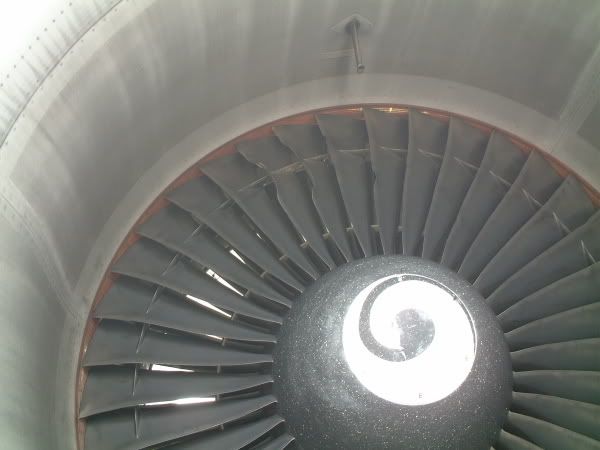
This just occured to me – what’s the painted spiral on the cone at the centre of the fan for, as shown in the a.net shot? i see it on some engines, but not on others?
http://www.airliners.net/open.file/0998402/L/
thanks

By: GZYL - 11th March 2006 at 15:31
How true is the part about the birds? I mean….. once the bird is near enough to the engine to see the spiral painted on the fan hub wont it already be in the process of being sucked through the engine??????????????
By: wysiwyg - 11th March 2006 at 06:51
Dont know for sure, but I would say Pitot tubes also on the engine inlet in order to give an accurate Engine Pressure Ratio.
The answer was just a few posts above!
By: wawkrk - 10th March 2006 at 11:47
Dont know for sure, but I would say Pitot tubes also on the engine inlet in order to give an accurate Engine Pressure Ratio.
By: wysiwyg - 9th March 2006 at 22:04
So is that a yes?
No. Pitot probes are on the nose. :p
By: Bharatheeyan - 9th March 2006 at 05:43
I think the real reason is, if you use fluoroscent lighting, you will misjudge the fan speed. The spiral will clearly show the actual rotation. That will help maintenance crews. JM2C
By: andrewm - 9th March 2006 at 00:28
So is that a yes?
By: wysiwyg - 8th March 2006 at 23:14
Pitot tubes are used to measure the air pressure resultant from the forward motion of the aircraft.
This probe measures the pressure of the air immediately prior to entering the fan/compressor stages and amongst other things is used to compute the EPR indication.
By: andrewm - 8th March 2006 at 21:05
pitot tube?
By: adamdowley - 8th March 2006 at 20:27
How about painting this type?
Engine damage caused by a heron hit very close to V1!
did the heron make that large white mess on the cone?
seriously now, to raise another question, whats the pipe sticking out of the top of the engine casing in that picture for?
By: Hugh Jarse - 8th March 2006 at 17:50
How about painting this type?
Engine damage caused by a heron hit very close to V1!
By: andrewm - 8th March 2006 at 11:49
A little trick i learnt in pre-gcse HE classes – If you get the paint in its pourable form and spin the nose cone for the fan blades very quickly (like normal idle spinning or maybe just a bit less) then pour the paint from the center in a line directly to the edge of it. This will create the spiral effect 😀
Usually used with chocolate or carmel etc
By: andrewm - 8th March 2006 at 10:56
They arn’t an aircrafts equivalent of go faster stripes 😮 😮 😮 😮 😮
By: Hugh Jarse - 7th March 2006 at 11:10
While the tips may be going round close to the speed of sound the centre is stationary. As distance from the centre increases as does the speed. It is possible to see the shape (it’s not always a spiral) painted on the spinner particularly at idle.
Another use of the shape is to indicate rotation to the pushback crew as some engines require a call to confirm the N1 is rotating before fuel is selected on. I don’t know why some engines don’t have them though. We have one aircraft that has one engine with the painted spinner and one that doesn’t.
By: cloud_9 - 7th March 2006 at 10:38
…what’s the painted spiral on the cone at the centre of the fan for,…i see it on some engines, but not on others?
Interesting topic, I too have been curious to know why this is the case…and now I know – thanks for the information!
To hypnotize the curious onlookers 😉
LMAO!:D:D:D
By: adamdowley - 7th March 2006 at 10:34
How could anyone man or bird see the spiral once the engine has been run up.
Unless they have strobe vision!
Well, I guess if you can’t see it – you know its spinning.
By: Dandpatta - 7th March 2006 at 10:18
How could anyone man or bird see the spiral once the engine has been run up.
Unless they have strobe vision!
Dude.. read all the posts again. Birds have better framing rate than humans. Hence… !
By: wawkrk - 7th March 2006 at 09:56
How could anyone man or bird see the spiral once the engine has been run up.
Unless they have strobe vision!
By: adamdowley - 7th March 2006 at 09:04
cheers guys!
By: Bharatheeyan - 7th March 2006 at 05:59
To hypnotize the curious onlookers 😉
By: PMN - 7th March 2006 at 01:35
It’s the two reasons mentioned above. Its primary function (as I understand it at least) is to scare birds away. Birds have a higher vision ‘refresh rate’ than humans, so although it may just look like a tiny swirl in the middle of the fan to us, for birds it’s much more noticable.
And of course it allows ground crews to see when the engine is tuning in low light when it’s not easy to see the fan blades.
Paul


 Sign In








 March 6, 2006 at 10:50 pm