Home › Forums › Modern Military Aviation › Missiles and Munitions › AIM-120 range questions › Reply To: AIM-120 range questions
 blackadam
AIM-120A/B: 48-55km
AIM-120C5/6: 70km
AIM-120C7: 50-80-88km
AIM-120D: 72-105km (no ramjet)
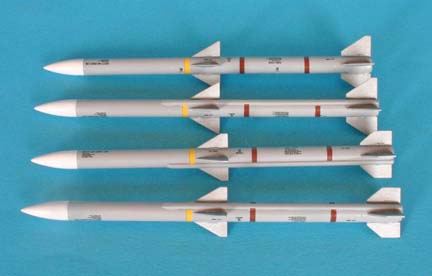
AIM-120 + ramjet (aka AIM-120C-8)

There are currently four main variants of AMRAAM, all in service with the United States Air Force, United States Navy, and the United States Marine Corps. The AIM-120A is no longer in production and shares the enlarged wings and fins with the successor AIM-120B. The AIM-120C has smaller “clipped” aerosurfaces to enable internal carriage on the USAF F-22 Raptor. AIM-120B deliveries began in 1994.
The AIM-120C deliveries began in 1996. The C-variant has been steadily upgraded since it was introduced. The AIM-120C-6 contained an improved fuse (Target Detection Device) compared to its predecessor. The AIM-120C-7 development began in 1998 and included improvements in homing and greater range (actual amount of improvement unspecified). It was successfully tested in 2003 and is currently being produced for both domestic and foreign customers. It helped the U.S. Navy replace the F-14 Tomcats with F/A-18E/F Super Hornets – the loss of the F-14’s long-range AIM-54 Phoenix missiles (already retired) is offset with a longer-range AMRAAM-D. The lighter weight of the advanced AMRAAM enables a hornet pilot greater bring-back weight upon carrier landings.
The AIM-120D is an upgraded version of the AMRAAM with improvements in almost all areas, including 50% greater range (than the already-extended range AIM-120C-7) and better guidance over its entire flight envelope yielding an improved kill probability (Pk). Raytheon began testing the D model on 5 August 2008, the company reported that an AIM-120D launched from an F/A-18F Super Hornet passed within lethal distance of a QF-4 target drone at the White Sands Missile Range.
The AIM-120D (P3I Phase 4, formerly known as AIM-120C-8) is a development of the AIM-120C with a two-way data link, more accurate navigation using a GPS-enhanced IMU, an expanded no-escape envelope, improved HOBS (High-Angle Off-Boresight) capability, and a 50% increase in range. The AIM-120D is a joint USAF/USN project, and is currently in the testing phase. The USN will field it from 2014, and AIM-120D will be carried by all Pacific carrier groups by 2020, although the 2013 sequestration cuts could push back this later date to 2022.
There are also plans for Raytheon to develop a ramjet-powered derivative of the AMRAAM, the Future Medium Range Air-Air Missile (FMRAAM). It is not known whether the FMRAAM will be produced since the target market, the British Ministry of Defence, has chosen the Meteor missile over the FMRAAM for a BVR missile for the Eurofighter Typhoon aircraft.
Raytheon is also working with the Missile Defense Agency to develop the Network Centric Airborne Defense Element (NCADE), an anti-ballistic missile derived from the AIM-120. This weapon will be equipped with a Ramjet engine and an IR seeker derived from the Sidewinder missile. In place of a proximity-fused warhead, the NCADE will use a kinetic energy hit-to-kill vehicle based on the one used in the Navy’s RIM-161 Standard Missile 3
The −120A and −120B models are currently nearing the end of their service life while the −120D variant has just entered full production. AMRAAM was due to be replaced by the USAF, the U.S. Navy, and the U.S. Marine Corps after 2020 by the Joint Dual Role Air Dominance Missile (JDRADM). This was unexpectedly terminated in the 2013 budget plan, and so the future replacement is uncertain.
AIM-120A
Initial model with solid-propellant rocket motor in a WPU-6/B propulsion section. The AMRAAM is fired in the general direction of the target, the WGU-16/B guidance unit bringing it to a (by the aircraft determined) point, using mid-course information from a data-link. In the final stage, the AMRAAM activates its own active radar seeker for terminal homing. Warhead is a 23 kg (50 lb) WDU-33/B fragmentation type with proximity and an impact fuze. Typical range is 50 km (30 miles) to 70 km (45 miles). The CATM-120A is a captive-carry training missile, the DATM-120A is used for ground-handling training and the JAIM-120A is equipped with telemetry electronics for test and evaluation purposes.
AIM-120BDelivered in 1994, the AIM-120B has a new WGU-41/B guidance section, reprogrammable EPROM modules, a new digital processor and other electronics updates. Model CATM-120B is captive-carry and JAIM-120B test and evaluation missiles.
AIM-120CA three-phase Pre-planned Product Improvement Program (P3I) has brought the AIM-120C missile version into inventory use. The AIM-120C-2 is programmable in the field and has ECCM improvements. In Phase 1, the AIM-120C-3, introduced in 1996, has clipped wings and fins to fit in the internal weapons bays of the F-22 Raptor. Moreover, the guidance unit is upgraded to WGU-44/B standard. Phase 2 includes the AIM-120C-4 (first delivered in 1999, with improved WDU-41/B warhead), AIM-120C-5 (introduced July 2000, with a slightly larger motor in the new WPU-16/B propulsion section and a new shorter WCU-28/B control section with compressed electronics and ECCM upgrades) and AIM-120C-6 (Target Detection Device). Phase 3 covers the AIM-120C-7, with improved ECCM with jamming detection, an upgraded seeker, and longer range. Training and development rounds are designated CATM-120C and JAIM-120C.
AIM-120DFormerly known as AIM-120C-8, the AIM-120D has a two-way data link, more accurate navigation using a GPS-enhanced IMU, an expanded no-escape envelope, improved HOBS (High-Angle Off-Boresight) capability, and a 50% increase in range, bring it to the 180 km class. The AIM-120D is a joint US Air Force/US Navy project.
MIM-120ACompany designation of a ground-launched application, developed by Norway as the NASAMS (Norwegian Advanced Surface-to-Air Missile System). The NASAMS, which became operational in 1995, carries AMRAAM missiles from a six-round box launcher.
There are two basic upgrade approaches to increase the range of the AMRAAM, of especial concern since the AIM-54 Phoenix. Actually, both can be implemented as incremental upgrades. Future medium range air-to-air missile (FMRAAM) is the high end, which replaces the existing engine with a ramjet using a high-energy rocket fuel. ERAAM would upgrade to a dual pulse rocket motor, and is estimated to give 80% of the capability of FMRAAM for 50% of the cost.
Competitors
Missiles comparable to the AMRAAM include the Russian Vympel R-77/NATO: AA-12 Adder. Competing against EMRAAM/FMRAAM would be the European Matra-Bae Meteor, which combines a ramject with the radar from the Matra-Bae MICA AAM, or a ramjet derivative of the R-77.
https://mikimiki248.wordpress.com/2014/06/07/aim-120-amraam/
http://wiki.scramble.nl/index.php/Raytheon_%28Hughes%29_AIM-120_AMRAAM
http://en.citizendium.org/wiki/AIM-120_AMRAAM
https://books.google.com.vn/books?id=dccE7YOi-54C&pg=PA142&lpg=PA142&dq=AIM-120C7+80+km&source=bl&ots=0j2gd0kGp5&sig=LYBgHExnqglX5sX3GyPhyFlKEFE&hl=vi&sa=X&ei=GqITVfbrOY_poATS3oHwDQ&redir_esc=y#v=onepage&q=AIM-120C7%2080%20km&f=false
http://www.deagel.com/Air-to-Air-Missiles/AIM-120D-AMRAAM_a001164006.aspx
http://www.pmulcahy.com/aams/us_aams.htm
http://www.deagel.com/Air-to-Air-Missiles/AIM-120C-AMRAAM_a001164003.aspx


 Sign In






