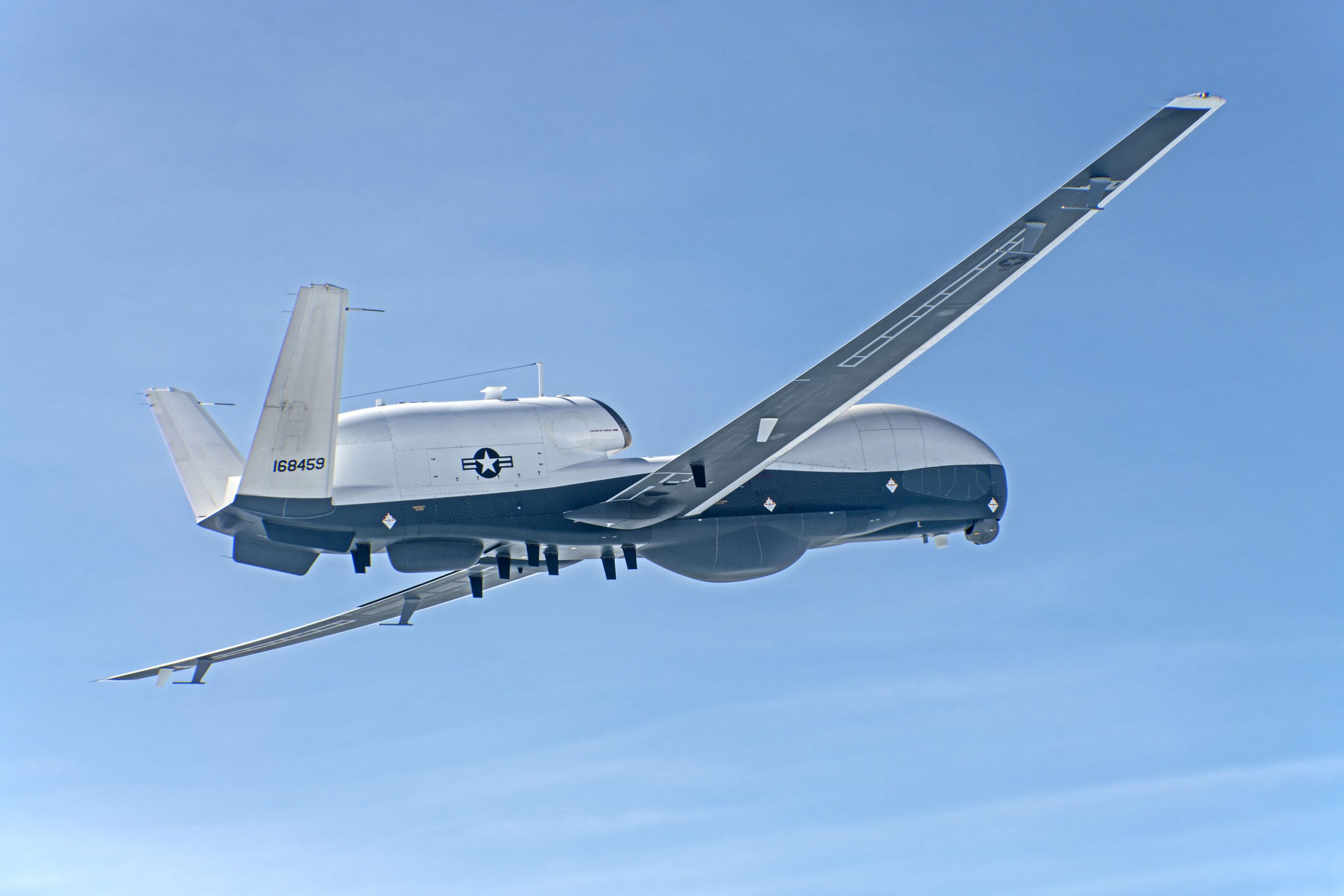
A Northrop Grumman MQ-4C Triton high-altitude long-endurance (HALE) unmanned aerial vehicle (UAV) has been flown for the first time in the platform’s new, highly upgraded multi-intelligence configuration.
Northrop Grumman announced that the maritime intelligence, surveillance and reconnaissance (ISR) HALE UAV had completed its first flight in this new configuration on July 30. It added that the milestone demonstrates “significant progress” toward the type achieving initial operational capability (IOC). Known as Integrated Functional Capability Four (IFC-4), the recently flown configuration will allow the US Navy to replace its 12-strong fleet of Lockheed EP-3E Aries II signals intelligence (SIGINT) aircraft with the Triton. It will also be employed by the Royal Australian Air Force (RAAF).
![MQ-4C Triton first flight configured for multi-intelligence role 07-21 [US Navy]](https://fullfatthings-keyaero.b-cdn.net/sites/keyaero/files/inline-images/MQ-4C%20configured%20for%20multi-intelligence%20role%20completes%20first%20flight%2007-21%20%5BUS%20Navy%5D%201.jpg)
Doug Shaffer, vice president and program manager of Triton programmes at Northrop Grumman, said: “The multi-intelligence configuration of Triton will completely revolutionise how the US Navy and [RAAF] conduct maritime patrol and reconnaissance missions. Multi-intelligence capabilities, coupled with Triton’s long-range sensors and 24-hour endurance, will enable an unprecedented amount of maritime situational awareness to inform real-time decision making at tactical to strategic levels.”
Capt Dan Mackin, program manager for the US Navy’s Persistent Maritime Unmanned Aircraft Systems Program Office (PMA-262), added: “This hugely important milestone for our Triton Multi-INT programme is the culmination of over five years of intense engineering, integration and test, and represents the efforts of the hundreds of team members who have worked so tirelessly to achieve this Herculean task.
“The Multi-INT capability that the US Navy and [RAAF] have procured through Northrop Grumman, our Naval Warfare Centers and our GFE partners is like no other - 360° [active electronically scanned array (AESA)] maritime radar, full-motion [electro-optical/infrared (EO/IR)] video streaming; high-altitude, long-endurance [SIGINT] and the pipes to send multiple data types to ships, aircraft and intelligence community ground stations allow our forces to hold adversaries at risk and protect the peace which is so vital to our national interest,” he added.
![MQ-4C Triton [US Navy/Chad Slattery] 1](https://fullfatthings-keyaero.b-cdn.net/sites/keyaero/files/inline-images/Northrop%20Grumman%20MQ-4C%20Triton%20%5BUS%20Navy%20-%20Chad%20Slattery%5D%201.jpg)
The US Navy is currently operating a pair of MQ-4C Tritons in a baseline configuration as part of an early operational capability deployment to the Pacific region. As per current plans, the type is expected to achieve IOC in 2023. In total, the US Navy plans to acquire 68 MQ-4Cs under its programme of record. It also aims to eventually maintain five 24/7 operational orbits once the type’s fleet numbers have increased and it has achieved IOC.
Australia intends to acquire a fleet of six MQ-4Cs, which will be stationed at RAAF Base Edinburgh near Adelaide in South Australia. The first example is due to be handed over to the RAAF in mid-2023, but due to delays in completing the required infrastructure, the Australian Department of Defence announced in April 2021 that the type’s in-country arrival had been pushed back to at least 2024. The MQ-4C will supplement the RAAF’s Boeing P-8A Poseidon fleet, allowing the service to retire its ageing Lockheed AP-3C Orions.
Read more about Wake turbulence cited as cause of USAF F-35A crash at Hill AFB Events round-up
This is a premium article and requires an active Key.Aero subscription to view.
I’m an existing member, sign me in!Premium Key Aero subscribers get access to read all our magazines online as soon as they leave the editor’s desk.










 Sign In








 23rd June 2025