Has anyone here been involved with or have knowledge of a fabric covered, steel tube, wood fairings & wings aircraft being recovered from the Channel?
I believe the Hurricane and Dominie have this type of construction, as well as many light aircraft types.
TIGHAR seems to be placing a lot of faith in the reported snagging by a fishing boat and the intact raising of a certain Norseman.
I’m asking this question not to question the sincerity of the fishermen, but to simply ask if it is likely an aircraft of this type of construction could survive decades in the channel and raised intact after all that time?
We have all heard of and seen photos of metal types being raised, but given this forum members knowledge of old aircraft and recovery efforts, what’s your opinion?

By: scotavia - 25th December 2018 at 10:35
Not Channel but salt water…http://www.rod-macdonald.co.uk/index.php/Scottish-Wrecks/ss-breda.html I have seen mention of engine parts but never any aircraft fabric and the cargo included Tiger Moths and other bi planes.
By: Malcolm McKay - 24th December 2018 at 22:42
That video of the crashed B24 is interesting but really tells us little of what the condition of a Norseman would be after nearly 75 years in the Channel. As has already been noted the only fabric covered surfaces on the B24 were the ailerons, elevators and rudders. The jacket in the wreck appears to be post-war. I’m curious about the light fabric appearing material – I wonder if that is actually snagged fine fishing nets.
The Miller aircraft had a fiscal 1944 serial number. The sketch of what the fisherman claims to have recovered shows the early style US insignia of white stars (without white bars) on a blue ground applied in four positions on the wings (upper and lower port, upper and lower starboard). In early June 1943 that was changed to a style with white bars and a red surrounds applied to the upper port and lower starboard only. Following problems in the Pacific with red in national markings, it was changed at the end of 1943 to delete the red surround and replace it with blue – the positioning remained the same.
National markings and serials were applied at the factory when the aircraft was manufactured so an aircraft with a fiscal 1944 serial number will have the later style star and bar with a blue surround on the upper port and lower starboard surfaces*. National markings on aircraft are important for identification – I cannot imagine a unit commander allowing an aircraft to be repainted with national markings that had been superseded nearly 18 months before. The only permitted modification of national markings would be to update them if ordered to a later style.
Regardless of the survival of the wooden structure and fabric of the wings, if the fisherman was correct in his sketch of what he found then it cannot be a Norseman from fiscal 1944. I wonder if he did recover an aircraft, then could it be a Lysander which was the same size as the Norseman, had a radial engine, big wheel spats and most importantly an all metal fabric covered construction.
*A further note is that some US aircraft carried the post 1943 stars and bars on both the lower wing surfaces as a measure to prevent friendly fire on ground attack missions – the P47 for example.
By: pogno - 24th December 2018 at 15:09
JB Wrote ‘ I believe the Hurricane and Dominie have this type of construction, as well as many light aircraft types.’
Yes the Hurricane has a fabricated substantial steel tube fuselage and centre section with aluminium wings, and you are right many light aircraft also have welded steel tube fuselages, Tiger Moths, Auster’s, Cub’s for example, although in a lighter form to the Hurricane’s, but mostly with wooden wings. The Norseman and Anson were also built like this. The Dominie on the other hand was an all wood ply box fuselage with wooden wings, the only steel was used for fittings and engine mounts.
The Wessex Archaeology underwater film does look very much as if it is a B24 which was an all metal airframe with very little fabric covering just the flying control surfaces.
In that film at 0:23 an engine appears which has been reduced to just its high strength/stainless steel components, cylinder liners, firewall and exhaust collector ring, all the aluminium has gone. High strength steel can last well in salt water.
At 0:40 another engine appears in a similar state but this one is lying in front of its tubular engine bearer frame, this is a mild steel welded structure that I would have expected to have rusted away in sea water, but it obviously this has survived.
Then at 3:07 a prop hub, blade and a engine nose case appears followed by a section in monochrome that shows what is captioned as ‘Fabric around the main Hull’ and the ‘Hull of the bomber’ but as only the control surfaces were fabric covered makes me wonder if this is something else. One possibility I put forward is that it is a decomposing rubber fuel cell, the B24 had these spaced out all along the wing.
Richard
By: Rocketeer - 24th December 2018 at 13:19
I just looked at the snorkel fabric and thought it looked the label And lining I had on mine in the 70s.
By: J Boyle - 24th December 2018 at 03:19
Just for clarification, when I asked about fabric, I was referring to aircraft covering, not clothing, harnesses, sails or other items.
Aircraft covering was a linen-like like material, treated with dope and paint. I don’t know if those coverings would help or hinder its long term preservation in salt water.
The fishermen who said they pulled up an aircraft have told TIGHAR that it was still fully covered and they apparently saw national insignia on the underside of both wings (which would be incorrect for 1944).
By: Ross_McNeill - 23rd December 2018 at 21:05
Correct Tony.
In ALSF survey detail the fabric remains were covered in more detail
https://www.wessexarch.co.uk/our-work/alsf-wrecks-seabed
Several pieces of textile were seen in different areas on the site. Some items were half-buried, while others were entangled in and around wreckage. The generally good preservation of the textiles suggests that it was buried until recently.
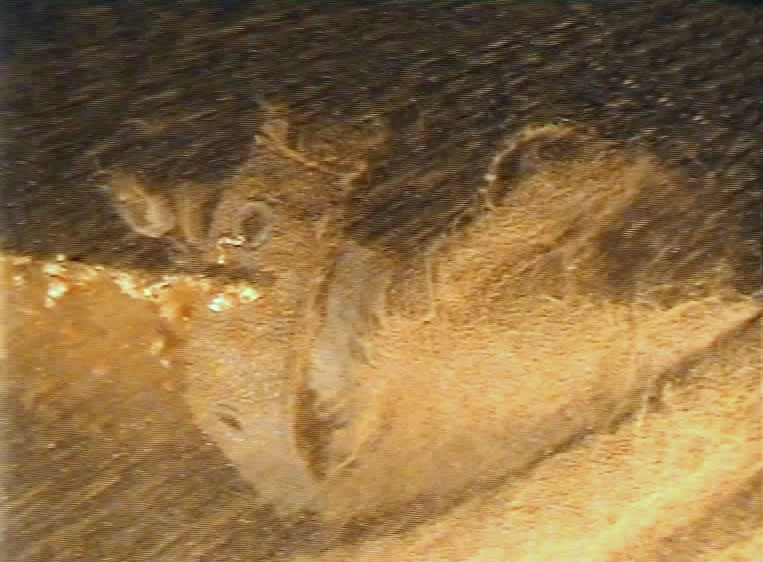
Most of the items on site were difficult to recognise. Strips of olive drab material were observed entangled around fuselage. White fabric, possibly parachute silk was also seen in several areas around the wreckage. A leather strap with buckle attached to olive or khaki fabric was stuck in a piece of aluminium fuselage on Wing 2.
To the west of the wreckage, a thin blue fabric with a white floral pattern lay half buried. This could be the remains of either a shirt or a scarf.
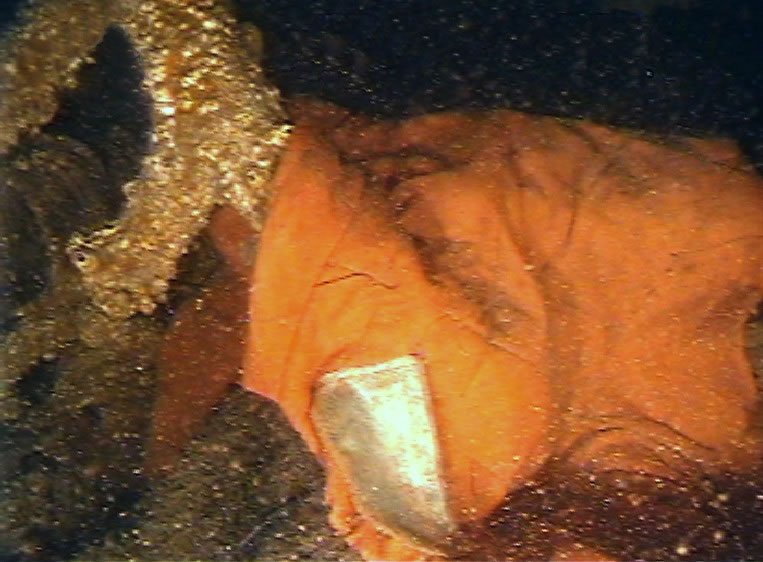
The most diagnostic item on the site was the orange lining of an olive flying parka. This was wrapped around Engine 1. A label attached to the lining is decorated with a floral border and reads “Original Snorkel Parka”.
This type of parka was not a standard military issue item during the Second World War, but looks very similar to the standard issue N-3 snorkel parka that was introduced with the formation of the USAF in 1947.
The N-3 snorkel parka or heavy flying jacket was based on prototypes tested from 1942- 1945. During the war it was common for military personnel to supplement issued clothing with privately bought items. The snorkel parka on the site could either be a test prototype, although the non-military label makes this less likely, or a private item bought by an airman to keep warm at high altitudes in the unpressurised and unheated aircraft.”
Ross
By: Rocketeer - 23rd December 2018 at 20:38
Pretty sure an original snorkel parka was not part of the B24 equipment
By: Ross_McNeill - 23rd December 2018 at 15:31
sea bed conditions are never absolute = variations occur from nothing to survival of the lightest fabric.
See this from 2005/6
https://www.wessexarch.co.uk/news/b-…r-site-wa-1001
But the facts have never sttood in the way of any Internet pundit so I expect to see this used to suit either extreme of opinion and all the shades of grey inbetween.
Ross
By: stuartm - 23rd December 2018 at 05:53
It depends on so many factors, the fabric most certainly would be gone leaving at best the underlying structure.
Other factors would depend on salinity, temperature, marine growth, currents etc.
If the a/c was ditched then a substantial amount of the a/c could still exist, if it crashed, good question.
But as it is TIGHAR I doubt anything concrete will happen, but I have been known to be wrong before!!!!!
StuartM


 Sign In








 December 23, 2018 at 12:37 am