…go supersonic in a vertical climb?
Obviously this isn’t ‘level flight’ and I’m pretty sure that a Lightning doing ‘Mach 2’ can pull-up and still be doing over ‘Mach 1’ when it reaches the vertical (if the wings don’t come off in the process) but can a Lightning already going vertical at less than ‘Mach 1’ (and I appreciate that this will be changing rapidly) break the ‘sound-barrier’?
Discuss.
(P.S: Mine’s a pint of cider.)

By: Deskpilot - 26th April 2017 at 03:02
All your questions answered. Read and learn.
Climb
“Lightning, was designed…as an intercepter fighter. As such, it has probably the fastest rate-of-climb of any combat aircraft” – Flight International, 21 March 1968[63]
The Lightning possessed a remarkable climb rate. It was famous for its ability to rapidly rotate from takeoff to climb almost vertically from the runway, though this did not yield the best time-to-altitude. The Lightning’s trademark tail-stand manoeuvre exchanged airspeed for altitude; it could slow to near-stall speeds before commencing level flight. The Lightning’s optimum climb profile required the use of afterburners during takeoff. Immediately after takeoff, the nose would be lowered for rapid acceleration to 430 knots (800 km/h) IAS before initiating a climb, stabilising at 450 knots (830 km/h). This would yield a constant climb rate of approximately 20,000 ft/min (100 m/s).[45][nb 3] Around 13,000 ft (4,000 m) the Lightning would reach Mach 0.87 (1,009 km/h) and maintain this speed until reaching the tropopause, 36,000 ft (11,000 m) on a standard day.[nb 4] If climbing further, pilots would accelerate to supersonic speed at the tropopause before resuming the climb.[24][45] A Lightning flying at optimum climb profile would reach 36,000 ft (11,000 m) in under three minutes.[45]
Lightning in flight at the Ysterplaat Airshow, Cape Town, September 2006
The official ceiling of the Lightning was kept secret; low security RAF documents would often state in excess of 60,000 ft (18,000 m). In September 1962, Fighter Command organised interception trials on Lockheed U-2As at heights of around 60,000–65,000 ft (18,000–20,000 m), which were temporarily based at RAF Upper Heyford to monitor Soviet nuclear tests.[64][65][66] Climb techniques and flight profiles were developed to put the Lightning into a suitable attack position. To avoid risking the U-2, the Lightning was not permitted any closer than 5,000 ft (1,500 m) and could not fly in front of the U-2. For the intercepts, four Lightning F1As conducted eighteen solo sorties. The sorties proved that, under GCI, successful intercepts could be made at up to 65,000 ft (20,000 m). Due to sensitivity, details of these flights were deliberately avoided in the pilot log books.[67]
In 1984, during a NATO exercise, Flt Lt Mike Hale intercepted a U-2 at a height which they had previously considered safe (thought to be 66,000 feet (20,000 m)). Records show that Hale also climbed to 88,000 ft (27,000 m) in his Lightning F.3 XR749. This was not sustained level flight but a ballistic climb, in which the pilot takes the aircraft to top speed and then puts the aircraft into a climb, exchanging speed for altitude. Hale also participated in time-to-height and acceleration trials against Lockheed F-104 Starfighters from Aalborg. He reports that the Lightnings won all races easily with the exception of the low-level supersonic acceleration, which was a “dead heat”.[68] Lightning pilot and Chief Examiner Brian Carroll reported taking a Lightning F.53 up to 87,300 feet (26,600 m) over Saudi Arabia at which level “Earth curvature was visible and the sky was quite dark”, noting that control-wise “[it was] on a knife edge”.[69]
Brian Carroll compared the Lightning and the F-15C Eagle, having flown both aircraft, stating that: “Acceleration in both was impressive, you have all seen the Lightning leap away once brakes are released, the Eagle was almost as good, and climb speed was rapidly achieved. Takeoff roll is between 2,000 and 3,000 ft [610 and 910 m], depending upon military or maximum afterburner-powered takeoff. The Lightning was quicker off the ground, reaching 50 ft [15 m] height in a horizontal distance of 1,630 ft [500 m]”. Chief test pilot for the Lightning Roland Beamont, who also flew most of the “Century Series” US aircraft, stated his opinion that nothing at that time had the inherent stability, control and docile handling characteristics of the Lightning throughout the full flight envelope. The turn performance and buffet boundaries of the Lightning were well in advance of anything known to him.[70]
Speed
Early Lightning models, the F.1, F.1A, and F.2, had a rated top speed of Mach 1.7 (1,815 km/h) at 36,000 feet (11,000 m) in an ICAO standard atmosphere, and 650 knots (1,200 km/h) IAS at lower altitudes.[22][71] Later models, the F.2A, F.3, F.3A, F.6, and F.53, had a rated top speed of Mach 2.0 (2,136 km/h) at 36,000 feet (11,000 m), and speeds up to 700 knots (1,300 km/h) indicated air speed for “operational necessity only”.[23][24][26][72] A Lightning fitted with Avon 200-series engines, a ventral tank and two Firestreak missiles typically ran out of excess thrust at Mach 1.9 (2,328 km/h) on a Standard Day;[73] while a Lightning powered by the Avon 300-series engines, a ventral tank and two Red Top missiles ran out of excess thrust at Mach 2.0.[45] Directional stability decreased as speed increased, there were potentially hazardous consequences in the form of vertical fin failure if yaw was not correctly counteracted by rudder use.[nb 5] Imposed Mach limits during missile launches protected stability;[nb 6] later Lightning variants had a larger vertical fin, giving a greater stability margin at high speed.[75]
Supersonic speeds also threatened inlet stability; the inlet’s central shock cone served as a compression surface, diverting air into the annular inlet. As the Lightning accelerated through Mach 1, the shock cone generated an oblique shock positioned forward of the intake lip; known as a subcritical inlet condition, this was stable but produced inefficient spillage drag. Around the Design Mach speed, the oblique shock was positioned just in front of the inlet lip and efficiently compressed the air without spillage. When travelling beyond the Design Mach, the oblique shock would become supercritical, and supersonic airflow would enter the inlet duct, which could only handle subsonic air. In this condition, the engine generated drastically less thrust and may result in surges or compressor stalls, these could cause flameouts or damage.
Thermal and structural limits were also present. Air is heated considerably when compressed by the passage of an aircraft at supersonic speeds. The airframe absorbs heat from the surrounding air, the inlet shock cone at the front of the aircraft becoming the hottest part. The shock cone was composed of fibreglass, necessary because the shock cone also served as a radar radome; a metal shock cone would interfere with the AI 23’s radar emissions. The shock cone would be eventually weakened due to the fatigue caused by the thermal cycles involved in regularly performing high-speed flights. At 36,000 feet (11,000 m) and Mach 1.7 (1,815 km/h), the heating conditions on the shock cone would be similar to those at Sea Level and 650 knots (1,200 km/h) indicated airspeed,[nb 7] but if the speed was increased to Mach 2.0 (2,136 km/h) at 36,000 feet (11,000 m), the shock cone would be exposed to higher temperatures[nb 8] than those at Mach 1.7. The shock cone was strengthened on the later Lightning F.2A, F.3, F.6, and F.53 models, thus allowing routine operations at up to Mach 2.0.[76]
The small-fin variants could exceed Mach 1.7,[nb 9] but the stability limits and shock cone thermal/strength limits made such speeds risky. The large-fin variants, especially those equipped with Avon 300-series engines could safely reach Mach 2, and given the right atmospheric conditions, might even achieve a few more tenths of a Mach. All Lightning variants had the excess thrust to slightly exceed 700 knots (1,300 km/h) indicated airspeed under certain conditions,[45][73][78] and the service limit of 650 knots (1,200 km/h) was occasionally ignored. With the strengthened shock cone, the Lightning could safely approach its thrust limit, but fuel consumption at very high airspeeds was excessive and became a major limiting factor.[nb 10]
By: Oxcart - 25th April 2017 at 12:51
I’d imagine a lightning would easily accelerate to Mach 1 going vertically, and maybe even Mach 2 given the height. The hole at the bottom of the vertical would be very impressive I’d think….
????
By: Flanker_man - 25th April 2017 at 09:06
Not really answering the original question – but wasn’t one of the Lightnings at Thunder City being prepared for an attempt at the Time-to-Climb records currently held by the Russian P-42 (Flanker) ???
What ever became of that attempt ???
P-42…….
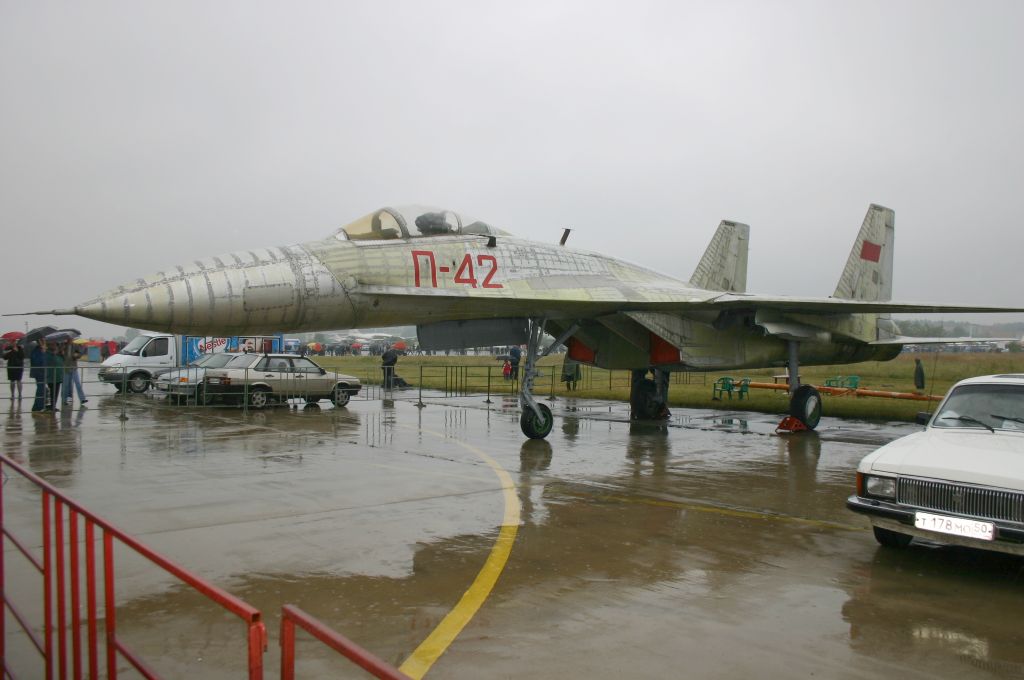
Ken
By: Piston - 24th April 2017 at 22:53
I’d imagine a lightning would easily accelerate to Mach 1 going vertically, and maybe even Mach 2 given the height. The hole at the bottom of the vertical would be very impressive I’d think….
By: Rocketeer - 24th April 2017 at 14:34
‘In the vertical’?! Weird way of posing a question! This could be taken as…..standing the lightning on its tail (i.e. perpendicular) can it go supersonic….nope. Or it could be taken as, can the Lightning go supersonic in a climb? Well, yes…… if its shallow enuff! Same goes for Concorde.
By: Oxcart - 24th April 2017 at 13:53
Aircraft with the most delusional fan base? Aircraft type with the highest number of examples littering the North Sea? :highly_amused:
Most over-rated design???
By: John Aeroclub - 24th April 2017 at 10:00
Mildenhall 1988


By: steve_p - 23rd April 2017 at 10:45
Even watching ‘rotation’ take offs was really exciting,I was born and brought up near Leuchars 🙂
Once saw a Lightning use it’s hook when landing at Leuchars. That was really exciting too.
By: hampden98 - 22nd April 2017 at 19:46
As we are talking supersonic aircraft, to add a theoretical fly in the ointment,
could Concorde achieve supersonic flight in the vertical?
Empty and with full power?
By: cdmurray - 21st April 2017 at 20:47
Everything you need to know can be found in the database here http://www.lightnings.info
By: Fouga23 - 21st April 2017 at 19:36
How many crashed out of how many built?
By: AlanR - 21st April 2017 at 18:49
Surely a more appropriate question would be “Could the EE Lightning…” given that none fly.
What’s the latest on “BBD” ? I believe the last time it flew was 2014 (?)
By: Keefy041 - 21st April 2017 at 18:15
Think Delusional is a bit harsh !
Yes a lot did crash and yes they had a very short range, but as a display aircraft they were impressive.
I think anyone who saw the two lightnings depart Mildenhall air fete in 1988 , especially knowing they’d never see it again , could not fail to be impressed.
By: bazv - 21st April 2017 at 13:53
Aircraft with the most delusional fan base?
You obviously never saw one display 😉
Even watching ‘rotation’ take offs was really exciting,I was born and brought up near Leuchars 🙂
By: Meddle - 21st April 2017 at 13:24
Did the Lightning get any official records at all?
Aircraft with the most delusional fan base? Aircraft type with the highest number of examples littering the North Sea? :highly_amused:
By: WP840 - 20th April 2017 at 21:47
A few points from Wiki (sorry):
The Lightning’s optimum climb profile required the use of afterburners during takeoff. Immediately after takeoff, the nose would be lowered for rapid acceleration to 430 knots (800 km/h) IAS before initiating a climb, stabilising at 450 knots (830 km/h). This would yield a constant climb rate of approximately 20,000 ft/min (100 m/s).[45][nb 3] Around 13,000 ft (4,000 m) the Lightning would reach Mach 0.87 (1,009 km/h) and maintain this speed until reaching the tropopause, 36,000 ft (11,000 m) on a standard day.[nb 4] If climbing further, pilots would accelerate to supersonic speed at the tropopause before resuming the climb.
The official ceiling of the Lightning was kept secret; low security RAF documents would often state in excess of 60,000 ft (18,000 m). In September 1962, Fighter Command organised interception trials on Lockheed U-2As at heights of around 60,000–65,000 ft (18,000–20,000 m), which were temporarily based at RAF Upper Heyford to monitor Soviet nuclear tests.
In 1984, during a NATO exercise, Flt Lt Mike Hale intercepted a U-2 at a height which they had previously considered safe (thought to be 66,000 feet (20,000 m)). Records show that Hale also climbed to 88,000 ft (27,000 m) in his Lightning F.3 XR749. This was not sustained level flight but a ballistic climb, in which the pilot takes the aircraft to top speed and then puts the aircraft into a climb, exchanging speed for altitude.
By: Oxcart - 20th April 2017 at 14:59
Did the Lightning get any official records at all?
By: ZRX61 - 20th April 2017 at 02:21
If climbing further, pilots would accelerate to supersonic speed at the tropopause before resuming the climb. on full re-heat topping out at about 65,000 feet on a good day. There are records of Lightning trials doing dummy intercepts of Upper Heyford Lockheed U2s in excess of 65.000 feet.
Isn’t the record 88,000ft?
By: TonyT - 19th April 2017 at 09:55
Amazingly; it could run-out of fuel faster than anything on the planet!
That was British fuel efficiency, they realised the damned things leaked fuel so badly, it made sense to try and burn it as quickly as possible, thus not wasting fuel.
By: Fouga23 - 18th April 2017 at 20:32
Amazingly; it could run-out of fuel faster than anything on the planet!
F-104?


 Sign In








 April 17, 2017 at 2:53 am