I have noticed in several pictures of the complete Wellington at Brooklands, that there appears to be a second Wellington fuselage on display there. Can anyone tell me the origin of this Wellington section, and if the museum has any future plans for it?
Cheers. 🙂

By: Creaking Door - 9th July 2014 at 23:59
Possibly the propeller blades were left bent because of the impossibility of straightening them; better to have original bent blades than replace them with straight or dummy blades?
It goes back to the old argument of what we are ‘preserving’; an actual historically significant aircraft with a notable combat record or a collection of replacement material with a few original components?
Personally I like to see the airframe of R for Robert without it being covered in new fabric; I like to see the corrosion evidence of decades underwater. If the whole airframe was covered in new fabric people would be saying (quite wrongly) how easily it could have been made airworthy and asking why it wasn’t done?
By: Seafuryfan - 9th July 2014 at 22:36
Great to see this Wellington on the boards again. I know that the props remain in an ‘as found’ condition (bar the paint, which makes them look even more out of place), but to me they just don’t fit in with the rest of the airframe presentation. It’s similar in my eyes to, say, keeping a piece of airframe squashed due to impact damage with the loch.
If I could voluntarily work on something like this, I would do. Perhaps sometime in the future.
By: John Green - 9th July 2014 at 12:04
I think that it was the car manufacturer Mercedes that brought about significant changes to the Brooklands site. Some degree of irony there !
As the first, and therefore the most important motor racing and aviation development site in this country and possibly the world, Brooklands should have been the recipient of large amounts of taxpayers cash the intention of which should have been to turn Brooklands into a showcase of British motor racing and aviation. A superb opportunity was lost – for ever.
Under the control of Mercedes, the entire site, which admittedly was fragmented, was converted into one – more or less – huge industrial complex. The last portion of runway – about 400 yards or so – disappeared. I was one of the last to land and depart on this runway on 11th July, 1993 in a PA38 after attending what was, I believe, the last ever ‘fly in’ supported by the Museum.
One interesting item concerned the Brooklands Military History Society which met every month in the original control tower. One of the members unrolled a huge German navy battle ensign on the boardroom sized table. This was the battle ensign of the German heavy cruiser Prinz Eugen which ultimately met a rather sad end for a fighting warship. It was taken to the Bikini Atoll in the Pacific and used as a target along with many others by the Americans conducting air dropped, atomic weapon tests.
In another area of the Brooklands site was a medium sized storage warehouse occupied by a company refurbishing and re- manufacturing Ford GT40 and AC Cobra sports cars. The owner was also an aviation enthusiast and was in the final stage of completing the return to flight of a Hurricane. I think that this Hurricane was registered as G-HURR, although I can’t be sure.
Just in front of the Hurricane was the fuselage of either a Tempest or Typhoon that had been recovered from India. In the bottom of the cockpit lay the skeleton of a long dead snake plus a bit of what looked like jungle debris, twigs, leaves etc.
Whether they are still there or not I don’t know but, there was plenty of evidence of WW2 including air raid shelters, ammunition storage, signage and other indicators of what had been a very busy wartime airfield. The arrival of Wellington R for Robert established yet another link in the chain that now connects the events of over 100 years of intense use and activity.
By: Moggy C - 9th July 2014 at 07:37
One of the girders of the hangar still carries cannon shell damage from a Luftwaffe attack.
Moggy
By: Creaking Door - 8th July 2014 at 23:47
Yes, R for Robert was dragged up from the bottom of Loch Ness…
…the building just looks like it was!
The building is an exhibit in its own right having been used in Wellington production during the war. I think there were plans to restore it when it was moved from its current location (on part of the Brooklands motor racing track); does anybody know if this is still the plan?
By: Moggy C - 8th July 2014 at 23:12
Remember too that most of the restoration team were actually ex-Vickers WW2 employees, so though partly a rebuild, it was done by the original folks, so more ‘late production’
Moggy
By: j_jza80 - 8th July 2014 at 22:54
Some great photos there, especially of the walk through exhibit. I had no idea it was partially skinned. 🙂
Another thing the photos show is the poor condition of the building itself!
By: Creaking Door - 8th July 2014 at 22:43
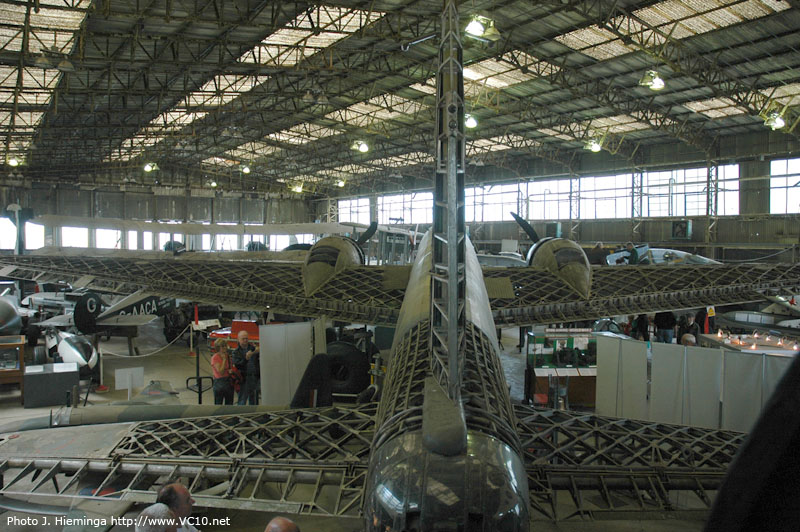
I think you can actually see the new-build geodetic in Archer’s photograph of the nose section; the darker diagonal band from the cockpit rearwards is almost certainly original. Possibly not all the ‘shiny’ geodetic is new-build (some may have been cleaned) but the nose must have been badly damaged in the ditching and the front turret was apparently missing when R for Robert was raised.
This is no criticism of the restoration; the new-build material is ‘original’ in its own right and the weight of the front turret requires structural integrity.
By: Archer - 8th July 2014 at 20:23
This is the inside of the walkthrough-Wellington: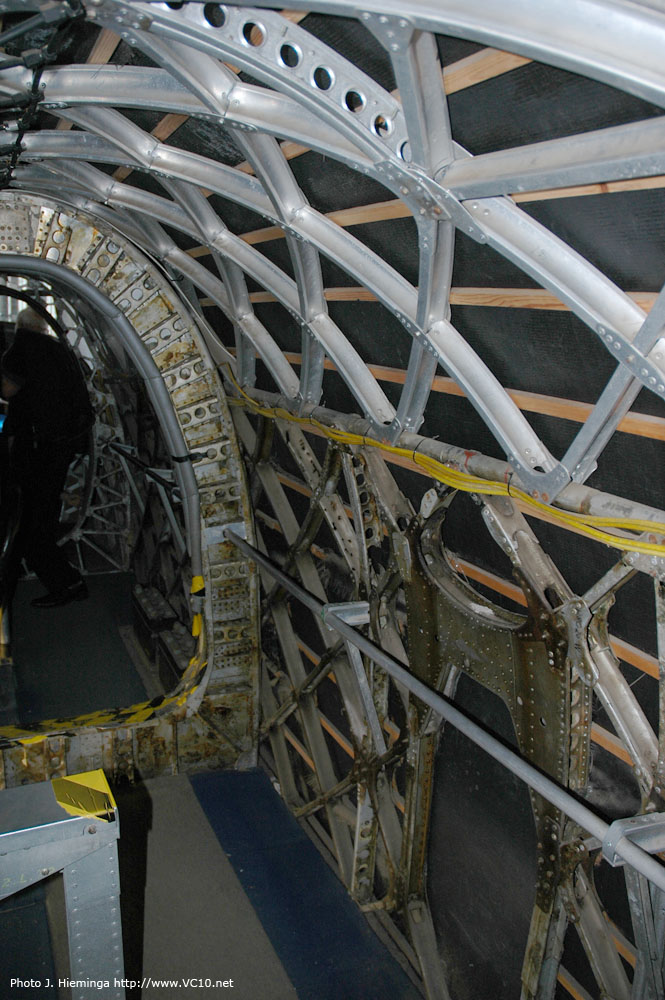
And I’ve posted these before, but they show the structure. I think that most of the new tubing is in the covered section of the rear fuselage.
By: Mike J - 8th July 2014 at 19:21
If only there were some wings somewhere that it could be united with….
East Kirkby…? 🙂
By: Chitts - 8th July 2014 at 17:58
http://www.youtube.com/watch?v=7jR_eXWjv6c
The TV program from 1985 is now on youtube.
By: Zidante - 8th July 2014 at 08:29
If only there were some wings somewhere that it could be united with….
By: ollieholmes - 8th July 2014 at 01:06
From memory of my visit the other day the walk through is a mixture of parts from R for Robert and neew manufactured parts according to the information board.
By: Creaking Door - 8th July 2014 at 00:07
All the parts are genuine? Surely there was some new-build geodetic in R for Robert (and the ‘walk-through’).
By: Arabella-Cox - 7th July 2014 at 20:38
The walk through Wellington at Brooklands is not a mock up but a genuine Wellington fuselage it was found in use as a garden greenhouse, “Halls” the garden furniture supplier gave a greenhouse to the gardener for the fuselage who then donated it to Brooklands Museum.
One of the “D” rings on R for Robert was found to be so badly corroded that it was swapped for one of the greenhouse “D” rings, all the parts used are genuine.
By: John Green - 7th July 2014 at 18:06
I lived in Weybridge, just about a mile or so from the Vickers plant. Barnes Wallis’ office was still there, and in daily use, I believe, by the great man.
A family friend, Mrs. Joan Howe, had been employed at Vickers, building Wellingtons during the war. When R for Robert arrived, as one of a band of volunteers, she worked tirelessly on the re-construction. I know that she would be tickled pink to know that she and her work on R for Robert, had been remembered via this forum.
She is still very active and still going strong.
By: TEXANTOMCAT - 7th July 2014 at 16:39
Ahh, that article got me into aircraft preservation – if you remember the ‘Its Your Round’ article – £5 bought you an original demilled .303 from the aircraft – I saved up my pocket money and wrote a nice letter to Robin Holmes – he sent me five with a very nice letter! Bless him! Still have the letter and the rounds – I recall it was to raise funds to get the nose turret which was recovered separately.
I’ve never forgotten that act of kindness…helped inspire me to get involved with restoring warbirds (my own!!) and starting my own museum…..was that really nearly 30 years ago?
TT
By: Moggy C - 7th July 2014 at 16:16
I seem to recall that Issue One of Flypast featured the discovery of R Robert as its cover story.
I suppose I always hoped it would be recovered and rebuilt to flying status.
Moggy
By: mike currill - 6th July 2014 at 23:47
If the Wellington was R for Robert, this was the airframe recovered from Loch Ness about 35 or more years ago. At the time of the restoration, the decision was taken to leave some of the fuselage exposed for educational purposes.
Good grief, is it really that long since it was raised? I remember the euphoria at the time. Seeing the structure naked makes it easy to understand how they took so much of a beating and still came home.
By: Junk Collector - 6th July 2014 at 20:58
I visited Brooklands many years ago before it was fully open, the Wellington was then in one piece and on it’s legs, I was lucky to be able to go in it by helping to carry some of the radio equipment in to help. Anyway the section was there at the time and I was told by one of the team, it was a section that had been retrieved from somewhere, and they had used the fuselage frames from inside because the ones from R Robert were too corroded to take the weight, and it would be used as a walk through exhibit.


 Sign In








 July 6, 2014 at 12:53 pm