
By: Bruggen 130 - 5th March 2014 at 19:33
The answer to the original question may simply be because it could be done . The mounting allowed the tank to be fitted either way around without modification .
You might be right, if it can go on either way then you can bet someone will get it wrong, I’ve seen car top boxes with the flat end facing forward more than once.:D
By: OHOPE - 5th March 2014 at 18:37
The answer to the original question may simply be because it could be done . The mounting allowed the tank to be fitted either way around without modification .
By: Duggy - 5th March 2014 at 16:12
Gen. Douglas MacArthur’s predicament in May 1943 is very clear: “This will be a long war if for every division I have facing the enemy I must count on a second division in hospital with malaria and a third division convalescing from this debilitating disease!” It appears that the general was not at all worried about defeating the Japanese, but was greatly concerned about the failure to defeat the Anopheles mosquito! 60,000 U.S. troops died in Africa and the South Pacific from malaria. U.S. Forces could succeed only after organising a successful attack on malaria.
However all the photos I have seen of this utilize a hopper.?


By: JDK - 5th March 2014 at 10:57
There was spraying against mosquitoes carried out on the India/Burma front, an early example of the use of DDT, because of the high sickness rate amongst servicemen in the theatre. However, my understanding is that this was carried out by the RAF, and a P-40 would not have been a particularly useful aircraft for the job, being a bit too fast and perhaps(?) that’s a small container for the job. Certainly Lysanders were used elsewhere, and Ansons, so I suggest these were the types used in SEAC as well.
Two Lysanders were used for anti-malarial dry dusting in Corsica. The IWM image in Bruce Robinson’s “Lysander Special” shows a boxy bespoke dispenser, and says the observer’s cockpit was used as a hopper.
So all points away from that theory, for what it’s worth.
When researching captions for weaponry in our A-36 book, there were some pretty weird and wonderful local lash-ups in the far east; and I also suspect bentwingbomber may well know but has nothing to prove on the forum, so I’d look for further data on early Napalm use. However Stepwilk’s point on dates is also pertinent, and may then lead to something like – but not – napalm; a fuel bomb?
Regards,
By: cabbage - 5th March 2014 at 07:02
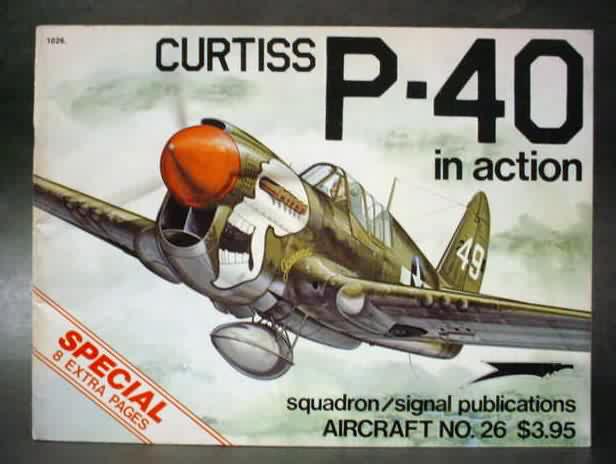
All it says, on the caption to a picture inside, is that it is unusual with the drop tank fitted backwards. The picture is the same as in post #1.
Cabbage
By: Chad Veich - 5th March 2014 at 02:53
The Squadron/Signal “Curtiss P-40 in Action” book has an illustration of this aircraft on the cover. There is some mention of the backwards drop tank in the description of the cover but I do not recall exactly what was said about it.
By: hampden98 - 4th March 2014 at 18:54
Interesting pic of the P40 mail carrier. The cowlings have been replaced and the Shark Mouth repainted. You can see the mouth from the original nose art still exists at the edge of the cowling.
All of these theories are great but why on backwards? I don’t buy the accuracy theory. Wouldn’t the tank hit the aircraft as it dropped away with the thin end near the nose?
Good fun debating.
By: Bager1968 - 4th March 2014 at 04:09
P-40s were in front-line use in the CBI theatre until the end of the war.
By: Stepwilk - 4th March 2014 at 03:33
The many commenters theorizing that this was a napalm dispenser need to realize that napalm (developed at my old university, Harvard) came pretty late to the war. Its very first recorded use was March 1944. Would a P-40 have been dispensing it that late? (I don’t know; you tell me.)
By: Duggy - 3rd March 2014 at 18:07
I have never seen napalm tanks put on backwards, all other aircraft had them facing normally.
Some P-40 drop tanks were converted to carry the mail, but still not backwards.


By: Lazy8 - 3rd March 2014 at 13:56
Since the suggestion it was for spraying was mine, I guess I need to comment. I did say that my memory suggested it was a lash-up and that I couldn’t find evidence, and I still can’t (not that I’ve put much effort into looking). I’m also happy with the idea of it being for napalm. Given that other converted drop-tanks were used for spraying insecticide, and similar-size tanks were used for laying smoke-screens, I don’t see why my suggestion is a non-starter (it’s certainly not “obvious” to me), but I’ll happily bow to superior knowledge.
By: Graham Boak - 3rd March 2014 at 13:03
Just to be clear we do not have evidence: we have a statement by one individual. We have another statement by another individual suggesting that it was used for spraying. I’m certainly more convinced by the napalm suggestion, but hard evidence is so far lacking.
By: merlot - 3rd March 2014 at 12:26
Just to be clear we have evidence that tanks were used like this for Napalm from BWB and a tank that matches that description (c/w fuse). Why don’t we go with that?
Insecticide would be a none starter with that tank for obvious reasons
By: Simon Beck - 3rd March 2014 at 04:11
Not sure if this adds anything to the overall topic here but I built a 1:72 scale P-40E
some years ago and the instructions said to mount the drop tank pointed end first?
I figured there must have been some mistake with the instructions but apparently not…
By: Graham Boak - 2nd March 2014 at 19:04
There was spraying against mosquitoes carried out on the India/Burma front, an early example of the use of DDT, because of the high sickness rate amongst servicemen in the theatre. However, my understanding is that this was carried out by the RAF, and a P-40 would not have been a particularly useful aircraft for the job, being a bit too fast and perhaps(?) that’s a small container for the job. Certainly Lysanders were used elsewhere, and Ansons, so I suggest these were the types used in SEAC as well.
By: bentwingbomber - 2nd March 2014 at 18:27
The thing on the back is the fuse for the napalm
By: tbyguy - 2nd March 2014 at 18:25
IIRC, that unit was in the Aleutians.
Anyone who has been up to Alaska or Northern Canada in the summer will testify how bad the insects are, so a spray system makes sense.
There looks like something (a small windmill prop?) mounted on the front (back) of the tank.
Umm…no. The 80th Fighter Group (“Burma Banshees”) never served in the Aleutians.
By: J Boyle - 2nd March 2014 at 18:18
IIRC, that unit was in the Aleutians.
Anyone who has been up to Alaska or Northern Canada in the summer will testify how bad the insects are, so a spray system makes sense.
There looks like something (a small windmill prop?) mounted on the front (back) of the tank.
By: bentwingbomber - 2nd March 2014 at 18:12
From what I have been told it was reversed when filled with napalm.
They were turned so they were more accurate to drop.
I seem to recall talking to a guy in the hangar one day who had been crew in the CBI
By: Lazy8 - 2nd March 2014 at 16:33
Interesting about using it as a spraying system. Any ideas why it would be used. Outbreak of mosquito perhaps?
That’s what I was thinking. I’m sure I read something about it, but years ago and I’ve no idea where. As usual when I have such thoughts, Google is no help…


 Sign In








 March 2, 2014 at 10:28 am
