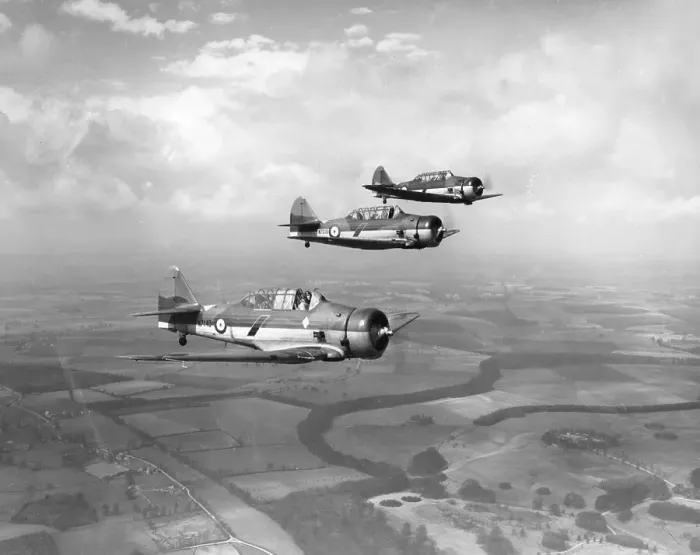
Do any of you knowledgeable people know if the Yale and the Harvard I shared the same forward fuselage frame? I was looking at pictures on the Legend of Aces site http://legendofaces.com/na_64_3456/3456_main.htm and the frame of their Yale looks incredibly similar to the Harvard I frame (which is different to the frame used on the Harvard II). I believe the drawing number for the Harvard forward frame is 49-31105 if that helps.
Anne

By: 43-2195 - 2nd November 2013 at 03:30
The major problem at the end of the day though, is you would spend at least two to three times what the finished machine fetch on the market. For example, it is reputed that certain collector bought a Wirraway recently at significantly less than half what it cost to rebuild back in the 90’s, and it was a very good, very complete project to begin with.
Recovering, restoring, owning, displaying and flying warbirds. Is NOT a profitable venture. Yes, very large numbers are involved, but that is NOT profit. If the Mark I Harvard floats your boat, and your using your own money. By all means go ahead and enjoy yourself. You are doing the world a favour and a very small percentage of the people on the planet will be grateful to you. And, yes, some idiots will critisize you. “Such is life”.
By: derekbu - 1st November 2013 at 12:26
It also looks like someone has been quietly swapping parts out, as these look suspiciously like Ceres tailplanes with their wider leading edges.
Mark, you might be right that parts are being swapped out, but he tailplane hanging on the wall is standard Wirraway. Here’s a sketch of the differences:
[ATTACH=CONFIG]222511[/ATTACH]
Regards,
Derek
By: derekbu - 1st November 2013 at 12:05
The North American Aviation part number system is a little different, but once understood, is quite simple. The dash number, eg -31105 is the basic number for the item in the aeroplane and can be broken down even further by, IIRC, the first number relating to the grouping of the different major assemblies.
Here’s a link to a list of all the different major assemblies according to the NAA numbering scheme:
http://virtualwirraway.blogspot.nl/2012/08/the-cac-wirraway-was-training-and.html
Regards,
Derek
By: Avro Avian - 23rd June 2013 at 12:59
Of course other than money, parts and time, such an outcome would seem relatively straight forward to achieve in Australia or the US under more liberal certification arrangements?, but the type is not likely to generate the same interest as it would in the UK?
With a bit of judicious research into drawings, careful selection of parts and a data plate identity, I reckon it would be possible to build one to Standard Category in the US. See the Type Certificate here.
The fabric side panels aren’t a problem; it’s a matter of ponying up the cash to have the rollers made for the stringer material.
I just happen to have a spare x-rayed Wirraway rear fuselage frame at home too…. 😀
The major problem at the end of the day though, is you would spend at least two to three times what the finished machine fetch on the market. For example, it is reputed that certain collector bought a Wirraway recently at significantly less than half what it cost to rebuild back in the 90’s, and it was a very good, very complete project to begin with.
By: mark_pilkington - 23rd June 2013 at 07:02
Terrific post Mark! 🙂
I haven’t been to Port Moresby at all, let alone to have a look in the Museum there. Unfortunately, the collapse of the airline I was working for in 2001 stole that opportunity away. 🙁
I can only go by what other people have told me and from what I remember (fraught, I know!!) from photos I have seen of it in much happier times, as it has deteriorated significantly now.
There are some pics of A20-13 online:
http://www.pacificwrecks.com/aircraft/wirraway/A20-13.html
http://www.adf-gallery.com.au/gallery/Wirraway-2A20-13
But they are not detailed enough to confirm CA-1 configuration?

It also looks like someone has been quietly swapping parts out, as these look suspiciously like Ceres tailplanes with their wider leading edges.

I cant recall who it was who advised me it wasn’t a CA-1, (Mr IW most likely?) but of course until its confirmed I’m only relying on rusty memory.
The other idea I have had mulling over in amongst the detritus in my head, is possibility of any wrecks/remains in either South Africa or Zimbabwe. From memory, a lot of the Harvard Mk 1s were sent there as a part of the ETS.
I think a number of us have probably had those thoughts and discounted them as likely to have been scrapped long ago, but South Africa had those Ventura’s sitting on farms for years and elsewhere in Africa there were those early Fireflies waiting to be recovered until relatively recent times.
Either way, to me, the project would certainly be possible, it just needs someone with the time, ca$h and madness to do it. I’ve got the madness, but not the other two prerequisites….:D
I know the UK CAA doesn’t have an experimental category and that would mean some creative paperwork and an ID would need to be established for a hybrid T-6 to claim to be a Harvard Mk I, but given (I recall?) that a Tora “Zero” flew in the UK, surely a T-6 “modified” (even with steel tube fuse and fabric side panels) could be flown in the UK?
Of course other than money, parts and time, such an outcome would seem relatively straight forward to achieve in Australia or the US under more liberal certification arrangements?, but the type is not likely to generate the same interest as it would in the UK?
Equally however, it would be possible to do the same thing in the USA and produce a very nice looking pre-war BC-1 or SNJ-1?
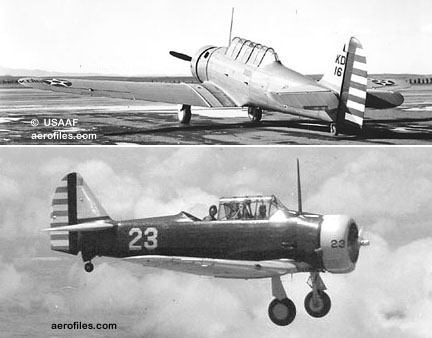
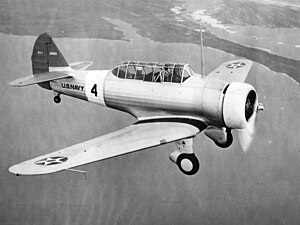
Although I would be happy enough to own one of the skytypers SNJ-2s and have it in the pre-war USN colours. (although one of those in two tone British camo and yellow undersides with roundels and RAF serial would easily pass as a Harvard Mark I on the Duxford flightline for most people in anycase, despite its solid side panels, tapered wing and full monocoque rear fuse and would be a fairly simple CAA paperwork).


Regards
Mark Pilkington
By: Avro Avian - 23rd June 2013 at 03:00
Terrific post Mark! 🙂
(Paul have you visually confirmed A20-13 is actually a CA-1, as had heard Tom King has simply repainted a much later example to represent that early identity)
I haven’t been to Port Moresby at all, let alone to have a look in the Museum there. Unfortunately, the collapse of the airline I was working for in 2001 stole that opportunity away. 🙁
I can only go by what other people have told me and from what I remember (fraught, I know!!) from photos I have seen of it in much happier times, as it has deteriorated significantly now.
The other idea I have had mulling over in amongst the detritus in my head, is possibility of any wrecks/remains in either South Africa or Zimbabwe. From memory, a lot of the Harvard Mk 1s were sent there as a part of the ETS.
Either way, to me, the project would certainly be possible, it just needs someone with the time, ca$h and madness to do it. I’ve got the madness, but not the other two prerequisites….:D
By: mark_pilkington - 23rd June 2013 at 02:30
Ah, but not all Wirraways are same! 🙂
There are six different models of the Wirraway – the CA-1, CA-3, CA-5, CA-7, CA-9 and the CA-16. The CA-1 fuselage frame is the closest to the Harvard Mk 1. The CA-3 and subsequent forward fuselage frames have larger tube diameters, especially the longeron tubes.So, back to our hypothetical Harvard Mk 1 build. I know of only three surviving CA-1 frames. Two airframes are pretty well complete and are in museums – one in Port Moresby and the other at Moorabin. The only other frame I am aware of is bare.
Nonetheless, I would still like to see a Harvard Mk 1 brought back to life. 🙂
*Now where are my winning lotto tickets….*
I would agree the CA-1 as the earliest of the Wirraway family, is closest to its NA-16 parent, and therefore its Harvard Mark I sister, the CA-1 also had the ribbed skin fin which was deleted in later model Wirraways.
https://en.wikipedia.org/wiki/North_American_NA-16
While the CA -1 is the closest surviving Wirraway variant I’m not sure I would be keen to see one of the two complete survivors or any other complete Wirrway consumed into a Harvard I reproduction, nor would I be keen to see a complete Yale similarly “consumed”.
I personally think you could create a quite convincing flying reproduction using a T-6 airframe as the starting point and substituting in certain other essential components.
(Paul have you visually confirmed A20-13 is actually a CA-1, as had heard Tom King has simply repainted a much later example to represent that early identity)
Of course a museum in Sweden consumed both a Wirraway and a Yale to create a very convincing SK-14 (NA-16-4M) static reproduction in the 1980s.

With the Wirraway donating its fuselage and the Yale donating its fixed undercarriage centre-section and wings (I understand the Wirraway wing later returned to Australia).
Of course a complete and original NA-16 still survives in Hondura’s although sadly preserved in outdoor display.
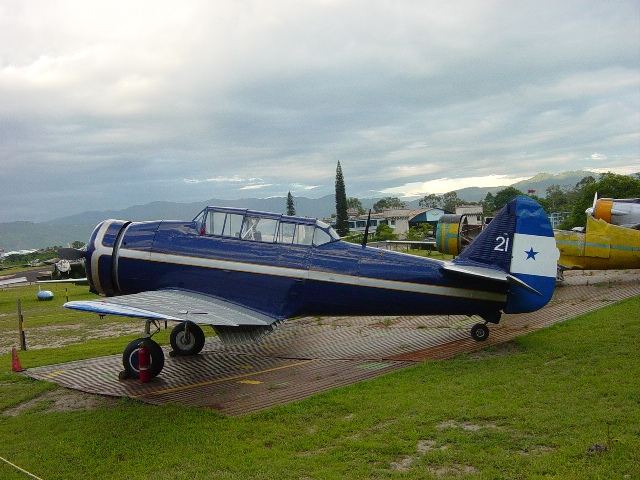
Surely a flying Harvard Mark I hybrid project could be achieved using the following?
T-6 Forward Fuselage steel frame
Wirraway rear fuselage steel frame (or new build based on Wirraway)
Wirraway rear fuselage monocoque (or new build based on Wirraway)
Wirraway fuselage cap strips and fabric side panels (or new build based on Wirraway)
T-6 and Wirraway capstrip castings (or new build based on Wirraway)
T-6 fuselage furnishings including flight controls (Rudder pedals/ Control Column yoke)
New build Harvard I instrument panel and electrical side boxes
T-6 windscreen and sliding and fixed rear Canopies
T-6 Wing Centre-Section
T-6 tapering trailing edge wing outer panels (with new rounded wingtips)
T-6 Tail group with modifications as required to fit Wirraway rear fuselage frame.
SNJ-2 Square bottom Rudder (or T-6 modified based on SNJ-2)
T-6 QEC engine and prop ie Firewall forward
T-6 undercarriage
Someone questioned my earlier post relating to using T-6 Windscreen and sliding canopies and rear framed canopy, the Wirraway windscreen has curved lower mounting frame, and the canopies do not have the same vertical dividing bars ie they are substantially different in anycase – and hence the T-6 style is much closer to the Harvard I style.
Most if not all of the above would seem do-able?
The T-6 is obviously close enough to its NA-16 ancestor to form the basis of a Harvard hybrid.
While a pursist museum outcome would seek Wirraway or Yale Wing outer panels with straight trailing edge and round wingtips, for a flying outcome I would argue a set of T-6 tapered trailing edge wing panels, and new made round wing tips would suffice.
There is already a convincing Boomerang in the USA based T-6 parts, there are also numerous T-6 conversions into convincing NA-64, NA-44 replicas and of course the Tora Tora Tora replicas.
There are restorers in Australia repairing Wirraway rear fuselage frames (I’m sure one could be manufactured new – even to incorporate mounts to suit the T-6 tail group).
Similarly they are making new build capstrip sets, castings and rear fuselage monocoques.
Fabric side panels are being repaired, I have no doubt the same restorers could fabricate new ones.

[img]http://www.rafmuseumphotos.com/image/harvard_i_aircraft_of_2_sfts_raf_4…]

IE A Harvard Mark I flying reproduction could be created from plentiful T-6 parts sourced from the USA ie Lance Aero tc, and incorporate the essential visible differences of the square rudder from the SNJ-2 and the steel tube rear fuselage and fabric side panels from the Wirraway.


The very light framing of the Wirraway canopies can be compared easily in the photo above, the curved lower frame is not so obvious in that photo but is in the photo below.

Regards
Mark Pilkington
By: Avro Avian - 23rd June 2013 at 00:25
First catch your Wirraway, of course
Ah, but not all Wirraways are same! 🙂
There are six different models of the Wirraway – the CA-1, CA-3, CA-5, CA-7, CA-9 and the CA-16. The CA-1 fuselage frame is the closest to the Harvard Mk 1. The CA-3 and subsequent forward fuselage frames have larger tube diameters, especially the longeron tubes. I know this because I have physically tried to offer up a T-6 up lock support fitting and they do not fit. Also, the later fuselage alloy fittings do not fit the early CA-1 frames for the same reason. The CA-16’s were a combination new build airframes and modified earlier models, incorporating strengthening of the wings and centre section for the carriage of bombs and the addition of dive brakes. The dive brake setup was incredibly dangerous and ended up being de-activated in service. It relied on the pilot to stop the normal flap extension prior to the last portion of travel of the flap actuator which “popped” the dive brakes. One can imagine if you are busy in a crowded circuit, a momentary lapse of attention during operation of the flaps could having alarming, and quite often, fatal consequences.
So, back to our hypothetical Harvard Mk 1 build. I know of only three surviving CA-1 frames. Two airframes are pretty well complete and are in museums – one in Port Moresby and the other at Moorabin. The only other frame I am aware of is bare.
Nonetheless, I would still like to see a Harvard Mk 1 brought back to life. 🙂
*Now where are my winning lotto tickets….*
By: Graham Boak - 14th June 2013 at 14:44
I think you will find the Harvard mk 1 is quite closely related to the Wirraway and BC-1 which along with the BT-9 had steel tube rear fuselages (even through to the SNJ-1), where as while the Yale has a similar early wing, it has a full monocoque rear fuselage more in keeping with the later SNJ-2 & evev T-6/SNJ-3 fuselages.
However the Yale does use the early wing, but with fixed gear not retractable gear.
I personally think a Wirraway fuselage frame would form a better Harvard mark I starter kit than a Yale, even though T6 windscreen/canopies would be more appropriate.
Regards
Mark Pilkington
There’s no such thing a a nice simple aircraft! Strictly, the Yale has a different wing in that the tip (and aileron?) are unique.
I’ve heard this comment before about Wirraways having a different canopy (aftmost part excepted) and raised the point here, but the comments back were that it isn’t true. However, earlier BT-9s up to the NA-57 had a different windscreen and initial frame – I think the Yale is like the Harvard Mk.I but it’s well worth a look to check.
In external looks, the Wirraway and the Harvard Mk.I only differ in the prop and the rearmost canopy, although the Harvard Mk.I did grow leading-edge slats in service. First catch your Wirraway, of course.
By: anneorac - 14th June 2013 at 13:53
Thank you one and all.
I have to admit that until recently, I’ve been guilty of lumping all the descendants of the NA-16 into a space in my brain labelled ‘Just another Harvard/Texan’. It’s only since I’ve started to look into my totally unrealistic Harvard Mk.I pipe dream that I’ve realised how many different types there are and how different some of these aircraft can be. Well that’s what happens when you take an aircraft type for granted.
Anne
By: mark_pilkington - 14th June 2013 at 13:38
I think you will find the Harvard mk 1 is quite closely related to the Wirraway and BC-1 which along with the BT-9 had steel tube rear fuselages (even through to the SNJ-1), where as while the Yale has a similar early wing, it has a full monocoque rear fuselage more in keeping with the later SNJ-2 & evev T-6/SNJ-3 fuselages.
However the Yale does use the early wing, but with fixed gear not retractable gear.
I personally think a Wirraway fuselage frame would form a better Harvard mark I starter kit than a Yale, even though T6 windscreen/canopies would be more appropriate.
A Wirraway steel tube frame with Wirraway fabric side panels and T6 internal furnishings, fitted to a T6 wing could provide a flying Harvard mark I outcome relatively easily even though flying with the later wing.
Using a Yale as the basis would still leave you to solve the solid metal rear fuse and fixed undercarriage.
Regards
Mark Pilkington
By: Avro Avian - 14th June 2013 at 13:13
The North American Aviation part number system is a little different, but once understood, is quite simple. The dash number, eg -31105 is the basic number for the item in the aeroplane and can be broken down even further by, IIRC, the first number relating to the grouping of the different major assemblies. For example -3xxxx is the fuselage group, -2xxxx is the empennage group, -1xxxx is the wing group, etc. As related above, the prefix numbers (numbers before the dash) are the aeroplane model number. So, it is possible for the dash number to be the same, because it will be the same item, eg forward fuselage frame, but the actual parts will be different due to a different model number. I did get into this quite heavily at one stage, trying figure out what was interchangeable between the Wirraway and the much later AT-6/SNJ series aircraft and that was not much at all…
I do think it is a terrible shame that none of the early RAF Harvard Mk 1s have survived, as they did play an important part in the Empire Training Scheme. However, I reckon if I could get hold of the drawings for the BC-1 or BT-9 and compared them with a Yale or SNJ-2 fuselage frame, I don’t think I would find too many differences. In fact, if I won the lotto, I would like to have a crack at bringing a Harvard Mk 1 back to life. 🙂
The SNJ-2 did reputedly have a 6in wider centre-section to allow for an additional fuel pump: although an external bump covering this pump can be seen in photos I’ve not seen other evidence for this wider c/s.
The SNJ-2 has a quite different wing centre section, in that it is “wet”, ie it does not have separate, removable, fuel cells like its brethren.
By: air-relics - 14th June 2013 at 12:52
Hi Graham,
I was just giving a simple answer that the tube frame I thought was the same on all BT9 against Harvard. yes various wing and fuse differences on Harvards but the BT9 I thought stayed pretty much the same.
At lease Anna got the answer !”
By: air-relics - 14th June 2013 at 12:44
Hi Graham,
I was just giving a simple answer that the tube frame I thought was the same on all BT9 against Harvard. yes various wing and fuse differences on Harvards but the BT9 I thought stayed pretty much the same.
At lease Anna got the answer !”
By: Graham Boak - 14th June 2013 at 12:22
Do other part numbers appear with different NA numbers? If so, I would expect common parts from the original design to have “16” prefixes. Anything specific to the Yale would have a 64 prefix, although some may have carried over from the earlier NA57 (the earlier French buy). The main differences in the forward frame I would expect would be there to allow for the more powerful engine, but that wouldn’t apply to the SNJ-2 vs Harvard Mk.I. The SNJ-2 did reputedly have a 6in wider centre-section to allow for an additional fuel pump: although an external bump covering this pump can be seen in photos I’ve not seen other evidence for this wider c/s.
By: anneorac - 14th June 2013 at 10:21
I think I may have just answered my own question by looking at a SNJ-2 Manual.
The front fuselage frame for the SNJ-2 looks identical to the Harvard I frame at first glance but has the Drawing Number 65-31105. Presumably part 31105 for the NA-65 as opposed to the NA-49. Looking closely there appears to be two small tubes on the floor of the NA-49 frame not present on the NA-65 frame, hence the change of number. The Yale frame also lacks these tubes so the answer to my question is no…although it may be adaptable if you can do a bit of welding.
Anne
By: Graham Boak - 13th June 2013 at 20:07
Air relics: I think you have missed the difference between the Harvard Mk.I and later variants. The Mk.I had the same wing shape and short fabric-covered rear fuselage as the BT-9 (with a different centre-section for the retractable undercarriage), being basically a higher-powered variant of this type. The Yale is a different BT-9 variant with an wing individual in shape and the later (Harvard Mk.II onwards) longer metal-skinned rear fuselage. The Harvard Mk.II and later types had a different wing again.
There are a very large number of subtleties in the history of the NA-16. I don’t know whether the Mk.I and Yale forward fuselages did have the same structure, but the design was always intended to be able to take a range of engine powers so I would expect so.
By: air-relics - 13th June 2013 at 18:11
I think a common frame was used but wings, engine and fuselage length smaller in dimmensions
Yale
Engine: Wright R-975-E3; 9 cylinder supercharged radial
Wing Span: 40 feet, 1-7/16 inch (12.25 m)
Length: 28 feet, 4-5-16 inches (8.64 m)
Height: 9 feet, 1-1/2 inches (2.77 m)
Weight (empty): 3163 pounds (1436 kg)
Weight (gross): 4291 pounds (1900 kg)
Maximum Speed: 170 miles per hour (274 km/h)
Range: 700 miles (1127 km)
Harvard
Engine: One 600-hp Pratt & Whitney R-1340-AN-1 radial piston engine
Weight: Empty 4,158 lbs., Max Takeoff 5,300 lbs.
Wing Span: 42ft. 0.25in.
Length: 29ft. 6in.
Height: 11ft. 9in.
Performance:
Maximum Speed: 205 mph
Ceiling: 21,500 ft.
Range: 750 miles


 Sign In








 June 13, 2013 at 3:02 pm