hi all
I have some very old aircraft long range receivers and radar stuff could you tell me a little about these Items and if perhaps there is a perhaps any value
one is a RF unit Type 26 with a receiver Type 3645
and the other is a Modulator type 67
many thanks

By: PeterVerney - 5th February 2013 at 20:09
Thanks Jim Jobe for the url
By: ozjag - 4th February 2013 at 11:23
Can any of you more knowledgeable people tell me if there is much external difference (incl size) between magiczigs Gee Receiver Type 3645 and the Type 3582A which was fitted to Canberra B2s?
Thanks Paul
By: Arabella-Cox - 30th January 2013 at 17:14
Have just come across a book I didn’t know I had…”Signals; Vol III, Aircraft Radio” covering WW2 and published by the Air Ministry (AHB) in 1956 marked CONFIDENTIAL. Carries a great deal of technical bumf on Gee, Loran, Eureka, Rebecca etc etc etc.
Worth getting hold of for those radio geeks out there! 671 pages packed with information, data, maps and photos. Might be worth looking for one on ABE Books if this kind of thing is a speciality.
By: Arabella-Cox - 30th January 2013 at 16:57
Try asking under Vintage Amateur and Military Radio on this site:
http://www.vintage-radio.net/forum/index.php
Jim
By: PeterVerney - 30th January 2013 at 15:37
Can anyone enlighten me as to where I might acquire an indicator unit for AI Mk10 (SCR720)
By: Arabella-Cox - 30th January 2013 at 11:53
These look like IF (Intermediate Frequency) transformers. If you’re going to pass them on, DON’T adjust the ferrite cores (they aren’t screws!). The other items are “postage stamp” trimmer capacitors and also shouldn’t be tightened up or otherwise.
Jim
By: magiczig - 29th January 2013 at 09:48
Thanks
Also There are many parts could you tell me what these Items are please
the first thing is fitted with micamold type 342 and another one the other side 343 or 345 I think thanks And I do have the missing knob
By: magiczig - 29th January 2013 at 08:40
thanks
No problem Paul just let me know
I have loads of Yaxley switches and other stuff so will have a look for your missing nob 😀
By: ozjag - 29th January 2013 at 03:01
Hi Magiczig
I ‘may’ be interested in the GEE RF receiver but neeed to do some further research to see if it is the one that fits in my plane.
In the meantime though, if you are going to dismantle anything I am looking for 1 knob like the lower ones shown in the photo below (you will see the middle one is missing).
Cheers
Paul
By: magiczig - 28th January 2013 at 21:18
Thanks
Thanks very much for the Info rob very Interesting If you could Start a post for me and send me a link that would be very kind , I have been told there are a few bits in these units that are still wanted but some of the units are complete it would be nice if they could stay that way look forward to the link
thanks
By: Airspeed Horsa - 28th January 2013 at 20:15
With regards your latest photo’s;
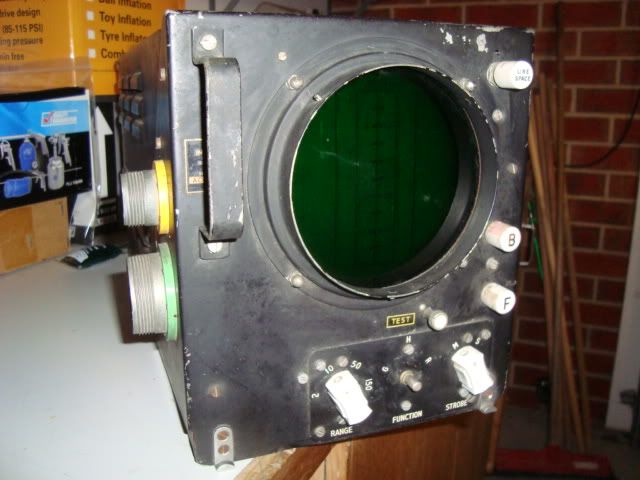
The unit on the top left is a US-built APN-4 LORAN receiver indicator unit. LORAN was a long distance navigation system based on a series of ground transmitter chains working a master and slave principle. This system is still operating in Europe on 100 Khz longwave with the UK station located in Anthorn, Cumbria. Top centre is the GEE RF unit (Shown inserted into its matching reciever in your original posting). To its right is the gutted remnant of a GEE indicator.
With regards value, they look as if they have been stored in the damp and will have only minimal value as parts and spares sets, although I have seen similar sets in worse condition transformed into immaculate restorations. Unfortunately there are few collectors of second world war avionics and the weight of old radar gear, it’s difficult power requirements and lack operability means there are few collectors. The UK vintage radio forum is good place for further enquiries, I can post a topic on your behalf if you wish.
Robs
(Who already has a 1950’s Green Satin set and who is on the lookout for further items to complete his AN/APN-1 project).
By: magiczig - 28th January 2013 at 17:10
more Pictures
Hi all more pictures as requested there are a few more but my computer is so slow today will all be up for sale please PM if you need any further info thanks
By: magiczig - 28th January 2013 at 11:56
thanks
Thanks so much for all the info I have been told one of these has been fitted with a mains transformer and was used the receive the BBC no sure which one
I guess it might be the very heavy one 🙂
By: TonyT - 28th January 2013 at 11:48
Not up to speed on wiggly amps, but would suggest these guys too, might be worth a query
Welcome to the forums BTW.
By: Arabella-Cox - 28th January 2013 at 11:48
The RF26 was available in huge numbers on the surplus market after the war and into the 50s. Lots of Radio Amateurs bought and converted them for use on the Amateur bands and they were also used by constructors interested in making sets to receive the then new BBC VHF FM broadcasts. Practical Wireless magazine was full of helpful hints and circuitry at that time.
Jim
By: magiczig - 28th January 2013 at 11:45
Thanks
Thanks for the info Rob
surplus set of high quality parts and components and may have items missing
Hi Rob So what high quality parts should I be looking out for as I will be totally honest I would hate to chuck away high quality parts when they might be worth a little to someone.
Thanks for the info
By: Airspeed Horsa - 28th January 2013 at 10:06
The RF unit plugs into the GEE navigation receiver. Each aircraft carried several of these so rapid changes between different GEE frequencies could be made. bSee the DRS website here: http://www.duxfordradiosociety.org/restoration/restoredequip/r1355/r1355.html
The modulator is part of a radar transmitter. I have not yet found reference to a Type 67. I can tell you it does not appear to be part of H2S MK2-3 (type 64) or ASV sets V-XI. The closest match so far is a type 66 in the Rebecca Mk IIB. I’ll keep looking.
In their present state neither has much in the way of use or value. GEE RF sections in particular are fairly abundant (many GEE receivers were converted into television sets after the war by keen amateurs). The modulator is likely to fall into the large category of “rare but not valuable”. Both sets are likely to have survived as a surplus set of high quality parts and components and may have items missing.
Rob.


 Sign In








 January 28, 2013 at 9:23 am