Much has been written about the legendary Malta Sea Gladiators, a lot is contradictory but what im trying to ascertain is during the main combat what propellers were used and at what time?
Im aiming to build the Silver Wings kit of the Gladiator, but as everyone will build the famous N5519 “R” id like to build N5520 “S” which is visable in the background of this picture coded “S”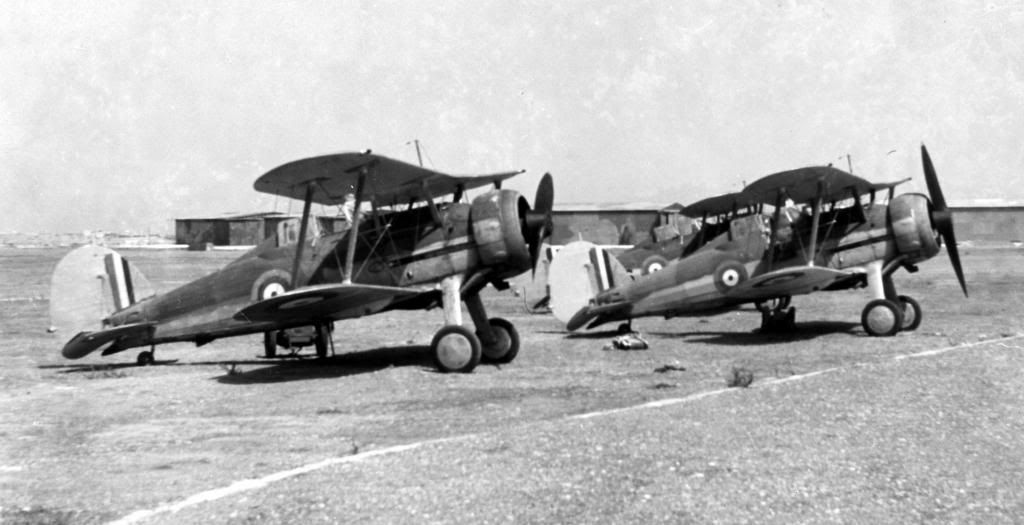
The question is did N5520 also use a two bladed watts prop or did it have the fairy reed like N5519? i believe the watts gave an advantage over the fairy reed in some way either manouverability or rate of climb?
Next question is does anyone have an idea at what point the Variable pitch props were installed? were the Glads relegated to met duty by the time they were fitted or did they see combat wearing the variable pitch props?
This picture is usually captioned as being N5520, but id imagine all the serviceable glads were probably fitted with them eventually.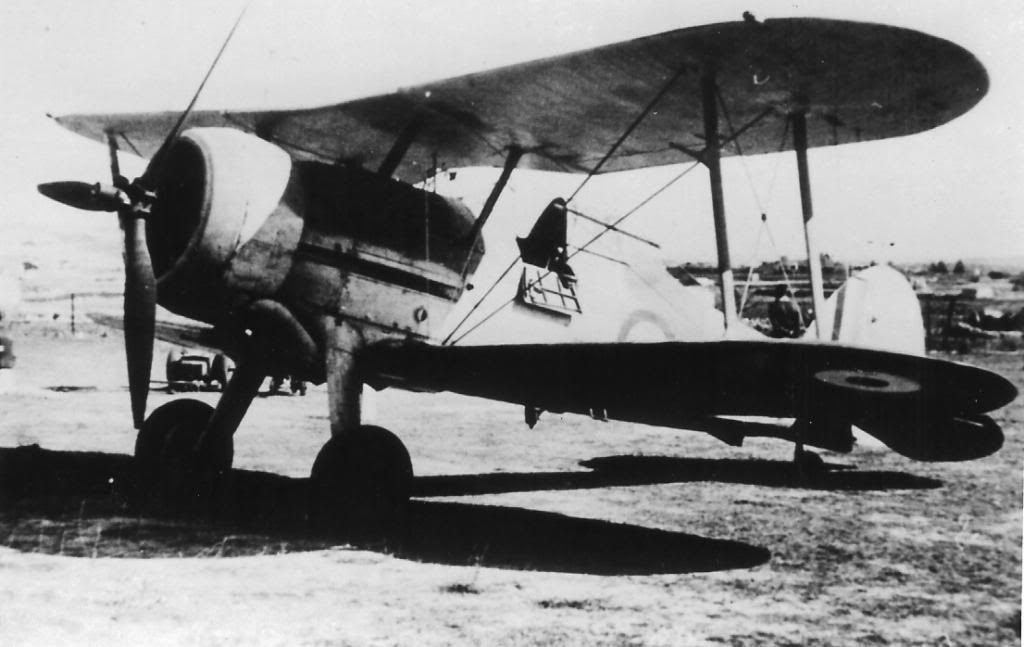
hope someone can give a bit of clarity, its a pity no more photos have surfaced of them.
Ta
Ben

By: Moggy C - 21st December 2012 at 09:35
Bristol might have been ahead of the game, but remember these were Royal Navy aircraft and that mighty force saw aviation way down its list of priorities at the time the Gladiators were current inventory.
Moggy
By: Arabella-Cox - 20th December 2012 at 23:26
Prop change
A few interesting technical questions there, Sycamore. someone should know or the relevant info will be tucked away somewhere. Regarding the gun interrupted mechanism; I recall seeing an annotated cutaway of a Bristol Pegasus engine (I think it was in an issue of the war-time Aeroplane Spotter) and there was provision on the accessory case for a gun interrupter device, probably hydraulic by that time rather than mechanical linkages/cams of WW1.
It was only possible to overspeed a Watts in any sort of dive. However, even such a big prop did its job well under normal conditions. One can relate the power of an engine by the size of its prop and the Gladiator certainly wasn’t underpowered by any means. In fact, an old RAF friend once told me that the Gladiator with a Watts used to climb like a rocket.
Bristol’s were ahead of the game with their engine development and ‘plumbed’ their engines for CS operation before the war and Constant Speed props were around well before the conflict began. It is surprising, considering the enhanced performance for the same power, of a VP prop, why the Spitfire even went to war wearing its Watts, with the subsequent replacement prop crash-programme being required.
The performance gains of such a device were obvious and manufacturers designed accordingly, the Blenheim prototype (actually Lord Rothermere’s type 142) first flying in 1935 with Mercury engines and VP props.
Interesting stuff:)
Anon.
By: sycamore - 20th December 2012 at 22:03
A few more thoughts about whether just the props were changed,or the complete engine,plus props.
It would seem straightforward to change the engine and prop combination as a unit,as the engine comes with a CSU already,and one would only require an additional lever/push-pull control for RPM.The original cowlings should also fit,as the Blenheim had `gills`,but not the Gladiator.
If one only changed the prop., then the engine would also require the fitting of a CSU,unless the basic engine was already `plumbed`,and appropriate cockpit controls,since it is possible to overspeed the Watts prop.
In both cases,however, the two inboard Brownings would need adapting and the interruptor gear,since it was not fitted(?) on Blenheims,I suspect ; an alternative would be to `gag` the fuselage ones,but that would seriously compromise the whole effort of having a more capable aircraft.
Someone ,somewhere must know a credible answer…..??
By: Graham Boak - 20th December 2012 at 15:21
The ones on Malta had been offloaded from Glorious (I think?) and some of the stock had indeed been reassembled and sent to sea. I gather the unit concerned preferred the Watts prop to the Fairey 3-blader, as being more suited to their particular operations. There may of course be more behind this than most histories tell us, either because it is not longer known, or the writers think we may not be interested.
By: bensummerfield - 20th December 2012 at 13:56
Thanks for the responses chaps.
The pic with the two blade props may be before hostilities kicked off as I’ve read they had been operating the Gladiators for a while before war was declared and also a few were loaded back onto HMS eagle and used by keighly-Peach. A few of the eagle fighter flight had watts propellers.
Big fan of the Gladiator, I hope the Maltese government lets the Malta Aviation museum add some wings!
By: Graham Boak - 20th December 2012 at 13:15
Just to pick up on one point, the Watts 2-blader had largely disappeared from front line service before the Battle of Britain, although a few were seen in France. The modification that was carried out immediately pre-BoB was the conversion of the De Havilland variable speed (2-position) 3-blader into a constant speed propeller. Many Hurricanes and some Spitfires already had Rotol constant-speed units.
By: Arabella-Cox - 19th December 2012 at 22:36
Blenheim prop
The engines were, barring fairly minor differences, the same for the Gladiator and the Blenheim. As far as I am aware, the Mercury and Pegasus (its longer-stroke stablemate) engines were factory internally configured for constant-speed props.
What the de-H/Ham-Stan prop installation needed was a Constant Speed Unit (CSU) and probably an oil pump unit, fitted to the engine and the relevant oil feeds to and from this from the oil system and the propeller, and a high/low or RPM lever in the cockpit linked to the CSU.
Like the pre-Battle of Britain Spitfire and Hurricane prop change (done on-station in a crash programme at about the same time) from the big fixed-pitch Watts units to the de-H two-position metal props, it could be accomplished with either a purpose-made kit for fitting or, in the case of small-scale re-engineering schemes, by competent fitters on-station with components available from stores.
The difference in performance between the fixed-pitch and variable-pitch propped machines would have been marked, and well worth the effort involved. An aircraft with a fixed-pitch prop, optimised for higher top speed would have had a poor take-off performance and vice versa.
Conversely, the two-position or variable-pitch equipped machine would have the best of both being able, in essence, to “change gear” to suit the flight condition required.
Malta Gladiators would have needed a short take-off and a rapid climb to height to interception. Once there, it would have needed the highest speed possible to catch any (then) modern enemy monoplane machine.
Anon.
By: Moggy C - 19th December 2012 at 21:27
Poolman gives the fitting of the 3-blade (Blenheim) props as being overnight 11 to 12th May 1940
Moggy
By: G-ASEA - 19th December 2012 at 20:02
The Gladiator’s had Mercury’s fitted from Blenhiems at some time. According to the book ‘Gladiators over Malta’.
By: pobjoy pete - 19th December 2012 at 18:23
Glad
Damm fine machine with any prop !!!!
By: Graham Boak - 19th December 2012 at 18:18
The second photo still shows the high demarcation of the camouflage, so I suggest that this is whilst they were still in combat. The later photos show a lower demarcation (following FAA instructions of the appropriate times) and I suggest that this is when they were carrying out Met duties.
My understanding is that the engines were changed. This would then allow for the variable pitch which would give a significant advantage overall, although perhaps not everywhere.
By: bensummerfield - 19th December 2012 at 17:52
Ben
I cannot help with your specific question other than I think the 3 bladed prop was a Hamilton Standard unit as used on the Blenheim. I have always wondered whether these were fixed when used on a Gladiator or still variable as they were on the Blenheim, if they were variable did it give an improved performance.Richard
Yeah i believe they only used the prop, not the Blenheim Mercury engine as is usually quoted as i dont belive it would give any advantage over the Gladiators, (surely it would be geared differently?) But would the controls be inplace for the variable pitch mechanism?
By: pogno - 19th December 2012 at 17:41
Ben
I cannot help with your specific question other than I think the 3 bladed prop was a Hamilton Standard unit as used on the Blenheim. I have always wondered whether these were fixed when used on a Gladiator or still variable as they were on the Blenheim, if they were variable did it give an improved performance.
Richard


 Sign In








 December 19, 2012 at 4:52 pm