Check out this article at RetroMechanix.com on the Higgins-Bellanca Cargo Model 39-60, a huge transport designed for the USAAF in 1944:
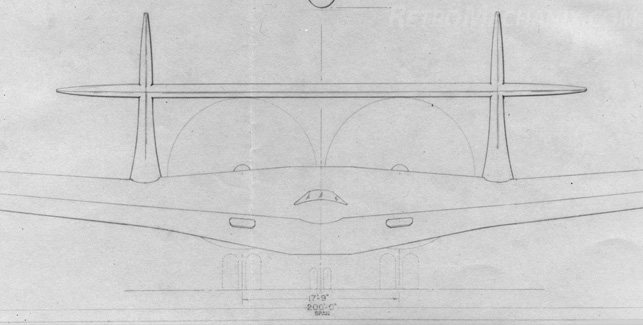
The aircraft featured a blended wing-body combined with a twin boom tail assembly; power was provided by a pair of pusher Pratt & Whitney Model R-4360 two-stage radial engines. The article reproduces the original specification for the aircraft, along with general arrangement drawings. Also included is a cleaned-up digital tracing of the three-view to provide greater clarity.
-Jared

By: J Boyle - 18th May 2012 at 19:22
There was recently a discussion here about twin-boom cargo designs, and it was agreed that the German Gothas were in production first but because of the C-82 and this design, you realy can’t credit the Germans with originatingthe configuration.
BTW: The Higgins mentioned here is the same Higgins that made the famous WWII “Higgins Boat” landing craft. Mr. Bellanca worked for them during the war in New Orleans.
As seen here, Bellanca was big on the lifting body concept, going as far as designing his planes ..the pre war high wing monoplanes popular with 1930 record setters and his post war low-wing Cruisair and Cruismasters/Vikings…with an airfoil-like curve.
However, I ‘ve recently read where that didn’t provide any lift because of washout or drag.
By: J Boyle - 18th May 2012 at 19:22
There was recently a discussion here about twin-boom cargo designs, and it was agreed that the German Gothas were in production first but because of the C-82 and this design, you realy can’t credit the Germans with originatingthe configuration.
BTW: The Higgins mentioned here is the same Higgins that made the famous WWII “Higgins Boat” landing craft. Mr. Bellanca worked for them during the war in New Orleans.
As seen here, Bellanca was big on the lifting body concept, going as far as designing his planes ..the pre war high wing monoplanes popular with 1930 record setters and his post war low-wing Cruisair and Cruismasters/Vikings…with an airfoil-like curve.
However, I ‘ve recently read where that didn’t provide any lift because of washout or drag.


 Sign In








 May 18, 2012 at 3:46 pm