
By: Al - 29th September 2011 at 06:19
Jim – an Aussie member of a Harley forum I’m in sent in a photo of a project he’s working on at the moment, using two jugs from an aircraft radial engine. It’s 247 cubic inches – 4047cc!
By: Pelagius - 23rd September 2011 at 20:41
I have always understood (I’m sure it’s in my apprentice notes somewhere) there are two aspects to using tulip valves…
As the hot exhaust valve is running closer to metallurgical limits, the reciprocating mass is critical – the tulip valve can maintain strength with reduced mass compared to ‘nailhead’ valves.
The gas flow effect allows a smoother, flowing exit for the exhaust gases, when compared with the potential rapid direction change of the flow around a ‘nailhead’; the smoother flow of the tulip valve prevents the localised hotspots on the stem of the nailhead.
There’s a video out there somewhere on the net of an exhaust valve in operation. I was amazed at the amount of hammering one gets.
How about a Merlin engined bike…
Or a rotary…
By: Vega ECM - 23rd September 2011 at 19:32
When dealing with metal to metal seals a few tenth of a thou of misalignment will cause leakage which would significantly impact an engines performance.
At 1100 – 1200K heat resisting steel maybe about 60% of its normal strength and maybe 4-5 times its normal flexibility. You’ve also got the potential for thermal creep which may lower your working allowable even more. And don’t forget the inertia loading on the valve stop/sealing surface ……maybe a 1000g + on snap close.
At these temperatures the material properties are in the process of falling off a cliff edge which is why they are filled with Na……… The solutions are getting quite desperate.
I guess the other thing that’s going on there is the differential expansion of the Na and the steel. This may generate quite an internal pressure within the valve and again a domed surface would keep this in check as per normal pressure vessel design methods.
By: Creaking Door - 23rd September 2011 at 17:27
The valve springs on any engine are never going to be strong enough to deflect (significantly) the head of the valve; they are far too weak. I also don’t think the pressure due to combustion would ever get so high as to deflect (significantly) the head of the valve, no matter how hot the valves ran normally.
Aero-engine wise the only valves I’ve seen with this domed shape are ‘sodium-cooled’ (although I’ve seen plenty of non-domed valves that are also sodium-cooled.
By: Vega ECM - 23rd September 2011 at 16:15
The domed end on the exhaust valve is to increase the stiffness of the metal to metal sealing surface and thereby ensuring a gas tight seal. The arched section across the valve bottom increases the section inertia by about 30-50% which prevents it collapsing away from the opposing face when pulled tightly closed. Arches are commonly used in this way e.g. bridges, pressure domes etc.
My guess is only the exhaust valves need this as they operate much hotter than the inlet valve and hence experience more heat induced softening.
By: Creaking Door - 23rd September 2011 at 15:19
Not to be confused with a Pratt & Whitney R-2800:
Rotec R2800, 7-Cylinder, 110 Horsepower…
…Pratt & Whitney R-2800, 18-Cylinder, 2100 Horsepower!!! :diablo:
By: Al - 23rd September 2011 at 14:13
Jim – looks like all the radial bike engines are R2800s from Rotec Engineering…
http://www.rotecradialengines.com/
By: Lincoln 7 - 23rd September 2011 at 13:53
Al Thanks for posting the photos of the radials, I did in all honesty with tongue in cheek, think it would be impossible, do you know what Radials they are, perhaps you or C.D. can answer that one. I noticed the photo showing the radial whoes cooling fins and engine are sideways on, has very little ground clearence.
Just shows what can be done……….if you have the money.;)
Jim.
Lincoln .7
By: AndyG - 23rd September 2011 at 12:49
They may well be sodium filled , but I dont think thats the reason , as many engines ( with non sodium valves ) use this configuration . My understanding was that it is for gas flow reasons . Trapping a small pocket of gas in the centre leaves the other gasses to flow in a more linear fasion out past the valve seat ( faster ) . The inlet doesnt benifit since the gasses are coming in , not out .
Convex, not concave he noted.
There is a patent for an exhaust valve which is significantly convex from a few years back IIRC. Improved gas flow is the benefit stated.
By: TonyT - 23rd September 2011 at 11:12
Seem to remember it was gas flow, also as they are sodium filled I suppose you have a larger surface area for cooling.
By: Al - 23rd September 2011 at 11:02
But all those radials look quite tame – here’s ‘Mad’ Ron Laycock and his afterburning RR Viper motorcycle – 3800hp!
By: Al - 23rd September 2011 at 10:52
Nice looking engine Al, all you need now is the other 7 cylinders, seriously though, I did read a long time ago some chap, where else but the USA had a motorcycle frame with a MERLIN engine in it.
I wonder if there is a small radial engine that could be put into a M’cycle frame?
Jim.
Lincoln .7
Jim, some people are amazing – Australian engineer ‘Lucky’ Keizer knew of some surplus Mosquitos lying around in the desert near his home, and chopped 2 cylinders from the V12, and made a 5 litre motorcycle from it…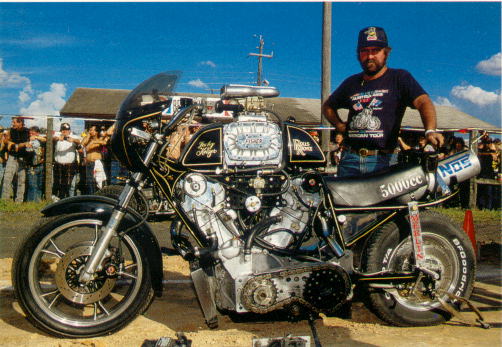
Folk have put radials in motorcycles, too – roasted nuts, anyone?


By: Creaking Door - 23rd September 2011 at 10:29
Here is a photograph of a sectioned domed-head exhaust valve. It is from a BMW-132 engine (a virtual copy of a US radial engine) from the wartime technical examination of a shot-down Luftwaffe aircraft.
In my opinion the main reason for the dome heads of cooled exhaust valves is to allow the coolant to get to the hottest part of the valve; the centre of the valve head. You can also see in the photograph how these valves are made; notice the weld around the circumference of the dome.
By: Lincoln 7 - 23rd September 2011 at 09:53
I suspect it’s more of an air flow reason Jim – my Harley-Davidson has the same 1930s hemispherical combustion chamber design as found on radials, but the valves are convex on the intake, flat on the exhaust!
Come to think of it, the old Shovelhead does look like a slice from a radial…
Nice looking engine Al, all you need now is the other 7 cylinders, seriously though, I did read a long time ago some chap, where else but the USA had a motorcycle frame with a MERLIN engine in it.
I wonder if there is a small radial engine that could be put into a M’cycle frame?
Jim.
Lincoln .7
By: lumpy - 23rd September 2011 at 09:06
Okay , so after thinking a bit , and reading Al’s post , I think my first response was wrong . On reflection most of the valve combinations I have seen do indeed have the cupped valve is the intake , not the exaust . So a very quick Google latter and I found this http://www.enginebuildermag.com/Article/2371/engine_valve_designs.aspx . The first few paragraphs seem to explain things pretty well .
By: Al - 23rd September 2011 at 05:27
I suspect it’s more of an air flow reason Jim – my Harley-Davidson has the same 1930s hemispherical combustion chamber design as found on radials, but the valves are convex on the intake, flat on the exhaust!
Come to think of it, the old Shovelhead does look like a slice from a radial…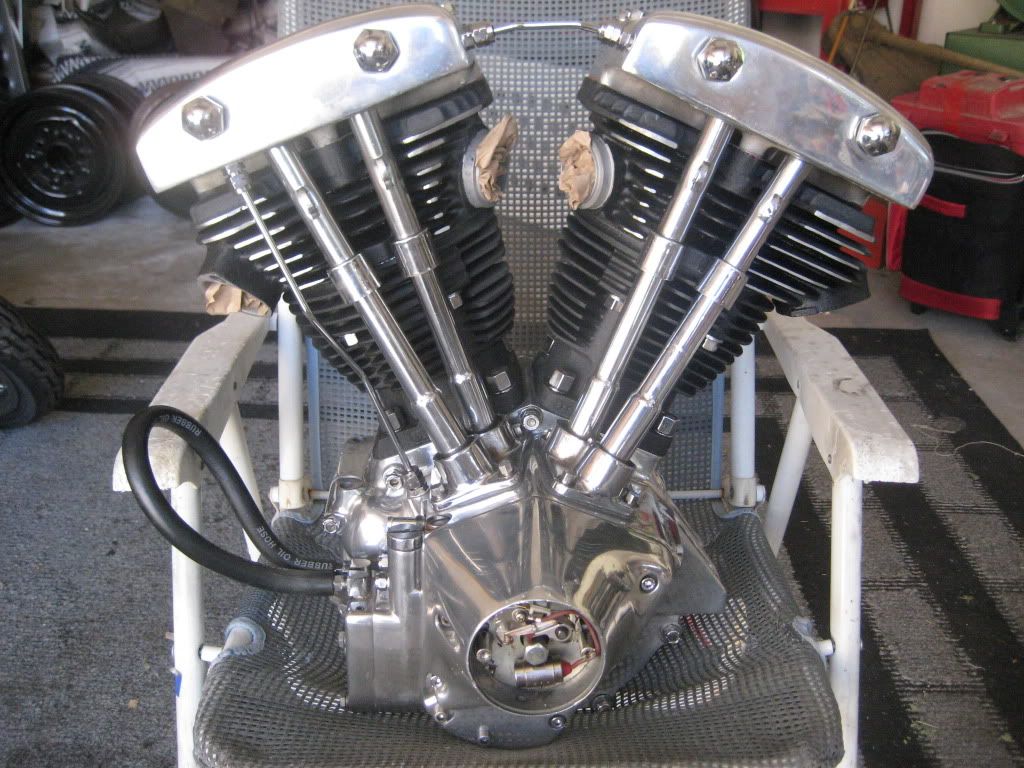
By: lumpy - 23rd September 2011 at 01:36
The exhaust valves are sodium filled.
Which engine?
They may well be sodium filled , but I dont think thats the reason , as many engines ( with non sodium valves ) use this configuration . My understanding was that it is for gas flow reasons . Trapping a small pocket of gas in the centre leaves the other gasses to flow in a more linear fasion out past the valve seat ( faster ) . The inlet doesnt benifit since the gasses are coming in , not out .
By: Lincoln 7 - 22nd September 2011 at 22:04
Hi. P&W R series mainly collected, but am interested in all, sadly no books on subject.Also, so many varients of valves for the same model engine, ie, have two different types of R2800 exhaust valve, collets.
Jim.
Lincoln.7
By: AndyG - 22nd September 2011 at 21:13
The exhaust valves are sodium filled.
Which engine?


 Sign In








 September 22, 2011 at 8:28 pm