Here’s a question I’ve never found a fully referenced answer to – why did most Russian transport aircraft have glazed lower noses, a la bomb-aimer positions? (Such as the Antonov An-12, Ilyushin Il-76.) As most of them were never equipped with bomb gear or so forth, I presume that’s not what they were for, but for navigation in Russian wastes, perhaps? It’s a different question to the (often the same) aircraft equipped with tail gun turrets – defensive is appropriate for transports, but offensive (bombing) a different thing.
Thanks in advance!

By: pagen01 - 17th April 2011 at 10:50
Definitely the case from here, hopefully Flanker_man will be along soon…
By: JDK - 17th April 2011 at 08:11
Could make an interesting “aircrew” article James? 😉
Certainly could, I agree, but that’s not why I’m asking. I’ll add it to the list though!
So… no one actually has any data (rather than conjecture) then? :dev2:
Regards,
By: J Boyle - 16th April 2011 at 21:19
Going back to JDK’s original question; all of the above doesn’t really explain why various Soviet jet transports particularly the Tu-104, Tu-124 and Tu-134A had glazed noses.
Gee, I thought I gave two reasons in the post before yours.:D
By: Rigga - 16th April 2011 at 20:40
According to a book I read many moons ago about the History of the Red Air Force (as opposed to the White Air Force) ever since the civil war and especially after WW2 there was a political directive that ALL aircraft designs had to fulfil at least TWO roles in order to maximise the use of aircraft in a crisis.
This show in civil aircraft designs as the Bomb-Aimers/Gunners windows and in helicopters such as the Hind that carries troops as well as being a gunship (Why else would you design a gunship – that needs to be manoeuverable – and then add 8 to 10 troops?)
The Policy was dropped when the wall came down and Russia realised that few of their aircraft were western-world compliant and therefore not commerciallly viable.
By: pagen01 - 16th April 2011 at 18:26
Well the question is Russian transports, and out of that little selection the 76 is more a transport than the others which are mainly airliners.
I’m not sure I’m fully persuaded by the radar issue being the sole reason for the glazing and positioning the nav in the front, I thought the USSR had good ground radar cover, and most of the types we are discussing were equiped with radar aswel as glazing.
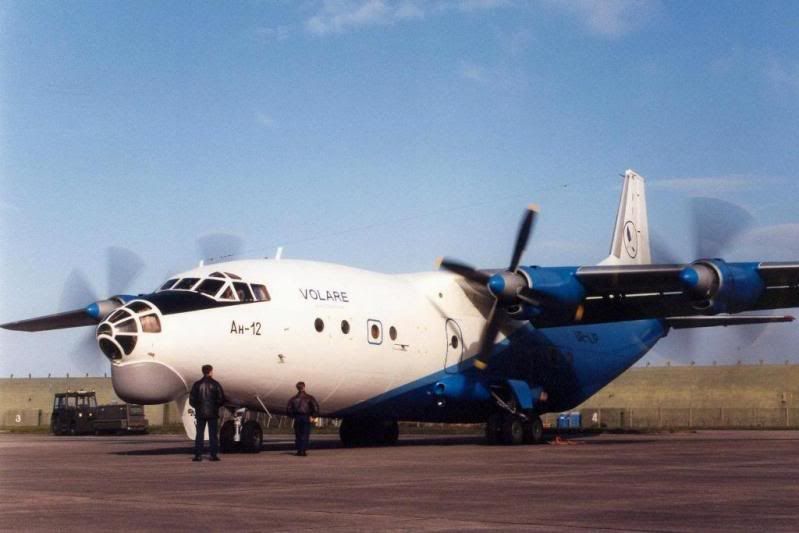
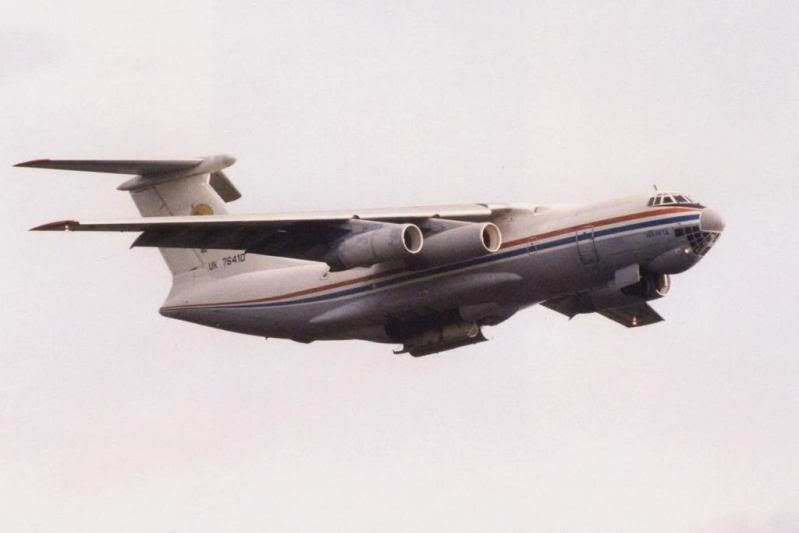
By: Fatcivvy - 16th April 2011 at 17:38
Like the Ilyushin IL-76 pictured above?
I’ll bite just to make you feel better :p With the obvious exception of the Il-76. I was thinking of the Il-12, Il-14, Il-18, Il-62 etc.
Jeesh, there’s always one :rolleyes:
FC
By: low'n'slow - 16th April 2011 at 16:31
As the post above, the prime reason for the glass nose on airliners was to aid visual navigation as electronic navaids were pretty nearly non-existent in Russia in the 1960s and 1970s.
In most Russian airliners of the period such as the Tu-104, the navigator sat at a desk in the nose, just ahead of the pilots.
While I am sure that when the aircraft were overseas, reconnaissance was done, it should be remembered that the vast majority of Aeroflot flights were internal flights within Russia.
It should also be remembered that the navigators on flights in Russia were effectively in command of the aircraft. it was they who directed the pilots course, and no doubt were they the first to become salt miners if the flight was late or lost!
Could make an interesting “aircrew” article James? 😉
By: markb - 16th April 2011 at 15:57
JDK, you got it right in your original post!
The glass noses on Tu-134s etc are for the navigator, when flying across Russian wastes. Very little in the way of radar, on the ground or in the aircraft!
Clearly they had other uses too…
By: bloodnok - 16th April 2011 at 15:45
Civil Soviet airliners sometimes strayed off track near Strumble Head to take photos of the missile test facility at Aberporth West Wales.
We used to get Russian Trawlers with an amazing ammount of aerials off the coast from Valley when the buccs were doing Sea Eagle trials at STCAAME.
By: ZRX61 - 16th April 2011 at 15:36
I really have to take issue with that statement, we flew, and as far as I am aware crews are still flying, highly accurate air drop missions in Afghanistan where loads are dropped within 15 feet of the DZ marker.
That’s a bit of a pisser, when I was involved the safest place to be was the aiming point as it was garanteed to be the one place a pallet wouldn’t land. It wasn’t unknown to set up a BBQ & lawn chairs etc:cool: then wait for daylight to go looking all over the Mojave desert to find out where the hell everything landed.:mad:
I never heard of anyone getting hurt (or flattened into the landscape) but there were a couple of near misses when personal had wandered away from the safety of the target area… One guy was taking a leak, had a pallet land about 15ft in front of him & then suffered an attack of the screaming abdabs as he was tangled up in one of the chutes as he tried to run away.. :diablo:
By: pagen01 - 16th April 2011 at 15:33
And also, why didn’t other Soviet manufacturers put glazed noses onto their aircraft, such as Ilyushin?
Like the Ilyushin IL-76 pictured above?
By: wl745 - 16th April 2011 at 15:17
Slow fly by
There was a Soviet type that used to overfly RAF Muharaq(Bahrein)same time every day and very slowly so all the lower ranks would drop shorts and moon it as it flew over!Perhaps somewhere the photos still exist!!
By: Fatcivvy - 16th April 2011 at 15:10
Going back to JDK’s original question; all of the above doesn’t really explain why various Soviet jet transports particularly the Tu-104, Tu-124 and Tu-134A had glazed noses. Surely, they wouldn’t have been used for load dropping. And also, why didn’t other Soviet manufacturers put glazed noses onto their aircraft, such as Ilyushin?
Just thought that I would stir it up a bit :diablo:
Cheers,
FC
By: J Boyle - 16th April 2011 at 13:53
While I don’t disagree with the bomber sentiment, allow me to point out a few possible theories….
A lot of Soviet-era airliners were developed from bombers, so it may have been anneffort to keep development costs down. the Tu-104 it is said had the same nose section as the Tu-16..with something like 22 windows.
The Soviets actually did build some…the Tu-104 and Tu-114 come to mind.
While many western firms looked at turning jet bomber designs into airliners, I’m not aware of any that actualy went into production, most like civil variants of the Victor (H.P.111), Valiant (Type 1000) and B-58 (a military SST that I’m not sure was ever seriously marketed to airlines) remained paper planes only.
Airliners (as opposed to civil transports based on military designs like the civil Il-76s) designed by Ilyushin don’t seem to have had glass noses. So it didn’t seem to be a requirement.
Finally, I ‘ve read that during the Soiet-era, full employement was mandatory, so that (along with the practical need for navigators flying in what can be assumed were parts of Russia that lacked modern Navaids) navigators were encouraged. My trusty Putnam’s Soviet Transport Aircraft since 1945, by John Stroud 1968, points out that typical crews consisted of two pilots, radio operator, navigator, flight engineers…ceratinly a large crew for a jet during a period where western commercial operators were trtying to get rid of crew members through technology.
By: FLY.BUY - 16th April 2011 at 13:32
My understanding (founded on general chat) was that the glazing aided photography / reconniassance opportunities whilst making approaches over potentially sensitive areas.
This was highlighted by flight plans often being filed over sensitive sites / locations – pre ‘Opensky’ days to maximise opportunities for such activities! :confused:
I would agree with the above, I remember years back (1970’s) being at Cigli airforce base, Izmir, Turkey (USAF and Turkish Airforce) waiting for a Aeroflot An-12 to land with Cargo. The Turkish air traffic controller told me at the time that despite the long runway he anticipated the AN-12 to do an overshoot, purely to give the crew an oppurtunity to photograph the field. True to his word the aircraft did exactly that and landed second time around. Glass nose AN-12 CCCP11104, sneeky!
http://aviation-safety.net/photos/displayphoto.php?id=19801028-1&vnr=1&kind=PC
By: scotavia - 16th April 2011 at 13:27
Civil Soviet airliners sometimes strayed off track near Strumble Head to take photos of the missile test facility at Aberporth West Wales.
By: Creaking Door - 16th April 2011 at 12:57
The Daisy Cutters used recently and MOAB both used GPS guidance to target…
How on earth do you use GPS guidance on something like that…..plus weren’t the BLU-82/B dropped with a rather unaerodynamic pallet attached? :confused:
During the Falklands there were reports of Argentine C-130 ‘rolling bombs off the cargo ramp’ against merchant ships; it later transpired that the C-130 involved had bomb racks fitted in place of the under-wing fuel-tanks but I wonder if the reports from the merchant ship crews were later ‘interpreted’ by some knowledge of those with similar experience or planning? Just a thought.
By: JDK - 16th April 2011 at 11:31
Thanks Baloffski, your expertise is acknowledged, and certainly I’m well aware of the accuracy of air drop loads, having recently researched similar for a feature on RAAF Hercs, and conversation with US Herc drivers and FEs. However it’s the official US view on the BLU-82 that it was ‘inaccurate’ – not mine or my conclusion. Also the Russians ‘dropped’ (excuse pun) a version of the same ordinance delivery system from one of their transports for the same (inaccuracy) reasons. Why one load might be regarded as ‘inaccurate’ following – as you point out – essentially the same process as another that is regarded as ‘highly accurate’ I don’t know.
By: baloffski - 16th April 2011 at 11:04
Interesting replies, chaps, thanks!
I’m a bit sceptical of the bombing element, because unless proper bomb racks are fitted, rolling out the back is lamentably inaccurate.
Thanks again,
I really have to take issue with that statement, we flew, and as far as I am aware crews are still flying, highly accurate air drop missions in Afghanistan where loads are dropped within 15 feet of the DZ marker. I am not talking harness packs here, but 1 ton pallets of food and ammo to troops where there were enemy positions close enough to benefit from maldropped loads. I have seen double MSP drops with similar accuracy (an MSP is a platform which could contain for instance a LWB Land Rover).
Replace stores with ordnance and the Nav, Loady and Air Despatch Crew would make sure that the package was still received by the recipient with the same accuracy.
The Daisy Cutters used recently and MOAB both used GPS guidance to target, so their accuracy at release is not really relevant as the weapon will correct all the way down to the Impact Point
By: pagen01 - 16th April 2011 at 10:44
The bomb that CD’s thinking of that the Americans dropped out of the back of Hercs was the BLU-82 (designed for the job, replacing the M 121) used in Vietnam to clear helicopter landing areas and in the first Gulf War for ‘shock and awe’ tactics, neither requiring major accuracy.
Not sure that those Daisy Cutters were aimed as such!:eek:
I get there is a difference here aswel, fast jet transports as opposed to lumbering British Piston jobs.


 Sign In








 April 16, 2011 at 9:33 am