I’ve just been watching some film of Sea Vixens being launched off a carrier. They use a kind of wire strop attached somewhere under the middle of the aircraft which then falls into the water after launch.
Did they recover these strops (I assume not) and if not how many would the aircraft carrier keep in store?

By: F-18RN - 20th February 2011 at 23:49
As far as I know the Buccaneer was always launched with the tail skid on the deck.
I have searched for photos of Bucc’s being lanched from USN super carriers to confirm this without success.Paul.
Thanks for trying to find pictures of Buccaneers flying from US supercarriers, I’ve tried myself with no luck so far.
By: Paul Holtom - 20th February 2011 at 19:00
As far as I know the Buccaneer was always launched with the tail skid on the deck.
I have searched for photos of Bucc’s being lanched from USN super carriers to confirm this without success.
Paul.
By: F-18RN - 20th February 2011 at 12:06
The Buccaneer was always launched with the tailskid on the deck. Below are photos of an early mk2 on board USS Lexington for hot weather trials during 1965. Notice the holdback bracket behind the tail skid in the lowered position ready for fixing to the ships holdback linkage.
I believe RN carriers had more powerful cats than the USN supercarriers due to their shorter run. American Pilots cross opperating would comment on the extra kick given by the British cats.
The USS Lexington featured in the photos was a converted Essex class, slightly longer than HMS Eagle and HMS Ark Royal. When cross-decking with a ‘supercarrier’ such as a Forrestal class or later were they launched in this manner?
By: Bager1968 - 17th February 2011 at 02:56
Victorious was re-engined in the 1950s with Foster-Wheeler boilers, one of the reasons for delays and cost increases as it was a late decision. Were these also 400psi?
My material shows those as 440 psi, so a slight increase.
By: Bager1968 - 17th February 2011 at 02:38
While the 150′ C11-2 was the shortest USN steam catapult, the RN had the BS4, which was shorter yet:
BS4…..103ft…160ft…40,000lb@78kt…Mod Majestic, Hermes 1959
…………………………..30,000lb@110kt
BS4M…112ft…169ft…?……………………Melbourne 1971+
BS4C …139ft…175ft…35,000lb@99kt…Centaur 1958
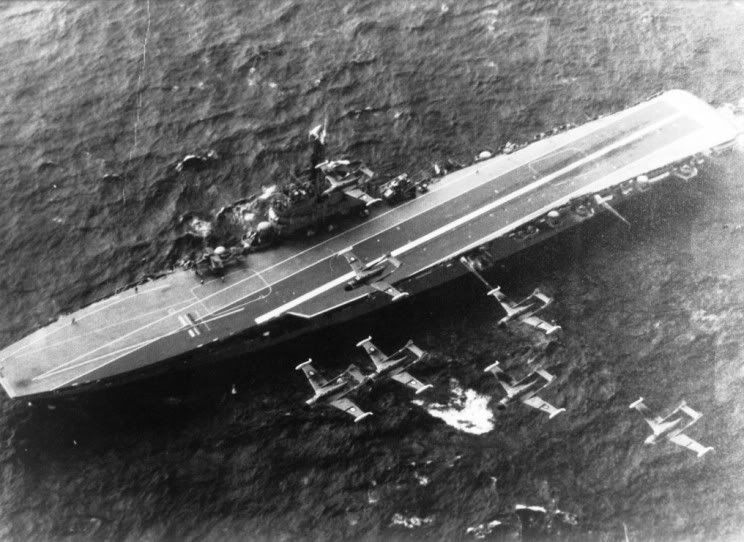
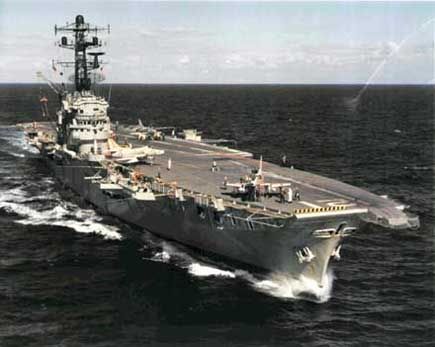
The extra 9 feet in HMAS Melbourne’s stroke length was added in 1971 when she was fitted with a bridle catcher extension… the end of the piston assembly was relocated from the forward end of the flight deck into the “horn” of the bridle catcher.
Note in the second pair of photos how close to the bow the catapult track ends.
By: graeme65 - 16th February 2011 at 18:46
Victorious was re-engined in the 1950s with Foster-Wheeler boilers, one of the reasons for delays and cost increases as it was a late decision. Were these also 400psi?
By: pagen01 - 16th February 2011 at 17:36
I was just looking at that, it is impressive and surprising that apart from the Nimitz class there isn’t the difference between the two nations catapult lengths that I expected.
By: Paul Holtom - 16th February 2011 at 17:29
Amazing bit of info there Bager. The faster initial acceleration explains why the USN pilots found the British cats more of a kick in the pants.
Has a decision been made on the type of cats for the new carriers yet?
Paul
By: Bager1968 - 15th February 2011 at 20:25
I believe RN carriers had more powerful cats than the USN supercarriers due to their shorter run. American Pilots cross opperating would commont on the extra kick given by the British cats.
It depends on what you mean by “more powerful”.
USN catapults could launch heavier aircraft at higher speeds.
I would say that the “instantaneous” power generated by the RN catapults was greater, but the total power was less.
The RN catapults apparently tended to accelerate the aircraft faster at the start, but ran out of “push” near the end.
Note the following data… and the difference in length.
Type….Shuttle Run..overall Length………Capacity………..Classes
USN:
C11-2…..150ft………..203ft………39,000lb@136kt….Essex, Midway & FDR waist cat 1960s
………………………………………….70,000lb@108kt
C11-1…..215ft ……….240ft………45,000lb@132kt…Kitty Hawk 1960s, Oriskany, Coral Sea (all),
………………………………………….70,000lb@108kt…Midway & FDR bow cats
C13……..250ft ……….285ft………78,000lb@139kt ..Enterprise, America 3, Kitty Hawk 1970s
C13-1…..310ft………..345ft………?@?…………………Nimitz, America 1
RN:
BS5……..151ft………..220ft………35,000lb@126kt…Eagle 1964 (bow), Ark Royal (bow) 1970
………………………………………….50,000lb@91kt
BS5A……199ft………..268ft………35,000lb@145kt…Eagle 1964 (waist), Ark Royal (waist) 1970
………………………………………….60,000lb@95kt
BS6……..250ft………..320ft………70,000lb@100kt…CVA01
The likely cause is the difference in operating pressure of the respective nations’ ships’ steam systems.
The USN had 600 psi boilers in the Essex class, the Midway class, and Forrestal, and 1,200 psi boilers in Saratoga/Ranger/Independence, the Kitty Hawk class, and the CVNs.
The British had 400 psi boilers in all of their classes of carriers, except for the planned CVA-01… I am not sure what they were planned for.
By: pagen01 - 15th February 2011 at 10:52
It was that TV show that’s narrated by Harry Enfield, each one is a half hour episode and features two aircraft.
http://www.youtube.com/watch?v=_Zd358QU5KM
7.05 is the bit
Thanks for that, forgot about that series, some nice footage and walkabout of FAAMs FAW.1.
Some good ‘Sailor’ clips there aswel with some up close catapult detail.
By: Paul Holtom - 15th February 2011 at 07:17
Thats something, during crossdecking with US super carriers were Scimitars and Buccaneers launched whilst perched on the tailskids or given the length/power of the US carriers’ catapults, were they launched with the nosewheels on the deck?
The Buccaneer was always launched with the tailskid on the deck. Below are photos of an early mk2 on board USS Lexington for hot weather trials during 1965. Notice the holdback bracket behind the tail skid in the lowered position ready for fixing to the ships holdback linkage.
I believe RN carriers had more powerful cats than the USN supercarriers due to their shorter run. American Pilots cross opperating would comment on the extra kick given by the British cats.
By: Bager1968 - 15th February 2011 at 04:01
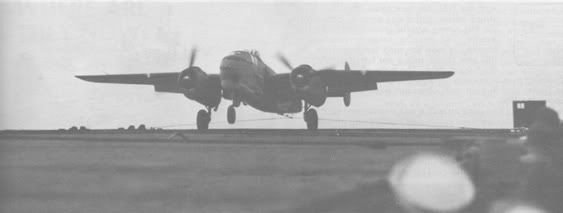
Here is a somewhat unusual picture of the USN WW2 set-up.
This is an aircraft being hooked up to the H-6 hydraulic catapult aboard USS Shangri-La on 15 November 1944.
Yes, that IS a “B-25″… actually USMC PBJ-1, BuNo 35277 (x USAAF B-25H 43-4700), on-board for carrier trials (the trials series included catapult tests on a P-38 Lightning, a P-39 Airacobra, a P-40 Warhawk, a P-47 Thunderbolt, a P-51 Mustang, and a P-61 Black Widow… as well as arrested landing tests on the P-51)!
The PBJ-1 made 2 arrested landings and 2 catapulted take-offs, according to the statement of the test pilot:
http://steeljawscribe.com/2007/10/05/flightdeck-friday-more-oddities
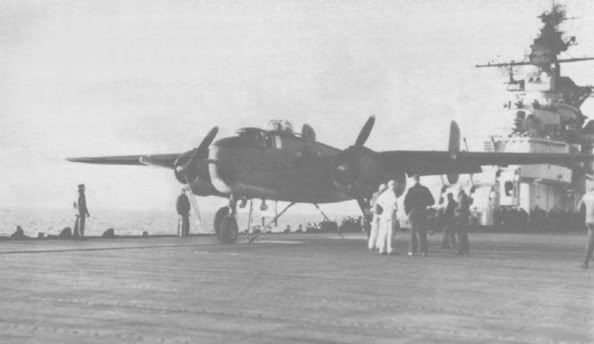
The aircraft had been modified, and also included a tailhook from a Douglas Dauntless dive-bomber.
By: JDK - 15th February 2011 at 00:51
Hi JD, I’m assuming that the catapault and cradle system that you show was an auxillary or early set up?
I seemed to think that Ark in her day used (the then new) steam catapaults to launch aircraft in what would become the standard way.
That is HMS Ark Royal (91), I understand, and I don’t see any reason to believe it a temporary system, although that’s part of the question.
Don’t forget most W.W.II British designed naval aircraft had four point accelerator (catapult) spools to fit this kind of set up (Sea Hurricane, Fulmar, early model Seafires etc.) I’m guessing what you are thinking of is the bridle system being used by the RN with US designed types.
Curious if anyone knows better on this?
By: F-18RN - 14th February 2011 at 21:33
Thanks pagen01 I think your right about the extra length being 4-ish foot.
Buccaneer and Scimitar were just lifted up at the nose until they sat on their tail skid, I don’t think the F4 had a tail skid hence the need for the nose extend.
The USNs F4Js were launched from Ark Royal many times during cross decking without problems. So maybe the F4k needed the extra AoA only if configured with certain stores and fuel load?
Paul.
Thats something, during crossdecking with US super carriers were Scimitars and Buccaneers launched whilst perched on the tailskids or given the length/power of the US carriers’ catapults, were they launched with the nosewheels on the deck?
By: Rockhopper - 14th February 2011 at 21:04
Yes I should have mentioned that, it displays the strop dropping away quite nicely. Can you remember what film you saw the Vixens in?
It was that TV show that’s narrated by Harry Enfield, each one is a half hour episode and features two aircraft.
http://www.youtube.com/watch?v=_Zd358QU5KM
7.05 is the bit
By: pagen01 - 14th February 2011 at 20:53
You would think, especially with that huge flat Phantom wing, the engines were already angled further down than the American J-79 powered aircraft.
It appears that speed was slightly more important than lift with most catapult launches, I guess it all comes down to lift and drag equations of which my mind can’t even begin to tackle 😮
By: Paul Holtom - 14th February 2011 at 20:40
From pictures it seems the RN Phantoms were always jacked up for take-off, don’t forget the British Spey aircraft were heavier and more draggy than the US counterpart, maybe this was an influence on the mod.?
Ahh yes! that would possibly be the correct answer. Would a higher AoA not also add to the drag?
Paul.
By: pagen01 - 14th February 2011 at 20:12
Yes I should have mentioned that, it displays the strop dropping away quite nicely. Can you remember what film you saw the Vixens in?
By: Rockhopper - 14th February 2011 at 17:52
Any excuse to repost this fantastic bit of film showing Scimitars, Vixens, Gannets, & Whirlwinds (even a Skyraider right at the end!) on an early Hermes commission, http://www.youtube.com/profile?user=joluqa#p/search/0/LFzRtOuj5GQ
You can just about see the splash as the bridle drops into the sea (right at the edge of the frame), its a surprisingly long way from the ship as well.
By: pagen01 - 14th February 2011 at 17:23
From pictures it seems the RN Phantoms were always jacked up for take-off, don’t forget the British Spey aircraft were heavier and more draggy than the US counterpart, maybe this was an influence on the mod.?


 Sign In








 February 6, 2011 at 5:24 pm