Afternoon all…
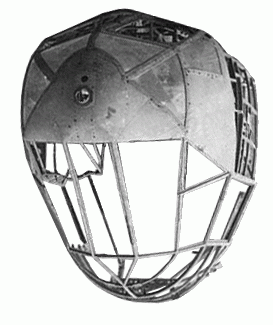
Does anybody have any suggestions as to what type the nose section below may have belonged to?

[Source: http://cgi.ebay.co.uk/ws/eBayISAPI.dll?ViewItem&item=140487727378%5D
Many thanks in advance…
Cheers
Peter D Evans
LEMB Administrator

By: Propstrike - 20th December 2010 at 18:57
Jolly Good Show !
Thank heavens that’s over- three nights with no sleep was taking it’s toll. 😉
By: Al Elliott - 20th December 2010 at 18:21
I must admit that it wasn’t that complicated.
I simply assumed that it had to be a more or less contemporary
french design, then I started to browse Aviafrance (great site!) by year,
starting with 1938.
I had no previous idea about design or purpose of the aircraft.
Al
By: John Aeroclub - 20th December 2010 at 17:41
It’s in Macdonalds Floatplanes. Well spotted. Hadn’t thought to look at floatplanes.
John
By: Mondariz - 20th December 2010 at 16:35
Good job Al!
These things drive me crazy and my head was spinning from clicking through the Flight Global Archive.
By: Tin Triangle - 20th December 2010 at 11:32
This was so challenging it would’ve given the “Wot plane” thread a run for its money! Amazing that this was answered.
Don’s link threw up some bizarre stuff the French built: you only have to scroll down that list of type histories to find a twin-fin Percival Prentice on floats, a beer barrel with wings, and easily the ugliest flying boat ever seen…
By: Creaking Door - 20th December 2010 at 02:04
Paris: of the two prototypes, the SE400-1 aircraft was assembled at the LeO works of SNCASE at Argentuil, which was and is on the R Seine, just outside Paris.
SE 400-01 assembled at Argenteuil was transported by rail and performed its maiden flight at Marignane, 31 December 1939.
Those two responses support and answer my question perfectly; and would also tend to confirm the identity of the mystery aircraft.
Thanks. 🙂
By: Scouse - 19th December 2010 at 14:25
If the first prototype ended up at Marignane and the picture was taken in or near Paris, then the unflown second aircraft seems a likely candidate.
By: Peter D Evans - 19th December 2010 at 13:52
The jokes get no better… but the answer to what I thought was going to be an impossible question is very much appreciated chaps & Al 🙂
Cheers
Peter D Evans
LEMB Administrator
By: bazv - 19th December 2010 at 13:41
My French isn ‘t good enough to wrestle any further with this brief
http://atf40.forumculture.net/l-aeronavale-f39/les-projets-inacheves-pour-l-aeronavale-aussi-t454.htmD seining off
Google translation Don….
Almost readable 🙂
SOUTHEAST SE400
In 1937, the technical department of aeronautics filed specifying a three-seater aircraft for coastal surveillance to succeed the now outdated CAMS 37. In March 1938, SNCASE began the construction of two prototypes, SE 400-01, with two aircraft powered by two engines flitteurs Gnome-Rhône 14 M8 / 9 655 hp, and SE 400-02, with two engines Lorraine Algol 120 to 500 hp. SE 400-01 assembled at Argenteuil was transported by rail and performed its maiden flight at Marignane, 31 December 1939.
The tests made it possible to restore the angle formed by the floats and the fuselage to provide better stability at takeoff. Similarly, between February 10 and March 14, the length of the fuselage and especially the nose was lengthened by 60 centimeters. Floats larger were needed. This work could not be achieved under conditions of ordinary performance, given the country’s commitment in World War II.
The weight of the military context was not the only influence on the work. Indeed, the instability of the machine was a constant problem experiments. SE 400-01 nevertheless had completed 12 hours and 5 minutes of flight on May 12, 1940, showing that the majority of difficulties would be overcome. But the German offensive SNCASE forced to cease continued testing. The work already undertaken on the SE 400-02 were also buried.
Type: Coastal Monitoring seater seaplane
Engine: 2 engines Gnome-Rhone 14 M 8 / 9 of 655 hp
Maximum lift-off mass: 5 500 kg
Performance: Maximum speed: 290 km / h
Ceiling: 3940 m
Autonomy: 960 km to 160 km / h
Dimensions: wingspan 19 m, length 13.30 m, height 4.40 m, wing area: 52 m2
Armament: no
By: pogno - 19th December 2010 at 13:37
Well done Al. What a business like aircraft that looks to be, it just looks right.
Richard
By: pagen01 - 19th December 2010 at 13:36
Where else can you find information and jokes of this calibre!:)
By: RedRedWine - 19th December 2010 at 13:12
how would a seaplane end up in Paris? :confused:
That question could drive you inseine.
(The joke is rather older than the photo)
By: Creaking Door - 19th December 2010 at 13:02
Yes, that looks like it…..well done! (Extra points since only one ever built!) 🙂
Does anybody know anything about its construction; was any of it wooden?
One other question; how would a seaplane end up in Paris? :confused:
By: bazv - 19th December 2010 at 12:54
Yes …well done Al
By: pagen01 - 19th December 2010 at 12:48
Al has it, well done!
By: RedRedWine - 19th December 2010 at 12:41
That’s convincing. You’re a genius, sir.
By: Al Elliott - 19th December 2010 at 12:29
My suggestion:
Sud-Est SE.400
http://www.aviafrance.com/aviafrance1.php?ID=1117&ID_CONSTRUCTEUR=1144&ANNEE=1939&ID_MISSION=0&MOTCLEF=
http://richard.ferriere.free.fr/3vues/se400_3v.jpg
Al
By: Bager1968 - 19th December 2010 at 12:20
That long flat plate in the center almost reminds me on a bomb-aimer’s window… if it was turned over.
By: pagen01 - 19th December 2010 at 11:06
I know it isn’t, but it reminds me of the Bristol 142 cockpit!
By: Arabella-Cox - 18th December 2010 at 22:54
Prototype?
Perhaps, as often happened (and still does), the prototype of an aircraft, its use no longer required, was donated to a training school and these are the remains of just such a machine?
Anon.


 Sign In








 December 17, 2010 at 2:36 pm