Looking at pictures on another forum of the racing P-51 “Precious Metal”.
With contra-rotating props it is powered by a RR Griffon.
Got me thinking – did the Griffon have any rivals? Were there any other late/post war piston engines with contra-rotating props that went into production?
Roger Smith.

By: Wyvernfan - 31st March 2025 at 15:02
Well not sure it counts as it was neither a rival nor did it actually go into production (only around 15 produced), but the RR Eagle 22 was designed for use with contra-props. Only ever fitted to the Wyvern TF-1 which first flew in 1946, it was a 24 cylinder H block monster rated at around 3200 hp.. but was sadly overtaken by the then new breed of turbo-prop powerplants.
Does make me wonder though that if one of these Reno racing teams unearthed an example that could be made to run, would they have the balls and money to fit it to an airframe.? Wishful thinking i guess..
Pictured is an impressive working model of an Eagle.
By: pogno - 31st March 2025 at 15:01
I know the RR Eagle was a stop gap engine fitted to the Wyvern while the Python was developed.
I have always wondered if it would have been better aircraft, reaching operational use earlier, saving on development, being simpler to maintain, more reliable and possible being produced in larger numbers, if they had stayed with the Eagle for the whole production run.
Richard
By: Wyvernfan - 31st March 2025 at 15:01
Thats the kiddie..!
By: minimans - 31st March 2025 at 15:01
Like this?
By: Nashio966 - 31st March 2025 at 15:00
was the napier sabre ever adapted to take contra rotating props?
By: Wyvernfan - 31st March 2025 at 15:00
I know the RR Eagle was a stop gap engine fitted to the Wyvern while the Python was developed.
I have always wondered if it would have been better aircraft, reaching operational use earlier, saving on development, being simpler to maintain, more reliable and possible being produced in larger numbers, if they had stayed with the Eagle for the whole production run.Richard
The answer to at least some of those is probably ‘yes’. But you also have to ask would the navy still want it, as among other things they were actively trying to move away from different aircraft using different types of fuel on board carriers. Although for a time the Wyvern / Seahawk / Sea Venom shared deck room with piston powered AEW Skyraiders, that was more out of necessity rather than choice. It was also a case of Rolls Royce not wanting to put the Eagle into production, as they deemed quite rightly that the way forward was with turbines.. not pistons.
By: pagen01 - 31st March 2025 at 14:58
Yes that Lycoming is something else, especially given the product that they are most associated with!
By: Nashio966 - 31st March 2025 at 14:58
well they came up with some colossal engines lol7
By: pagen01 - 31st March 2025 at 14:58
The Americans seemed to have stuck mainly with large radial engines after the war which don’t seem to get the contra-prop treatment, one noteable (and troublesome!) exception being the R-4360 fitted to the XB-35 ‘Flying Wing’.
The Griffon does seem to be fairly unique as a succesful in-line piston engine to power contra-props, possibly why it was in good demand for putting in the Reno racers etc.
By: RPSmith - 31st March 2025 at 14:58
Thanks for the responses guys.
I guess the hidden meaning of my original question was did the American engine industry not come up with one and, if not why not? They produced some very powerful piston engines – did they prefer to stick with large diameter props and longer undercarraiges?
Roger Smith.
By: pagen01 - 31st March 2025 at 14:58
was the napier sabre ever adapted to take contra rotating props?
Yes, Sabre 118 (VIII?) only fitted and flown in the Folland 43/37 test bed.
To the original question, don’t forget there was the contra-prop RR Merlins fitted to the Sturgeon.
By: Beermat - 31st March 2025 at 14:57
One application of a contraprop to a huge radial (Pratt & Whitney R-4360) – TB2D Skypirate, see http://en.wikipedia.org/wiki/TB2D_Skypirate
Oh, and the famously ill-fated Hughes XF-11:
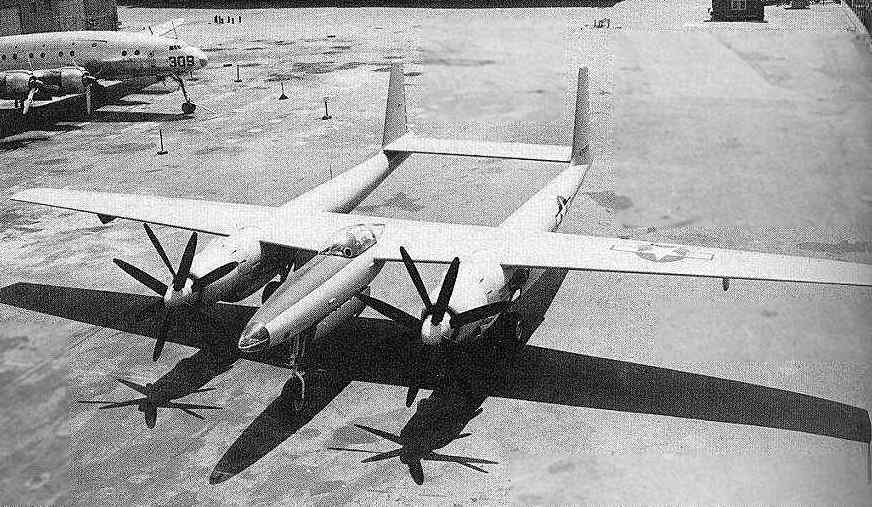
Cheers,
M


 Sign In








 January 10, 2010 at 4:58 pm