I was reading about the Short Stirling and noted (an allegation or fact?) that it was the first RAF heavy to be designed with 4 engines in mind. Both the Lancaster and the Halifax were originally designed as twins.
I am au fait with the Manchester but not the proposed H.P.56 which was the prior design to the H.P.57 Halifax.
The H.P.56 was to have been powered by RR Vultures (as per the Manchester) but none was ever built.
I wonder if anyone has an image of the design? I’d love to see it.

By: Cees Broere - 6th March 2009 at 11:32
Paul,
The Halifax was designed from the outset with air cooled radial engines, not the Merlin, That’s why the Merlin engine installation looks to be like an afterthought and caused so much drag.
There was one experimental Halifax with underslung nacelles and using higher powered Merlins which gave much better performance but the Halifax III with Hercules engines was considered to be a better option.
So the Air Ministry was partly to blame for the dissapointing performance of the early Merlin engined Halifaxes by forcing HP to use engines the airframe wasn’t designed for.
Cheers
Cees
By: Paul - 6th March 2009 at 10:33
Hi,
Two prototype HP56 were ordered in April 1937, as well as two Avro type 679. As far as I am aware they only got as far as the drawing stage, a one-sixteenth scale model was commisioned but I don’t think that it was built.
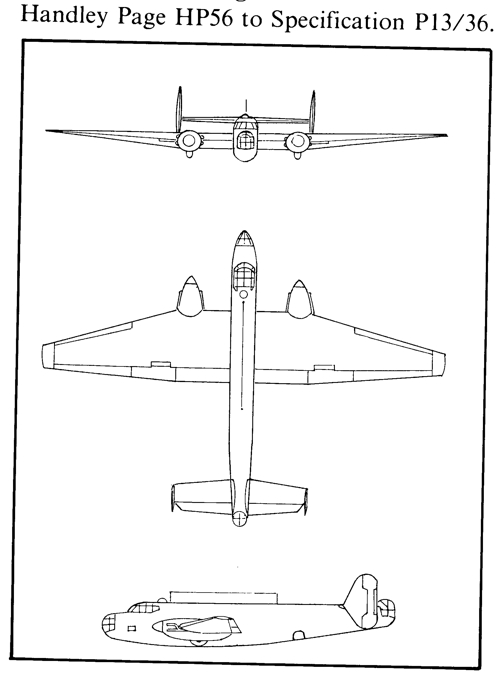
By July 1937 the air ministry was aware that the Vulture engine would not be available in sufficiant quantities so priority was given to Avro and they asked Handly Page to submit a drawing with four Merlins.
The two designs were developed but as became clear that the Vulture was not going available in sufficient quantities and the HP56 was dropped, the two Prototypes L7244 & L7245 appeared as HP57 with Merlins.
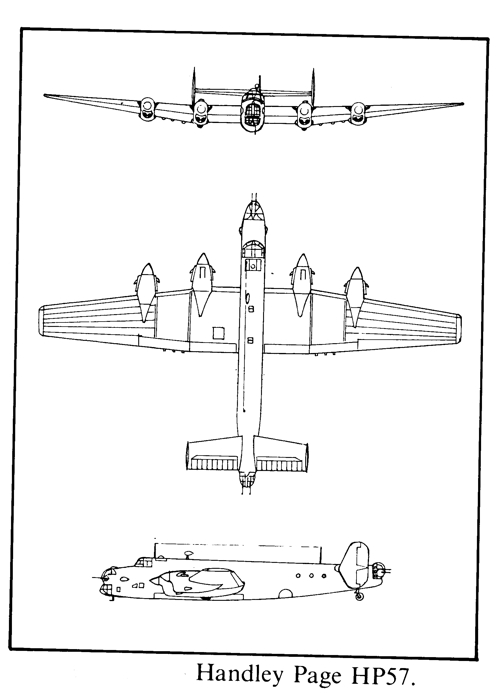
Interestingly HP Never really wanted the Merlin. The Air Ministry wanted to invesigate different engine possibilities; Napier Dagger, Bristol Taurus, Bristol Hercules etc. The mid wing engine mounting suited an air cooled radial, so why was it pushed into service with the Merlin? The design really came alive when the Hercules was installed.
(diagrams from “Halifax Second to None”: Victor Bingham)
Paul.


 Sign In








 March 6, 2009 at 3:08 am