
By: neil996 - 28th November 2008 at 10:13
Looks very clean!!!!!!!!
and cramped!
[ATTACH]167280[/ATTACH]
Rear gunners Turret at Elvington
By: neil996 - 28th November 2008 at 10:08
Looks very clean!!!!!!!!
and cramped!
By: turretboy - 27th November 2008 at 20:05
I can’t even imagine how you would swing a crash axe inside a turret.
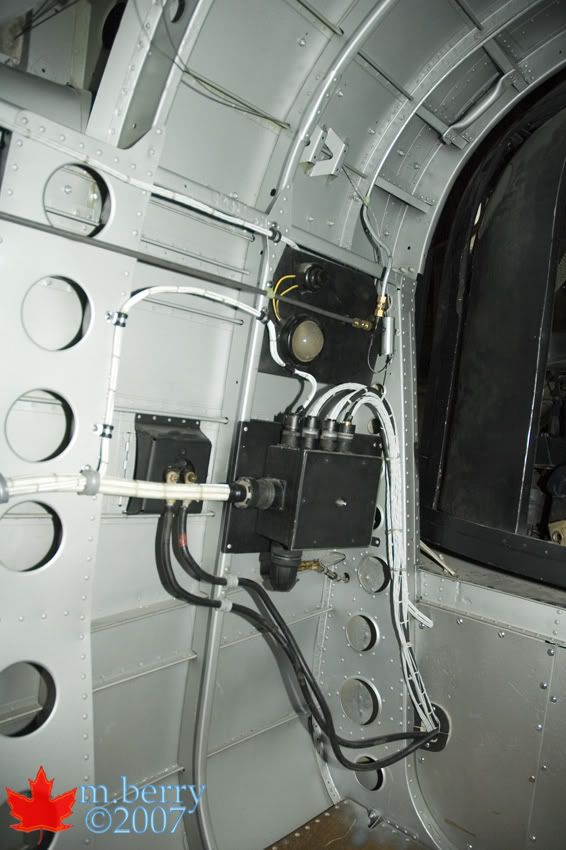
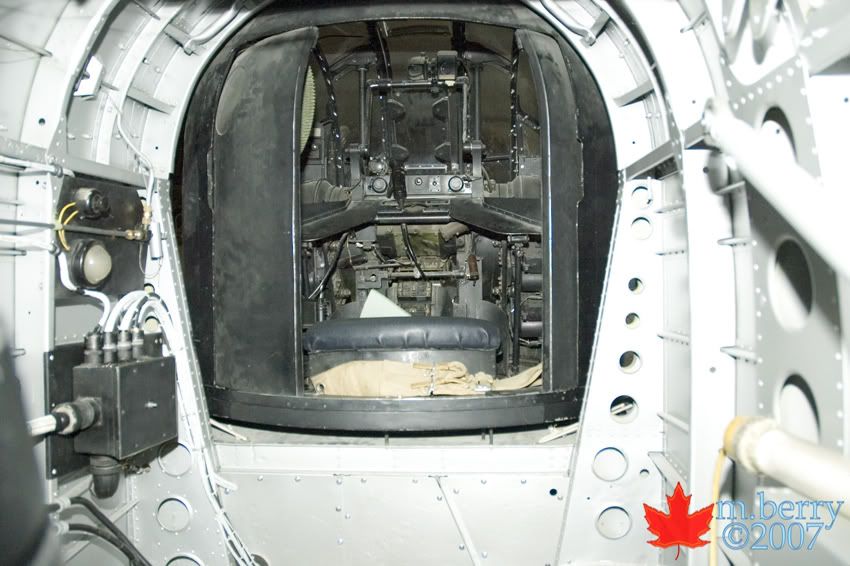
Here are a few interior shots looking towards the tail turret of Halifax NA337.
By: Cees Broere - 27th November 2008 at 19:15
I know there are several type E turrets about, does anyone know if some are being restored by private individuals?
Cheers
Cees
By: neil996 - 27th November 2008 at 18:59
cheers for that i was interested to know what other items were around the rear gunner.
😀
By: Arabella-Cox - 27th November 2008 at 11:43
Here you go neil996:-
By: neil996 - 27th November 2008 at 10:05
Item 70 on the accompanying extract from Vol. 1 is the parachute stowage for the rear gunner in a Halifax III.
At least the MUG could have eyes on the flight engineer from his bubble.
and i suppose it will depend on the pilots approach to let the rear gunner out of his turret early on the way home.
My relative was a 19 year old rear gunner who FTR on his 29th op.
any chance listing the other items numbered in this diagram please?
cheers
By: tiddles - 27th November 2008 at 05:47
My Old Man was a rear gunner in a Halifax 111 & flew with 578 Squadron Jan-August 1944. He died in 1959 so cant be of much help here but I remember him telling me that he was sometimes allowed to leave the turret & go up to the front of the plane at some point on the way home,I cant remember when. He said that they used to listen to the news on the radio sometimes with reports of the op they had been on & it was a lot more comfortable up the front. I also remember him telling me that the parachute was stored inside the fuselage which seemed a bit scary to me as a young boy.As for bailing out ,well crew had a much better chance statistically of getting out of the Halifax than the Lancaster,particularly the crew up front.
http://books.google.com.au/books?id=xcvFbza5RSoC&pg=RA1-PA755&lpg=RA1-PA755&dq=crew+survival+statistics+for+Halifax+%26+lancaster&source=web&ots=lWhh5uVW3l&sig=i7kZ6V98ayesMKjTVRmGuty_qcY&hl=en&sa=X&oi=book_result&resnum=7&ct=result
Tiddles
By: Frazer Nash - 27th November 2008 at 05:23
Yes the rear gunner was always in his turret from go to whoa. Some squadrons insisted rear gunners turn their turrets to port or starboard with guns depressed on take-off so as to avoid any accidental discharge into the aircraft behind. You will notice this in some period film clips.
It was a very lonely and frightening way to go to war. If (and that’s a big ‘if’) you saw a nightfighter there was no-one to turn to: the survival of the aircraft and crew was solely down to you.
We won’t see their likes again.
By: kev35 - 26th November 2008 at 23:20
Yes, I believe so. The two loneliest positions in a heavy bomber were the rear and mid upper turrets. As someone once wrote the remaining five crew members were together in a space not much bigger than a family car and that must have been comforting to them. I once knew a Flight Engineer on 514 who said that he couldn’t have completed his tour if he’d been confined to the rear or mid upper turrets.
The rear gunner, and the mid upper, as well as looking for night fighters would have had an important role to play in avoiding collision with other aircraft in the bomber stream. IIRC, a long time ago, when I was in the ATC, we had a Warrant Officer instructor who had been a rear gunner and I have a hazy recollection that he wore the ribbon of the DFM.
Regards,
kev35
By: neil996 - 26th November 2008 at 22:50
cheers for that info.
Would the rear gunner be in his turret from take off to landing?
By: Cees Broere - 26th November 2008 at 20:39
Another advantage was that when depressing the guns the seat would
go up which made aiming for the gunner much easier. The type E turret was
considered to be the best gunturret at the time.
Cheers
cees
By: Frazer Nash - 26th November 2008 at 20:08
There was a Mk1 and Mk2 type ‘E’ turret for the Halifax, but they are all but identical. There was no room for a parachute in the turret, but if I remember correctly, towards the very end of the war some pilot-type parachutes became available for the rear gunner.
The type ‘E’ turret was well-liked by its crews, and was unique in that the four .303 guns were mounted on their sides to facilitate the feed mechanism. It was controlled by a single ‘joystick’, with the trigger button on top.
Muchly hoping this is of some use!
By: Cees Broere - 26th November 2008 at 18:34
What they all above said.
:p
cheers
Cees
By: Arabella-Cox - 26th November 2008 at 15:34
Item 70 on the accompanying extract from Vol. 1 is the parachute stowage for the rear gunner in a Halifax III.
By: Graham Boak - 26th November 2008 at 14:42
Aircrew, by Bruce Lewis, Cassell 1991, includes the story of Reg Scarth. It described having to open the door of the Halifax rear turret, get the parachute from the rack nearby, and then rotate the turret to fall out.
Presumably it would depend on the urgency: not all bale-outs were immediate.
I also found comments about the parachutes being stored near the rear turrets on Whitleys and Lancasters – which both had the Frazer Nash turrets – but no direct comment about how the gunner escaped.
By: neil996 - 26th November 2008 at 12:42
can this be confirmed for Halifax’s?
By: Graham Boak - 26th November 2008 at 12:31
I believe there was no room in the turret for wearing the parachute, but on the other hand I have heard of tail gunners rotating the turret, opening the rear doors and falling out. This may not have been Halifax. The alternative was to go back into the rear fuselage, clip on the parachute and then leave via the crew hatch. He would not normally re-enter the turret.
By: neil996 - 26th November 2008 at 12:26
i would prefer to have it on then trying to reach in and put it on then move turret to bail out.
very scary stuff
By: kev35 - 26th November 2008 at 12:18
I reckon if you were given the order to abandon the aircraft you’d want very much to be putting it on!
When we were kids and read the comics and Commando books and saw some films it was always so easy for the crew to get out. Now we are older, though not necessarily wiser, we realise from reading and speaking to Veterans just how difficult the act of leaving the aircraft could be. Coping with the darkness, an aircraft possibly out of control, fire, structural damage, injury or wounds and the absolute fear that must have accompanied the experience.
There really can be no end to our admiration for what these crews endured.
Regards,
kev35


 Sign In








 November 26, 2008 at 10:30 am