So to keep with the Heritage theme folks.
Does anyone think we will every see any Historical Airdromes of Air fields be listed on the UNESCO Heritage List. While I know that there are some that are on National List, I don’t think their has been any listed on UNESCO yet.
And which ones would we put on this list,
For me I would think the following would be listed and mind you this list is just off the top of my head.
Duxford
Boscom Downs
Kitty Hawk
Point Cook
Pensacola
College Park
What would you add and what should the critera be.

By: Pete Truman - 20th February 2008 at 08:56
Very interesting information on Stow Maries, I’ve lived in this area for 30 years, had relatives living near the place but had no idea of it’s history.
You can easily pick it up on Google Earth, it’s NW of the village, presumably the take off field was situated to the east of the line of buildings.
I would nominate Biggin Hill for special status, still intact and in use, it must be the most famous surviving BoB station in existance, how much has it changed since 1940 in comparison to, say Duxford.
What is interesting is that if you look at it on Google Earth, the number of Learjets and their ilk on the airfield is quite amazing.
Another place worth listing must be Cardington as it is the only place in the UK with it’s airship sheds intact, is there such a place surviving in Germany.
By: mark_pilkington - 20th February 2008 at 07:11
howz about stow maries aerodrome in essex, the sole remaining and largely intact genuine 1stww airfield anywhere in the UK!
Another one is Hainault farm, similiar to the above site, but now in use by light industry!!
tim
:p
This one interested me, so off to “Google”, and all shall be revealed:
from http://www.angliamfc.org.uk/history.htm
Biggin Hill, Tangmere, and Duxford, became familiar names to many during World War One, but how many would remember Stow Maries, Essex? Home to men of the newly-blooded Royal Flying Corps (RFC)–the field was known by the locals as Stow St. Mary, after the nearby parish church of St. Mary and St. Margaret. The name ‘Maries’ derived from a marshy area of the parish alongside the River Crouch.
The aerodrome came into being in late 1914 when land was requisitioned from the Turner family at Edwins Hall and the Jones’ farm at Old Whitmans. Permanent brick structures began to take shape the following year. Although all the buildings were not completed until December 1918, by the time the first flying unit arrived in 1916 living conditions were good with airmen accommodated in barrack blocks on the western edge of the main site and catering facilities provided by a large canteen.
A mess building for officers was situated on the very edge of the flying field. Other structures included motor transport sheds, fuel stores, blacksmith’s shop, generator building and water tower. Married airmen had to find local lodgings for their families — the provision of married quarters did not come into being until the 1930s Expansion Scheme.
The only unit to occupy Stow (as it was usually called) was 37 Squadron RFC, which had formed in early September 1916 at the experimental establishment of Orfordness, Suffolk, flying BE.2s and BE.12s. The squadron headquarters was established at The Grange, Woodham Mortimer, and by September 15, its flights were dispatched to three Essex aerodromes. Their job was to combat the threat from German airships and aircraft as they attempted to reach targets in East Anglia and as far inland as West London. Upon receipt of orders, ‘A’ Flight moved to Rochford, ‘B’ Flight to Stow Maries and ‘C’ Flight to Goldhanger where it replaced the Royal Naval Air Service, then in the process of moving out………………..
After closing down in 1919, it is surprising to many that the aerodrome was not re-opened to serve during World War Two – with its facilities still in place it could have fulfilled a useful role quite readily. Air Ministry surveyors inspected Stow early on in 1939, but the powers-that-be decided to update another World War One aerodrome, Rochford, some 12 miles to the southeast.
Stow stayed under the plough – buildings on the technical site were used to house farm workers and the remaining structures provided storage and maintenance facilities for farm implements.
No attempt was made to camouflage the site or obstruct the old landing areas, consequently it still resembled an active station from the air. This most likely contributed to it receiving its share of bombs and missiles during World War Two.
The most notable of these occurred on April 20, 1941 when a pair of parachute mines dropped near to Flambirds Farm. They caused extensive damage to five of the technical site buildings lived in by farm workers and partially destroyed the northern aeroplane hangar. The farm workers were rehoused and the hangars finally taken down after the war, the timber being sold off locally.
The only known aircraft arrival at Stow during World War Two was on September 7, 1940, when P/O Dennis Crowley-Milling of 242 Squadron force-landed his Hurricane P3715 ‘LE-M’ on the field after sustaining a damaged radiator in combat. The aircraft’s undercarriage was damaged and it was dismantled for recovery by road……..
So what remains at Stow Maries from the days of World War One? Quite simply it provides the most complete example of a permanent aerodrome of that period. Its buildings have, almost miraculously, survived the vagaries of the English climate although the interiors of some barrack block buildings have suffered from their proximity to farm animals and vandals have left their mark in the Officers’ Mess washrooms. Thankfully, because the adjacent lounge area is now being used regularly by the aerodrome resident as a garage, the period fireplace built from Dutch bricks remains intact.
The ‘other ranks’ canteen is now a corn batching and storage area, so its future seems assured, whilst in the very centre of the technical site some buildings are inaccessible due to the ever-encroaching undergrowth. The water tower also still stands proudly erect, surveying all around it.
The Senior NCO’s quarters became a form of air museum in the late 1960s, mainly concerned with wreckology, as is evident from the remains of a V2 rocket engine venturi still lying in the grass nearby. Later it became the outdoor activity base for the local Scout group but since this came to an end the building remains empty at the edge of the field.
How much longer the aerodrome will remain as a memorial to the gallant fliers of the embryo Royal Air Force cannot be determined. For now at least Stow Maries remains a place for which time itself has stood still.

Its also on wiki > http://en.wikipedia.org/wiki/Stow_Maries
and its own webpage http://www.essex-family-history.co.uk/stowaf.htm
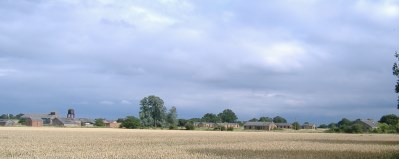

and certainly worthy of National Heritage listing in the UK and even world heritage listing?
Apparantly English Heritage investigated and reported the site in 1998 for the NHR?
Regards
Mark Pilkington
By: VX927 - 19th February 2008 at 11:45
I think RAF Scampton should be on the list… Not least because of 617sqn, Niggers grave and it’s overall war time roll…
But it’s hard to find a WWII airfield that shouldn’t be on the list!
By: low'n'slow - 19th February 2008 at 11:32
howz about stow maries aerodrome in essex, the sole remaining and largely intact genuine 1stww airfield anywhere in the UK!
:p
Wow. I’d never heard of it before.
Anyone got any further information on the site?
By: Arabella-Cox - 19th February 2008 at 10:10
Templehof – Berlin just has to be there. A mix of history and architechture. Never been there but the pictures seem to convey so much………
Oh, by the way, it is Boscombe Down
Planemike
By: Paul F - 19th February 2008 at 09:31
How about Shoreham, UK – the starting point for the world’s first commercial air cargo flight? (FYI It carried a cargo of electric light bulbs – flown from Shoreham Airport to Hove Lawns about six miles away).
Paul F
By: mark_pilkington - 19th February 2008 at 06:24
Australian Aviation Heritage Sites
Australia has a few important aviation sites, many are already on State Based heritage registers, or the Commonwealth list (that list is for sites owned by the Commonwealth or Federal Government and therefore outside the legal jurisdiction of the State laws and lists despite geographic location)
Point Cook is currently the only aviation site listed on the Australian National Heritage List and has been under consideration for nomination to the World Heritage List.
Other state or commonwealth heritage listed airfields include:
RAAF Laverton
RAAF Amberley
RAAF Richmond
Essendon – Melbournes original Civil airfield
Ballarat airfield (former EATS airfield).
Longreach (Qantas founders)
Rathmines (Seaplane Base)
Tocumwal (USAF base)
Werribee Satellite Airfield
and a number of these could be significant enough to be placed on the Australian National Heritage List along side Point Cook.
Other Australian “Avaition” locations worthy of listing include:
Cremourne Gardens in Richmond Victoria – site of first Hot Air Balloon ascent in Australia – 1858
Stanwell Park NSW Boxkite experiments by Hargraves 1984.
Narrebeen Beach NSW flight by Taylor of the first Glider in australia – 1909
Diggers Rest – Victoria site of first controlled powered flight in Australia by Harry Houdini in 1910
Spring Plains Mia Mia near Kyneton Victoria – site of first Australian designed/built aircraft to fly in 1910
Altona Bay Victoria – site of first passenger flight, and first cross country flight, by JJ Hammond in 1911.
Penrith NSW, site of (Hart’s) first flying School in Australia 1912
Most of these are sites with little or no built heritage or buildings relating to the notable event, but are certainly of State Significance and very likely of National Significance, and it would be appropriate for them to be nominated ahead of their centenaries being celebrated in the near years.
One which I am considering nominating myself (I have been directly involved in the listing of a number of sites including the nomination of Point Cook to the Commonwealth and National Heritage Lists and 3 other sites to lesser lists) is Ballarat Aerodrome, which is the most intact EATS school still surviving in Australia, as stated above it is already on the State Heritage List.
The EATS program was a very important part of the Australian War Effort, and had a major impact on both the recruits and their families, but also the rural communities which hosted the rapid development of the EATS schools and flying programs, and therefore very likely to be successfully assessed for the National List.
On the basis of the role EATS played in WW2, the site may well be suitable to a future World Heritage List, see below.
Regards
Mark Pilkington
1 AIRPORT ACCESS ROAD MITCHELL PARK, Ballarat City
VHR Number H2113
File Number PL-HE/03/0656 [ Part 1 an
Other Names BALLARAT AERODROME|BALLARAT AIRPORT|RAAF Buildings
Municipality Ballarat City
Extent of Registration All the land known as Ballarat Aerodrome marked L1 on Diagram 2113A held by the Executive Director.
The features marked as follows on Diagram 2113A held by the Executive Director
F1 Liberator Air Strip
F2 Parade Ground
All the buildings marked as follows on Diagram 2113B held by the Executive Director
B1 Building 184 Propeller Test House
B2 Building 132 Bellman Hangar
B3 Building 133 Maintenance Workshop
B4 Building 141 Parachute Hut
B5 Building 189 Woodwork, Fabric and Paint shop
B6 Building 188 Mechanical Workshop
B7 Building 138/139/140 Equipment Stores
B8 Building 274 Clothing store
B9 Building 191 Operations and Crew Room
B10 Building 190 Operations and Crew Room
B11 Building 130 Bellman Hangar
B12 Building 180 Bellman Hangar
B13 Building 182 Flight Office
B14 Building 131 Bellman Hangar
All the buildings marked as follows on Diagram 2113C held by the Executive Director
B15 Building 114 Boiler House
B16 Building 212 Temporary Married Quarters
B17 Buildings 116/117 Sergeants Ablution Block and Latrine
B18 Building 125 Sergeants Sleeping Quarters
B19 Building 118/119 Officers Ablution Block and Latrine
B20 Building 126 Store
B21 Building 111 Sergeants Mess
B22 Building 115 Boiler House
B23 Building 110 Officers Mess
B24 Building 207 Laundry and Drying Room
B25 Building 121 Sergeants Sleeping Quarters
B26 Building 122 Sergeants Sleeping Quarters
B27 Building 124 Sergeants Sleeping Quarters
B28 Building 120 Officers Sleeping Quarters
B29 Building 123 Officers Sleeping Quarters
B30 Building 196 Officers Sleeping Quarters
B31 Building 208 Garage
B32 Building 213 Temporary Married Quarters
B33 Building 210 Temporary Married Quarters
B34 Building 211 Temporary Married Quarters
B35 Building 107 Sleeping Quarters
B36 Building 233 Radio Hut
B37 Building 232 Emergency Power House
B38 Building 112 Sergeants Sleeping Quarters
B39 Building 113 Sergeants Sleeping Quarters
B40 Building 154 Gymnasium
B42 Building 234 Radio Hut
B48 Building 209 Garage
All the buildings marked as follows on Diagram 2113D held by the Executive Director
B40 Building 154 Gymnasium
B41 Building 170 Station Headquarters
B43 Building 135 M/T Office and Workshop
B44 Building 136 Barracks Store
B45 Building 134 Barracks Office Store
B46 Building 144 Latrine and Change Room
B47 Buildings 20/30/61 Sleeping Huts and Ablution Block
The structure marked as follows on Diagram 2113D held by the Executive Director
S1 Elevated water tower
Spatial Information -37.519003, 143.787085
Heritage Act Categories Heritage place
Statement of Significance
What is significant?
The former Ballarat Royal Australian Air Force (RAAF) Base on the site of the present Ballarat Aerodrome, 7 km northwest of Ballarat city centre was constructed in 1940 at the outset of the Second World War as a training school for Wireless Air Gunners under the Empire Air Training Scheme (EATS). The Scheme was established by the British with Canada, Australia and New Zealand to rapidly train air crews for the British Bomber Command to fight the then far superior German Air Force. Under EATS which operated from 1939-1945 the RAAF was committed to training 28,000 aircrew over three years including navigators, wireless operators, air gunners and pilots, equating to around 900 aircrew every four weeks. To achieve this the RAAF embarked on a rapid and extensive program establishing a network of 28 EATS schools in eastern Australia by the end of 1941, each specialising in specific skill sets required of air crew members. The former Ballarat RAAF Base was Australia’s No.1 Wireless Air Gunners School (WAGS), the first of three WAGS created under the Scheme and the only one in Victoria.
By 1941 there were nearly 800 personnel on the former Ballarat RAAF Base and by the end of March 1942 a total of 1238 air men had been trained in the operation of radio equipment and guns using Avro Anson and Wackett aircraft. A radar training wing was also established at the former Ballarat RAAF Base in 1945. Basic training for wireless operators ceased in May 1945 by which time 5025 trainees has been through the school.
In consequence of the United States declaring war on Japan in Dec 1941 a strategic alliance with Australia was formed and in 1942 the RAAF Base at Ballarat was extended to accommodate a Liberator Bomber Squadron to assist in the prosecution of the Pacific War and in the strategic defence of Australia. The US forces camped immediately south of the residential area of RAAF Base where they constructed the Liberator Air Strip for use by their B24 bombers, large planes for the long range bombing missions required in the Pacific. By 1943 there were 80 United States aircraft at the base.
The Wireless Air Gunners School was formally disbanded in January 1946. The RAAF continued to operate the aerodrome until 1961 when it became the property of the Ballarat Council. The Ballarat Aerodrome continues to operate as a civil airport and the surviving Second World War structures on the site provide accommodation for a large number of community organisations including an aviation museum.
The extant Second World War structures associated with the WAGS are primarily ‘P-Type Huts’ and Bellman Hangars neither of which were originally intended to be permanent structures, having been prefabricated and erected on military sites throughout Australia in response to the sudden and urgent need for semi-permanent accommodation for service personnel and for aircraft hangars at the beginning of the Second World War. The P-Type Huts, consisting of a simple timber and corrugated iron box with a gabled roof usually with doors at each end could be easily modified as required for particular functions. By 1941 approximately 160 standard P-Type Huts had been erected on the Ballarat site in two distinct functional precincts. In the northern aerodrome precinct around fifteen huts, of which twelve survive, were arranged on the outside of a group of four Bellman hangars arranged in pairs a few metres apart. Bellman hangars had been designed in Britain immediately prior to the Second World War to provide a fast, economical solution to the need for aircraft facilities. The surrounding P-Type Huts were used for equipment and clothing storage, maintenance and administrative functions associated with the operation of the aircraft. At the centre of the base was the administrative, domestic and teaching precinct where over 140 huts were erected in rows, singly or in combination with additional roofs to create larger buildings. They were adapted for various uses including sleeping quarters, recreation rooms and messes, lecture halls, radio huts, stores, offices, workshops and ablution blocks. Thirty four huts remain in the central precinct. These include the former Officers’ and Sergeants’ Messes, sleeping quarters, ablution blocks, Headquarters, the maintenance and transport depot, stores, the gymnasium and several ablution blocks.
Other remaining fabric associated with the Second World War includes an elevated water tower, the foundations of demolished P-Type Huts and other structures and in the southern part of the site, the archaeological remains of the United States Air Force camp and the ‘Liberator Air Strip’. Landscape features associated with the former Ballarat RAAF Base include road layout and the playing fields and parade ground with its border of Monterey Cypress (Cupressus Macrocarpa) that separate the aerodrome precinct to the north from the central domestic and administrative precinct.
How is its significant?
The former Ballarat RAAF Base is of historical and social significance to the State of Victoria.
Why is it significant?
The former Ballarat RAAF Base is of historical significance for its ability to demonstrate the importance of military aviation to the defence of Australia and its Allies during the Second World War, the first conflict in which aircraft played a major role in combat for the Australian military.
The former Ballarat RAAF Base is of historical significance for its association with the technical training aspects of the wartime development and operation of the RAAF. The former Ballarat RAAF Base is a representative example of the bases constructed to train aircrew under the Empire Air Training Scheme that included a contingent suite of temporary and semi temporary buildings that in their layout and surviving the Second World War fabric reflect both the training and domestic functions of the bases and the hierarchical nature of the military and domestic life on the Second World War bases. This contingent planning is clearly reflected in the two precincts of the former Ballarat RAAF Base – the aerodrome itself with the large prefabricated Bellman hangars and workshop huts, and the domestic and administrative precinct of standard P-Type Huts.
The former Ballarat RAAF Base is the most intact surviving Victorian example of the training schools that were rapidly constructed across Australia specifically to train aircrews under the Empire Air Training Scheme in the early years of the Second World War and representative of the inventive ways in which functional requirements of the military were satisfied during the war. The Ballarat RAAF Base was the first of three Wireless Air Gunnery Schools established nationally under the Scheme and the only such school in Victoria.
The former Ballarat RAAF Base is of social significance, providing an opportunity to educate about the operations of the Air Force throughout the Second World War, in particular the relationship of the Commonwealth allies against the German forces, particularly later in the war when personnel trained here were dispersed with others to serve with the RAF in Europe, and subsequently the increasing importance of the United States and Australian alliance during the Pacific campaign against the Japanese.
By: gwrco - 19th February 2008 at 01:37
howz about stow maries aerodrome in essex, the sole remaining and largely intact genuine 1stww airfield anywhere in the UK!
Another one is Hainault farm, similiar to the above site, but now in use by light industry!!
tim
:p
By: Colaga - 19th February 2008 at 00:18
I would have said Hawkinge were it not a couple of decades too late…
By: Martti Kujansuu - 18th February 2008 at 18:40
Helsinki-Malmi.
– “The official opening ceremony took place on 15 May 1938.”
– “Helsinki-Malmi Airport was among the first in the world to be designed from the beginning as an international airport.”
– “It has been selected to the worldwide List of 100 Most Endangered Cultural Sites 2004 by the World Monuments Fund, and re-selected to the 2006 list in June 2005. The Airport is also included in the Finnish selection of the international DoCoMoMo Workgroup dedicated to cataloguing and preserving buildings, monuments and sites of the modern movement.”


 Sign In








 February 18, 2008 at 5:07 pm