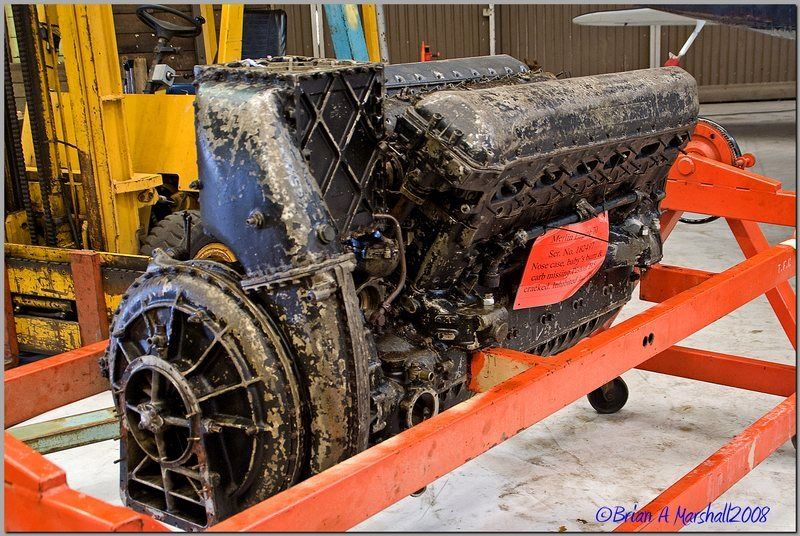
By: Camlobe - 20th February 2008 at 23:53
Andy G,
Thanks for pointing out the important part that I did forgot to mention.
As an aside, those brilliant engineers in Germany made fantastic aircraft and engines to power them. The mechanical fuel injection system used on the DB series was individually adjustable to ensure correct fuel/air mix to each cylinder. This fuel injection system ensured Me109’s could bunt without an engine cut, unlike the Spits and Hurri’s of the day. However, as Andy G mentions, because the DB’s had fuel injected directly into the inlet ports i.e. after the supercharger, these engines did not benifit from the adiabatic cooling of the charge. Rolls Royce’s Merlins and Griffons, carb’d and fuel injected versions, introduced the fuel into the air prior to compression by the supercharger, thereby enjoying the benifits.
camlobe
By: AndyG - 16th February 2008 at 19:20
Pen Pusher,
That ‘bit on the supercharger’ is the charge cooler, normally called the intercooler. It can be found on 60, 70 and 80 series Merlins as well as 100 series (if memory serves me correctly).
Following two stages of supercharging, the charge (or fuel/air mixture) has been compressed to such an extent that its temperature has increased to a level where detonation would happen in the combustion chamber. The solution was to install a heat exchanger between the supercharger outlet and the engine inlet ports. This heat exchanger is liquid cooled, and the pipework feeds to a radiator fitted in one of the underwing cowls. An engine driven pump circulates this charge coolant and forms a totally seperate system from the engine coolant system.
Although this system sounds similar to what you find on vehicles, including Land Rovers, most road vehicles are fitted with an intercooler, not a charge cooler.
The difference?
An intercooler cools air compressed (normally) by the turbocharger before it enters the inlet manifolds. Fuel is then added at the inlet port (fuel injected petrol engine) or in the combustion chamber (direct or indirect injection diesel).
A charge cooler cools the fuel/air mixture or charge prior to entering the inlet manifold.
Why did the Merlin / Griffon engines have a charge cooler?
The genius’s at Rolls Royce utilised the benifit of adiabatic cooling of the charge.
What???
If you mix the fuel and air prior to compressing it in a supercharger, the charge has the property of evaporative cooling (put simply) lowering the charge temperature on the Merlins and Griffons by approximately 25 Degrees C, lowering the tendency to detonate. Think of it as free intercooling.
camlobe
Thanks camlobe, also not to forget the increase in charge density and hence power output which is another free gain from compressing and cooling the charge. Something which the DB 6xx fuel injected series didn’t benefit from.
By: Camlobe - 16th February 2008 at 16:30
Pen Pusher,
That ‘bit on the supercharger’ is the charge cooler, normally called the intercooler. It can be found on 60, 70 and 80 series Merlins as well as 100 series (if memory serves me correctly).
Following two stages of supercharging, the charge (or fuel/air mixture) has been compressed to such an extent that its temperature has increased to a level where detonation would happen in the combustion chamber. The solution was to install a heat exchanger between the supercharger outlet and the engine inlet ports. This heat exchanger is liquid cooled, and the pipework feeds to a radiator fitted in one of the underwing cowls. An engine driven pump circulates this charge coolant and forms a totally seperate system from the engine coolant system.
Although this system sounds similar to what you find on vehicles, including Land Rovers, most road vehicles are fitted with an intercooler, not a charge cooler.
The difference?
An intercooler cools air compressed (normally) by the turbocharger before it enters the inlet manifolds. Fuel is then added at the inlet port (fuel injected petrol engine) or in the combustion chamber (direct or indirect injection diesel).
A charge cooler cools the fuel/air mixture or charge prior to entering the inlet manifold.
Why did the Merlin / Griffon engines have a charge cooler?
The genius’s at Rolls Royce utilised the benifit of adiabatic cooling of the charge.
What???
If you mix the fuel and air prior to compressing it in a supercharger, the charge has the property of evaporative cooling (put simply) lowering the charge temperature on the Merlins and Griffons by approximately 25 Degrees C, lowering the tendency to detonate. Think of it as free intercooling.
camlobe
By: merlin70 - 16th February 2008 at 15:21
I thought I was intact.
As far as I am aware the only bit that is missing from me is my appendix.
By: Pen Pusher - 16th February 2008 at 10:29
Cheers Gents.
It just didn’t look right with that bit on the supercharger sticking up above the top of the engine.
Many thanks
Brian
By: stuart gowans - 16th February 2008 at 09:56
Tank engines don’t have superchargers; this one is missing the carb.
By: Bruce - 16th February 2008 at 08:47
No, it is a Merlin 70 – but has a lot missing!
Bruce


 Sign In








 February 16, 2008 at 8:25 am