dark light
Boom XB-1 goes supersonic
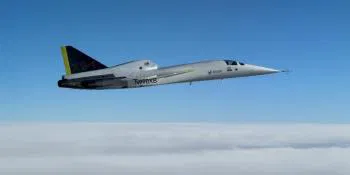
The Boom XB-1 has for the first time broken the sound barrier. Boom Technology’s quest to bring back faster-than-sound passenger transport took a significant leap forward on January 28 2025, with the first human-piloted civil supersonic flight since Concorde’s retirement in 2003. The company’s XB-1 technology demonstrator aircraft broke the sound barrier for the first time during Flight 12 of its test programme. The XB-1 was flown by the company’s Chief Test Pilot, Tristan ‘Geppetto’ Brandenburg, for the sortie, operating from the Mojave Air & Space Port in California.
Boom XB-1 flying
The Boom XB-1 went supersonic – a first for an American commercial design – on January 28, 2025. Boom
The aircraft was positioned for its supersonic run in the Black Mountain Supersonic Corridor at 35,290ft (10,756m), followed by Dassault Mirage F1 and Northrop T-38 Talon chase jets. The XB-1 achieved a maximum of Mach 1.122 (750mph) around 11 minutes 30 seconds into the flight. It landed back at Mojave after being airborne for 34 minutes. Speaking after the flight, Tristan Brandenburg said: “It has been a privilege and a highlight of my career to be a part of the team that achieved this milestone – every single member of this team was critical to our success. Our discipline and methodical approach to this flight test programme created the safety culture that made a safe and successful first supersonic flight possible. With the lessons learned from XB-1, we can continue to build the future of supersonic travel.” The event was livestreamed by the company, hosted by Mike Bannister, the former Chief Concorde Pilot for British Airways.  

Supersonic demonstrator

The XB-1 is claimed by the company to be the world’s first independently developed supersonic jet and the first civil supersonic jet made in America. During Flight 11 on January 10 the XB-1 reached Mach 0.95 over the Mojave Desert, reaching a maximum altitude of 29,481ft (8,986m) during a 44-minute sortie and experiencing the highest dynamic pressure the aircraft is expected to encounter in its flight profile. “XB-1’s supersonic flight demonstrates that the technology for passenger supersonic flight has arrived,” said Blake Scholl, the founder of Boom and its CEO. “A small band of talented and dedicated engineers has accomplished what previously took governments and billions of dollars. Next, we are scaling up the technology on XB-1 for the Overture supersonic airliner. Our ultimate goal is to bring the benefits of supersonic flight to everyone.” Boom was formed in 2014. At the time it was unveiled on November 15, 2016, the XB-1 ‘Baby Boom’ was expected to fly in late 2017, but the project was delayed as funding was secured and design and development undertaken and the configuration refined. The registration N990XB was allocated in the Experimental classification on May 15, 2017. The XB-1 was rolled out on October 7, 2020, and commenced taxi tests in December 2022. The maiden flight occurred on March 22, 2024, with the company’s then Chief Test Pilot, Bill Shoemaker, at the controls (Brandenburg took over from the second flight on August 26). Successive test flights have evaluated systems and aerodynamics, as well as incrementally expanding the flight envelope through subsonic and transonic regimes prior to the initial supersonic test on sortie 12. Boom is planning another supersonic flight in early February, which may see the XB-1 achieve Mach 1.3, although this is dependent on analysis of data from the January 28 sortie. It is understood that this will be the final fight of the demonstrator.
Boom Overture flying
A computer-generated image of Boom’s Overture supersonic airliner. Boom

Overture

The XB-1 was created to prove technologies for the Overture commercial airliner. They include the use of carbon fibre composites, which is used extensively in the XB-1 to provide a sophisticated aerodynamic design with a strong, lightweight structure. The long nose of the XB-1 and the forthcoming Overture, plus the high angle-of-attack the aircraft adopt for take-off and landing required the development of an augmented reality vision system for the pilots to dispense with the need to resort to the complex and heavy system that lowered and raised the nose of Concorde. Ground testing of the system began in late July 2021. The XB-1 also acts as a testbed for a digital stability augmentation unit that increases safety at high speed and during take-off and landing. The Overture will be powered by the Symphony medium-bypass turbofan, with a take-off thrust of 35,000lb (160kN). Design of the engine has been entrusted to Florida Turbine Technologies, with the prototype expected to be run for the first time during 2025. The airliner will be able to carry between 64 and 80 passengers at Mach 1.7, with Boom having identified over 600 different routes that could benefit from the shorter journey times offered by its supersonic capability. In 2017, Boom predicted that 1,000 supersonic airliners would be needed by 2035. It currently holds 130 orders and pre-orders from American Airlines, Japan Airlines and United Airlines. An assembly facility – known as the Overture Superfactory – has been constructed at Greensboro, North Carolina, which will be capable of manufacturing 66 Overtures a year at full capacity. Work on the first is expected to begin there around mid-2027.

Topics

Read more about Seccionales de la FAA ahora disponibles en Navigraph Charts PR Spitfire under way in Sweden

Become a Premium Member to Read More

This is a premium article and requires an active Key.Aero subscription to view.

I’m an existing member, sign me in!

from our leading aviation publications

Premium Key Aero subscribers get access to read all our magazines online as soon as they leave the editor’s desk.


our-landing-logo8
our-landing-logo7
our-landing-logo6
our-landing-logo5
our-landing-logo4
our-landing-logo3
our-landing-logo2
our-landing-logo1