dark light
First EPAWSS-modified F-15E Strike Eagles arrive at RAF Lakenheath
The US Air Force’s first F-15E Strike Eagles equipped with the advanced AN/ALQ-250 Eagle Passive/Active Warning and Survivability System (EPAWSS) have arrived at the 48th Fighter Wing at RAF Lakenheath Suffolk.This new electronic warfare (EW) system has been developed by BAE Systems in cooperation with Boeing. EPAWSS provides a significant upgrade of the F-15E’s capabilities to counter modern threats in contested environments. It follows years of development and testing of the EPAWSS, which is designed to replace the legacy Tactical Electronic Warfare System (TEWS). The new system enhances the F-15E’s ability to detect, identify, and counter both airborne and ground-based threats, improving survivability and operational effectiveness in high threat environments. Two F-15Es upgraded with EPAWSS were delivered to the 48th Fighter Wing, arriving after dark on January 16, 2025. One aircraft has been assigned to the 492nd Fighter Squadron (FS) and the other to the 494th FS, allowing each unit to familiarise and train with the new EW system. Lt Col Timothy Causey, 494th FS commander said: “Having EPAWSS operational at RAF Lakenheath significantly enhances our ability to detect and counter threats, ensuring the safety and effectiveness of our crews. This advanced electronic warfare system, when combined with the F-35s, acts as a powerful force multiplier, transforming our operations and amplifying the 48th Fighter Wing’s impact in the battlespace.”
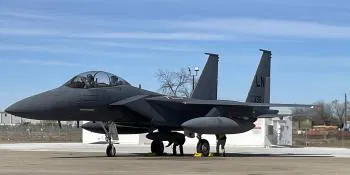
USAF F-15E on ground EPAWSS EW system fitted
An F-15E Strike Eagle that was recently upgraded with the EPAWSS system. Boeing

EPAWSS - a modular EW system

EPAWSS is an EW suite that uses advanced technology from fifth-generation fighter aircraft. The system provides both offensive and defensive EW capabilities within a modular, scalable architecture. This means that the single components of EPAWSS can be developed flexibly overtime, adjusting to emerging threats, without the need for a major redesign of its hardware and software. A significant advantage of EPAWSS is its ability to analyse electromagnetic fields to provide a 360° view of the battlespace. This situational awareness allows the pilot to detect, monitor, and counter threats in real time. The system’s radar warning function is fully integrated with the deployment of countermeasures, enabling faster response times and more effective threat mitigation compared to previous systems. Among its notable capabilities, EPAWSS can also identify radar signals that previous systems struggled to detect, and it can see “modern agile threats”, according to BAE Systems. The system integrates radar warning, geolocation, and countermeasures into a single system, reducing the F-15E’s electronic warfare footprint - thus making the aircraft less visible to enemies. In addition, an EPAWSS F-15E can carry 50% more chaff and flares than previously.  

A step up from TEWS

The F-15E’s legacy TEWS electronic warfare system was developed during the Cold War and is now being phased out in favour of EPAWSS. The new system replaces key TEWS components, including the AN/ALR-56C Radar Warning Receiver, the AN/ALQ-135 Internal Countermeasures Set, and the AN/ALE-45 Countermeasures Dispenser Set. While EPAWSS was initially intended to upgrade both F-15C and F-15E models, the US Air Force decided in 2020 to focus the upgrade solely on the F-15E variant. This decision was made in light of plans to replace the F-15C with the newer F-15EX, which will also be equipped with EPAWSS.  

Eagle background

The F-15 Eagle has a long and storied history. It was developed by McDonnell Douglas based on the requirements that emerged during the Vietnam War, when high manoeuvrability became a pressing need for the US Air Force. The first prototype, the YF-15A, was unveiled in St Louis, Missouri, in June 1972, while the maiden flight took place on July 27 that year. The aircraft entered service (as the F-15A version) with the 58th Tactical Training Wing of the US Air Force at Luke AFB, Arizona, in November 1974. The F-15 was the first US operational aircraft which had engines with thrust that exceeded its loaded weight, permitting it to accelerate even while in a vertical climb. In addition, the F-15 was designed to have a low wing loading (meaning a low ratio of aircraft weight to wing area), which was essential to achieve the high manoeuvrability for the programme’s requirements. Its first combat use came in the hands of Israeli pilots, who achieved notable success against Syrian MiGs in the late 1970s and 1980s. The F-15 also demonstrated its dominance during Operation Desert Storm in 1991, when US Air Force pilots achieved 36 air-to-air kills without a single loss. Its reputation as an air superiority fighter has been further cemented through decades of service. The F-15E Strike Eagle is a dual-role fighter designed to perform air-to-air and air-to-ground missions. For the latter, the F-15E can carry most weapons in the US Air Force’s inventory. The aircraft can also be armed with AIM-9M Sidewinders or AIM-120 advanced medium range air-to-air missiles (AMRAAM) for the air-to-air role. The Strike Eagle, like the pure fighter variants, also has an internally mounted 20mm gun. The first production model of the F-15E Strike Eagle was delivered to the 405th Tactical Training Wing, Luke AFB, Arizona, in April 1988. The first F-15E Strike Eagle for the 48th Fighter Wing at RAF Lakenheath arrived in 1992. In addition to the F-15E-equipped 492nd FS and 494th FS, Lakenheath also has two F-35A Lightning II units. The 48th Fighter Wing’s Strike Eagles are often the first to receive upgrades due to the units being forward deployed in Europe.  

Topics

Read more about Dornier Technology donates Bo-105 helicopter to the Philippine Army The Air Warrior Podcast Episode 26

Become a Premium Member to Read More

This is a premium article and requires an active Key.Aero subscription to view.

I’m an existing member, sign me in!

from our leading aviation publications

Premium Key Aero subscribers get access to read all our magazines online as soon as they leave the editor’s desk.


our-landing-logo8
our-landing-logo7
our-landing-logo6
our-landing-logo5
our-landing-logo4
our-landing-logo3
our-landing-logo2
our-landing-logo1