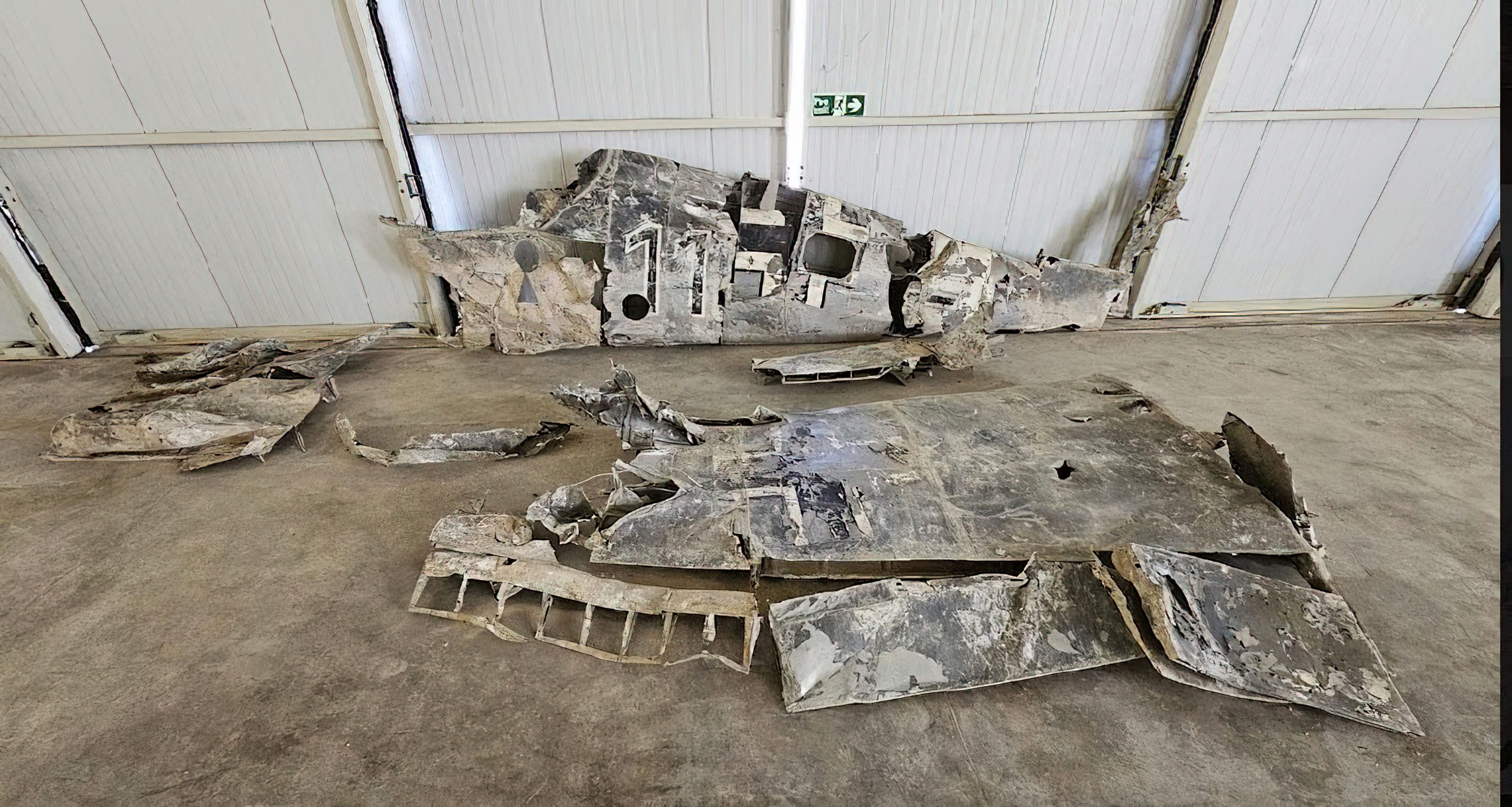
The fuselage a wing and other parts of a Messerschmitt Bf 109 F-4 were recovered in Malta during early March, and are now stored in the Malta Aviation Museum hangar at Ta’Qali.
The lead engineer at the museum, David Polidano, takes up the story. “On 21 February my father — Ray Polidano, director-general of the Malta Aviation Museum Foundation — called while I was out for a walk, having decided I needed some time away from our Gloster Sea Gladiator build. With a voice full of excitement he told me all about an interesting ’phone call he had just had with someone who has a relative at the St Vincent de Paul Residence, close to an old part of Luqa airfield. Ray was told that the remains of an aircraft had been unearthed during trenching works in a new garden being prepared for the use of dementia patients at the residence. In all honesty I was sceptical, but I agreed that if we could get the necessary permission to visit the construction site, by all means I would go and have a look at this claim.
“Upon arrival at the site on the morning of 22 February we saw substantial amounts of aircraft wreckage which had already been dug up, most of the recovered items having been covered with plastic tarps by the on-site archaeologist, presumably to be less of an attraction to souvenir-hunters. It was immediately evident to us that this was an old dump site of various aircraft parts. Determining that it was not a crash site made it less complicated to continue searching the crater. On this day, however, we were told that we were not allowed to continue searching, unless we were granted further permission by the Superintendent for Cultural Heritage. However, before we left I couldn’t resist descending into the crater to have a closer look at whatever wreckage was still down there. Climbing back out of this 3m-deep crater, I came eye-level with a small data-plate stuck to a part of buried structure. The black plate read AGO, with a part number starting 109 and ending F2. Here is when the excitement level shot up a few notches and I knew we had to come to this site again.
“A few days later, on 6 March, after having been granted permission to return to the site, a team of five from our museum and an on-site archaeologist started to excavate the area where I had seen the structure containing the AGO data-plate. It did not take us very long to unearth a complete port tailplane from a Bf 109 F. After recovering another part from an unrelated airframe lying next to the tail we had just recovered, a wing root section bearing a painted Werknummer 8668 became visible. This was fantastic — it cannot get any better than this, I thought to myself, not knowing what we would discover in the next hour or so.
“We manually removed loose rubble that was covering this wing section and had it secured at the wing attachment with a haulage strap. With the aid of an excavator and a very skilful operator, we lifted the port wing of the Messerschmitt. When we started to lift the wing, I noticed that underneath it was another structure with a Balkenkreuz painted on it, so I thought, great — another wing. After further manual digging, we reached this second structure, only to discover that it was no wing, but a chopped-up rear fuselage section.

“After recovering this we went on to find two further rear fuselage portions, the part just behind the cockpit containing the section with the ‘Black 11’ marking still clearly visible, and the rearmost part of the fuselage with the white band paint and horizontal bar also still there. The last item we found on that particular day was the forward port cowling with the tropical filter still attached. On the following day we returned to the site full of expectation; however, we only managed to find the port cockpit skin and the starboard forward cowling.
“If any more of it is buried in the vicinity is anyone’s guess. However, this present crater, which to me seems to be a bomb crater filled with aircraft wreckage, contains no more parts from this machine.
“The history of this Messerschmitt is quite interesting; apart from the Werknummer painted on the wing root and the fuselage markings to confirm that these parts all come from the same machine, we have discovered that the fighter was built by Erla between August-December 1941 in a Werknummer batch from 8400-8806. A search of Anthony Rogers’ book Battle over Malta confirms that the Werknummer and fuselage markings tally with a Bf 109 F-4Z from the 5. Staffel, II./JG 3, which fell victim to anti-aircraft fire during a sortie on 1 April 1942 while being flown by 23-year-old Unteroffizier Hans Pilz. Miraculously, Pilz survived the crash and became a prisoner of war. We are now doing our utmost to find out more about the history of the pilot.”

Read more about Asian air force to make Exercise Cobra Warrior debut ¿Cómo pudo desertar a Ucrania un piloto ruso de Mi-8 Hip?
This is a premium article and requires an active Key.Aero subscription to view.
I’m an existing member, sign me in!Premium Key Aero subscribers get access to read all our magazines online as soon as they leave the editor’s desk.










 Sign In








 24th June 2025