Plans have been made to employ drones in a logistics role during the forthcoming deployment of a Royal Navy aircraft carrier group to the Indo-Pacific region in 2025.
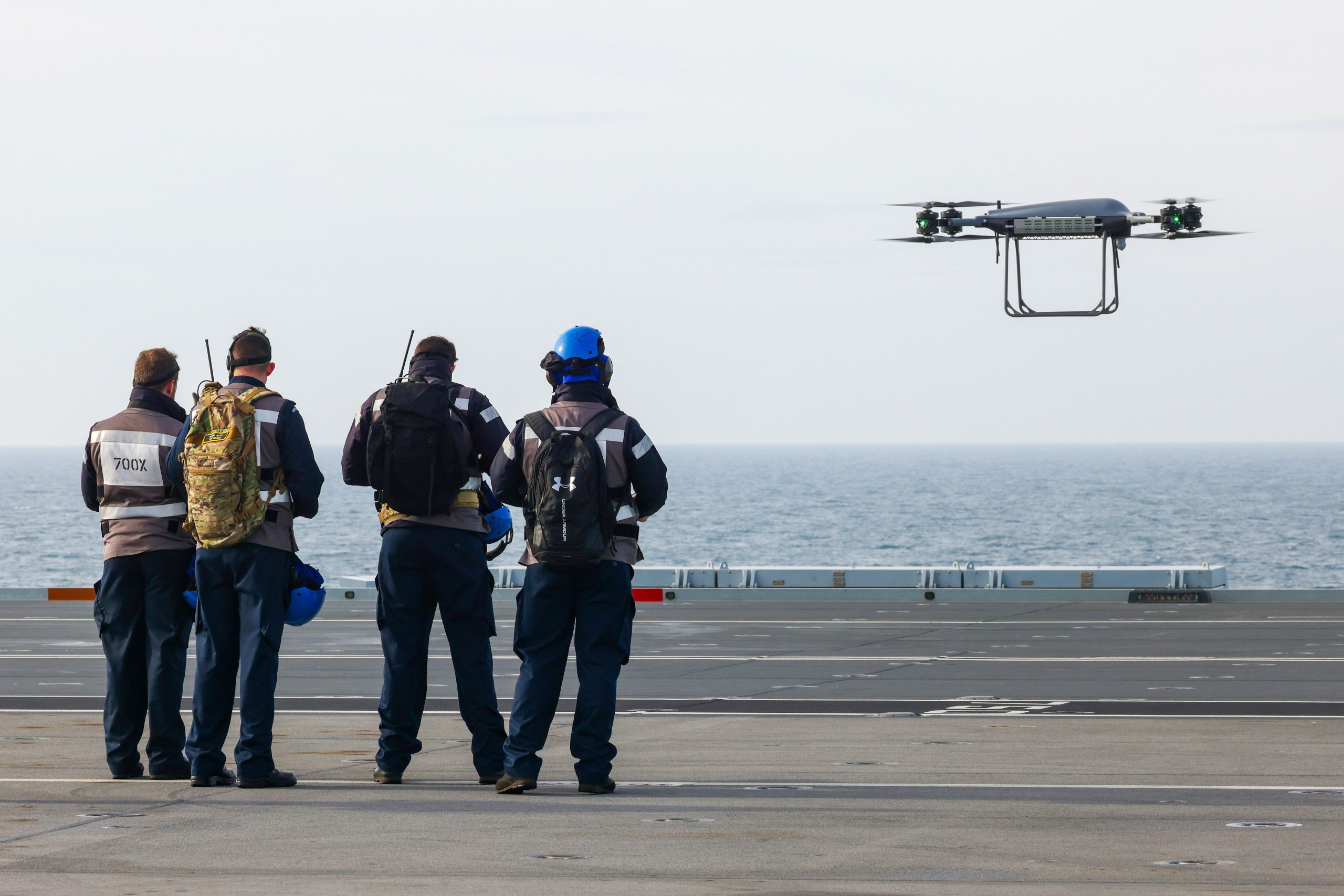
Heavy lift remotely-piloted air systems built by Malloy Aeronautics will move material between warships during the deployment. They will be used to transport equipment including but not limited to, defence equipment, food and packages from home. Nine Malloy T-150s will be involved, with the drones operated by 12 sailors of 700X Naval Air Squadron, the Royal Navy’s remotely-piloted air systems test, trials and operating unit. The dozen personnel and the air vehicles will be accommodated on three ships across the task force.

The drones will be evaluated as a more cost-effective method of moving items from ship-to-ship while under way, a task traditionally assigned to helicopters. Delegating the task to the T-150s will free up the helicopters of the task force to concentrate on their primary role of protecting the fleet.
“There is a statistic from previous carrier strike deployments that shows 95% of stores transferred weigh less than 50kg [110lb],” stated Lieutenant Matt Parfitt of 700X Naval Air Squadron. He added: “They could be anything from parcels from home to a vital engineering part. In the past we’d have used a helicopter if a part was urgently needed on another ship. This time we’re going to use a remotely-piloted, uncrewed system instead. This is exactly the sort of thing we joined the navy to do, and certainly why we joined this squadron.”
The T-150 is an all-electric powered quadcopter that is capable of lifting a payload of 150lb (68kg) and flying up to 60mph (96km/h). It was designed to make the ‘last mile’ of the delivery chain more cost-effective and efficient, operating over short ranges to get packages into the hands of the end users. BAE Systems acquired Malloy Aeronautics in February 2024.
Neil Appleton, CEO of Malloy Aeronautics said: “It’s an exciting moment to see the Royal Navy deploying with our T-150s as an efficient and cost-effective ship-to-ship resupply logistics solution. We are proud to contribute to this important deployment and look forward to watching these versatile drones prove their worth during operational duties.”
The Queen Elizabeth-class aircraft carrier HMS Prince of Wales is due to depart from Portsmouth, Hampshire, on April 22, 2025. It will be joined by a formation of warships and supply ships off the coast of Cornwall. The carrier’s air wing will land aboard before it heads for the Mediterranean, where it will participate in Exercise Neptune Strike to reinforce European security.
The overall deployment is known as Operation Highmast. According to a press statement released by the UK Government on April 8, “around 2,500 personnel from the Royal Navy and 592 from the Royal Air Force will be involved in the eight-month deployment, which will see the group sail through the Indian Ocean to conduct exercises and port visits with partners including India, Singapore, and Malaysia. They will be joined by around 900 personnel from the British Army for exercises during the deployment.” Twelve other nations will support the deployment with ships or personnel.
The exact size of the air wing to be embarked on the aircraft carrier has not been released. While it has been stated that two full squadrons of Lockheed Martin F-35B Lightning IIs will participate, 617 Squadron and 809 Naval Air Squadron, the April 8 press release refers to “up to 24 Royal Air Force F-35B Lightning fighter jets”. The number of Leonardo Merlin HM2 anti-submarine and airborne early warning helicopters and Leonardo Wildcat HMA2s to be included has not been disclosed.
No.700X Naval Air Squadron is based at RNAS Culdrose, Cornwall, although it undertakes many of its tasks from the nearby airfield at Predannack, where remotely-piloted air systems can be flown without fear of interfering with the operations of manned air platforms. The unit has a number of deployable flights equipped with AeroVironment Puma small surveillance unmanned air vehicles, which are used to expand the sensor range of warships. It is also responsible for the training of drone and quadcopter operators across the defence establishment, such as teaching Royal Marine Commandos how to use the Puma. Many other types of remotely-piloted air systems have also been evaluated by the squadron over the years.
Royal Navy interest in using drones to move stores across the fleet included the Heavy Lift Challenge, which began in November 2021 when the Future Capability Group of Defence Equipment & Support and 700X hosted the first round of the project. This evaluated the use of existing platforms to move cargo and supplies across a fleet or from ship-to-shore. During April 2022 a Mallory Aeronautics T-600 quadcopter carried 551lb (250kg), while a 220lb (100kg) payload was flown 621 miles (1,000km) by a Windracer Autonomous Systems ULTRA (Unmanned Low-cost Transport) to land on a replica of a Queen Elizabeth-class flight deck.
Read more about Pegasus Airlines fleet landmark Waterbird gana a lo grande en los premios Aviation Heritage UK
This is a premium article and requires an active Key.Aero subscription to view.
I’m an existing member, sign me in!Premium Key Aero subscribers get access to read all our magazines online as soon as they leave the editor’s desk.










 Sign In








 23rd June 2025