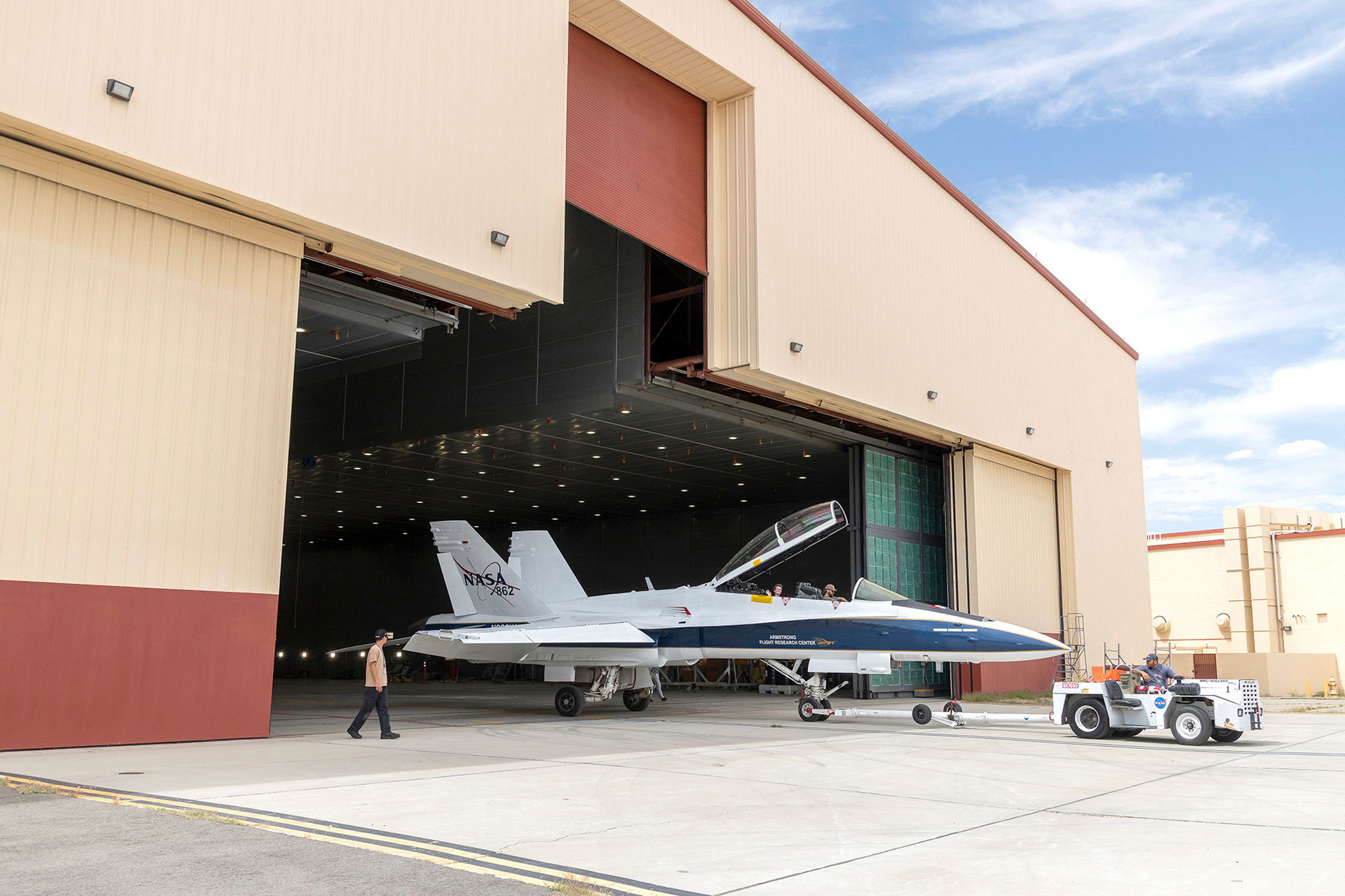
A former USMC-operated F/A-18D Hornet that was acquired by NASA from the US Navy in 2021 has been rolled out at NASA’s Armstrong Flight Research Center – a part of Edwards AFB in California – after being rejuvenated and repainted ahead of its planned use in supporting the testing of the administration’s X-59 Quiet Supersonic Transport (QueSST) technology demonstrator.
The dual-seat fighter (ex-USMC BuNo 164058 ‘SH-252’ now registered as N862NA ‘NASA 862’) was operated by the 3rd Marine Aircraft Wing’s Marine Fighter Attack Training Squadron 101 (VMFAT-101) ‘Sharpshooters’ at MCAS Miramar, California, until it was delivered to NASA in October 2021. NASA initially showed interest in the F/A-18D in 2020, when the Flight Operations department of the Armstrong Flight Research Center initiated an effort to replace its legacy two-seat F/A-18B fleet with newer aircraft. In the end, F/A-18D (BuNo 164058) was selected and was handed over to NASA, before being renamed ‘NASA 862’ in February 2022 and later sent to NAS North Island, California, for intense depot-level maintenance in June, that year.

Having been received by NASA, the Hornet was first sent for major maintenance, repainting and upgrade work to be prepared for joining Armstrong’s wider aircraft fleet. During this period, the F/A-18D received full aircraft controls in the rear cockpit to allow the back-seater to receive training, support test missions or maintain proficiency, along with the installation of an Aircraft Management Information System.
‘NASA 862’ returned to Armstrong in February 2023, before making an initial trip to the USAF’s Corrosion Control Facility at Edwards in March for sanding and masking in preparation for its repainting. It later returned to the ‘Paint Barn’ to receive the full NASA Armstrong Flight Research Center livery and identification markings, along with the final application of safety decals. The aircraft returned to Armstrong on May 15, with NASA claiming that maintenance for ‘862’ should “support a lifespan of about 40 years for the aircraft based on NASA Armstrong usage.”
The F/A-18D is now almost ready to support operations from Armstrong, with its initial airworthiness review set to take place before the end of May. Afterwards, the Hornet is intended to be used as a ‘chase aircraft’ for the X-59 QueSST – a technology demonstrator that aims to reduce the loud sonic booms associated with supersonic air travel to merely a quiet thump as part of NASA’s Low-Boom Flight Demonstration mission. During this, ‘NASA 862’ will act as a platform for videographers and photographers to document the X-plane’s test flights.
Read more about FREEDOM OF THE SKIES Boeing 747 back on UK register
This is a premium article and requires an active Key.Aero subscription to view.
I’m an existing member, sign me in!Premium Key Aero subscribers get access to read all our magazines online as soon as they leave the editor’s desk.










 Sign In








 23rd June 2025