RAF Mildenhall has been one of the most exciting air bases for visitor activity in recent times and 2024 was no exception. A wide variety of aircraft transited the base, quite aside from those performing the usual transportation roles. The rarest was undoubtedly the Botswana Lockheed C-130H and the most unusual were a pair of Boeing EA-18G Growlers.
Mildenhall is located in a sleepy backwater of eastern England, but the facility is anything but lethargic. While not supporting the same high volume of traffic as Ramstein, Germany, Mildenhall continues to be an important base for the USAF in Europe and Air Forces Africa, as well as a primary US aerial refueling air station. Airlifters often quick-turn at Mildenhall on their flights to their final destination, with one such a 15th Wing C-17A 05-5152 based at Hickam AFB, Joint Base Pearl Harbor-Hickham, Hawaii, which landed on November 10, and planned to depart to Ramstein after a brief refueling for both aircraft and crew.
However, due to a flying control malfunction, which required prolonged repairs, the crew returned home by others means. Once the issues were rectified a replacement crew was organised, who arrived at Midlenhall and who finally flew the aircraft away on December 3.
The 100th Air Refueling Wing remains the host unit ay Mildenhall, which continues to function with a complement of 17 Boeing KC-135R and T models of the Stratotanker. However, the wing usually only has 15 in residence at any one time, as two are regularly away in the US on major overhauls. In previous years, the wing would have received a pooled replacement aircraft prior to sending one of their own for planned depot maintenance (PDM) with the Oklahoma City Air Logistics Center (OC ALC) at Tinker AFB. The system has now changed whereby the 100th ARW has a core number of aircraft, so when an 100th ARW aircraft completes PDM it is returned to Mildenhall ahead of the next one beginning overhaul.
The year 2024 was the 90th anniversary of the RAF station officially being opened. This milestone was commemorated by the unveiling of new station crest, the Tudor Crown, used by King Charles III, replacing the St. Edward’s Crown formerly used by Elizabeth II. The new design is being applied to the tails of all 100th ARW KC-135 Stratotankers.
Operations by the 100th ARW were largely unchanged from previous years, with the unit having the primary role of providing aerial refueling training for USA fighter squadrons in Europe, as well as aircraft from other NATO air arms. The 100th also regularly supports the RC-135s that rotate to Mildenhall with the 95th Reconnaissance Squadron. Most RC missions from Midlenhall do not require aerial refueling, but more lengthy sorties, such as those to the Barents Sea or to Ukraine, are always provided with at least one tanker to extend the period on station.
Occasionally, aerial refueling support is provided for fighter aircraft performing patrols of NATO’s eastern border with Russia and Belarus. However, the Copper Arrow rotation of reservist KC-135s to Powidz Air Base, Poland, which began in March 2023, when the commitment moved from Spangdahlem AB, Germany, has relieved some of this commitment from the 100th. The unit also assists Air Mobility Command (AMC) or reservist tankers with long distance fighter aircraft deployments. These can be either transatlantic or those staging through the UK while flying to or from the Middle East.


Collectively, the 100th launches KC-135s every day of the week, often assuming an early morning departure by multipoint refueling system configured aircraft, compatible with hose and drogue receivers. Whereas for many years the station was closed at certain times during the night and at weekends, Mildenhall now has a 24-hour capability. Likewise, the resident KC-135s frequently perform sorties on days when the station is closed to all but essential movements.
KC-10A
For four decades the McDonnell KC-10A Extender was a regular Mildenhall visitor, but these have gradually been reduced and they are now all retired. The last multiple visit was by a trio of 60th Air Mobility Wing KC-10As – 84-0191, 86-0027 and 86-0031 – supporting the movement of 14 492nd FS F-15Es to the US on February 26 and 28. A small number of single visits followed, until the final KC-10A flight from Mildenhall by 86-0031 departed on August 12 to support four USAF F-16Cs which were returning to the US following overhaul by SABCA at Charleroi, Belgium. More than 40 years of service by the Extender was completed at Mildenhall with the same lack of fanfare as when the first example, 79-0434, visited the base on May 30, 1981. Nicknamed Big Sexy due to its alluring sleek wing design and Gucci because the KC-10As was cool, excellent and good looking, it bowed out on September 26 in a small ceremony at Travis AFB, California.
KC-46A
The Boeing KC-46A established itself as the new tanker supporting transatlantic deployments, as well as conducting the occasional general airlift. The Pegasus visited in small numbers during the first seven months of 2024, with seven arriving in the space of 90 minutes on August 6, supporting a dozen F-22As on a direct flight from Elmendorf AFB, Alaska to nearby RAF Lakenheath. Other KC-46s visited Mildenhall to perform local sorties allowing US crews the opportunity to be familiarise themselves with European operations flown within the changeable UK weather.
KC-135
Mildenhall has continued to host KC-135s in transit between their home stations and locations in the Middle East and Africa. The majority of these were single AMC aircraft, whereas those from the reservist squadrons often came as a quartet. These transit KC-135s have been far less in number than previous years, primarily due to a reduction in US assets in the Middle East. However, the recent expansion in the number of fighter aircraft deployed to the US Central Command region, along with the addition of strategic bombers, has seen a corresponding increase in the tanker fleet to support them. These include a small number of KC-46s, but primarily KC-135s.


During the spring of 2023, a trio of Special Operations Aircraft (SOAR) KC-135s night-stopped at Mildenhall on their flight from McConnell AFB, Kansas, to the US Navy complex at Camp Lemonnier, Djibouti. The aircraft returned to the US some months later. An identical situation took place on April 29-30, 2024, involving SOAR KC-135Rs 58-0011 and 58-0018, which are fitted with Air Refueling Receiver (ARR) systems mounted above the cockpit, as well as conventional SOAR KC-135R 62-3534 and KC-135T 58-0061, all assigned to the 22nd ARW. The four are part of the Special Operations Division at McConnell AFB. One returned home in June and another in August, possibly having been replaced in Africa by other SOAR tankers.


The resident 95th Reconnaissance Squadron has no aircraft of its own but continues to fly a single RC-135V or W Rivet Joint deployed from the 55th Wing at Offutt AFB, Nebraska. The open-ended commitment to maintain an intelligence, surveillance and reconnaissance (ISR) duty in Europe has gained even more importance since Russia invaded Ukraine in 2022. The primary obligation is to regularly monitor frequencies and activities in Russia and Belarus, as well as occupied areas of Ukraine. Sorties are launched at least three times each week as the unpredictability of the Vladimir Putin regime requires the 95th to repeatedly scrutinise communications and determine any changes to the order of battle of Russia and Belarus to ensure both nations do not have any expansion aspirations into NATO territory.

At the beginning of the year, RC-135W 62-4134 was the sole deployed aircraft, which was exchanged for RC-135V 64-14841 on March 9. Additionally, one of the two RC-135U Combat Sent aircraft ordinarily visit the 95th twice each year. They perform their unique tasking of verifying and updating all manner of known emitters, to acquire the location, capability and other vital data on radars and weapon systems previously unknown. In 2024, 64-14847 arrived on August 18 and was scheduled to return home on September 23, but due to the evolving threats the crew was required to instead fly a monitoring mission, then return to Mildenhall. Subsequently, this aircraft has regularly flown the familiar route over Poland to circumnavigate Kaliningrad, as well as observing and updating the military posture and government communications in Belarus. It finally returned home on November 1. This was one of the longest periods of temporary duty at Mildenhall by a Combat Sent for decades.
The 352nd Special Operations Wing (SOW) began the year with Bell Boeing CV-22Bs Ospreys grounded following the crash of a USAF airframe in Japan in late November 2023. However, by April 15, the circumstances of the loss had progressed sufficiently for a CV-22 to undertake ground taxiing. On June 16, 08-0050 flew two very brief air tests, before making a short flight to RAF Sculthorpe the following day. The MC-130Js were largely unaffected by the Osprey grounding, apart from being unable to aerial refuel CV-22s, and being restricted to performing missions solo. The 352nd SOW fleet remained constant at nine CV-22Bs and seven MC-130Js. While the Ospreys were restricted to operations within the vicinity of East Anglia, the MC-130Js were able to fly training sorties within the UK and conduct exercises in mainland Europe. The wing was host to a number of Air Force Special Operations Command (AFSOC) aircraft in transit between the US, the Middle East and east Africa. US-based AC-130Js and MC-130Js were periodic visitors, some singlys, although on April 2, three 1st SOW AC-130Js night-stopped before departing east. A further two arrived on September 24, but with the serials on the nose and tail taped over. The previous day saw three MC-130Js arrive, looking equally anonymous. All five were eastbound and departed quickly after refueling, except for one of the MC-130Js which was delayed due to a technical issue. As the year came to a close, there was clearly an increase of AFSOC assets in the

Middle East and East Africa. On November 17, a pair of AC-130Js and three MC-130Js all arrived, following the now familiar trend of having their serials obscured. This anonymity is presumed to be a temporary feature, otherwise the serials would have been completely removed, as is the case with AMC aircraft. However, the purpose is likely to be for operational security reasons.
On the evening of November 20, Feltwell, Lakenheath and Mildenhall were each targeted by a number of small unidentified drones. Subsequently, more evening activity was detected in the vicinity of each base, with various authorities being mobilised, including the East Anglian police helicopter, launched in a vain attempt to track and trace the source. Other military activity involved ground elements from the Royal Air Force Regiment at RAF Honington, other branches of the military security services; various police drone experts, as well as the RAF Beechcraft Shadow R1s of 14 Squadron at Waddington. Additionally, Lakenheath F-15Es were launched to overfly the drones and respond to any aggressive activity taking place.
On December 4, AFSOC Dornier C-146A 10-3077 of the 524th SOS arrived for assignment to the 352nd SOW, with the USAF stating that the deployment had been planned since March 2024. A local mission to Sculthorpe was flown the following day to enable the crew to familiarise themselves with operations in the UK.
The wing hosted special forces from other air arms, including the French Air Force, which flew local sorties to Sculthorpe from a C-130H between April 14 -26. Hungarian special forces regularly train with the 352nd, arriving and departing aboard their Airbus A319. Australian Air Force Special Forces also visited between April 6-15, arriving aboard Airbus KC-30A A39-004. The most recent special forces exercise hosted by the 352nd was on October 28-31, when personnel from Hungary were joined by troops from Belgium and France. The latter two air arms brought an Airbus A400 each, which flew day and night sorties to Sculthorpe.
Although unconnected with the 352nd, two highly modified US Army Boeing MH-47G Chinooks, serials 19-02914 and 19-02918, belonging to the 160th Special Operations Aviation Regiment (Airborne) were airfreighted from Hunter Army Airfield in Georgia aboard a pair of Boeing C-17As on September 3. After reassembly and air testing, they were escorted to RAF Odiham by an RAF Chinook HC6A on September 9, enjoying the opportunity to fly low level above the Thames along the designated helicopter lane. They subsequently participated in Exercise Dark Lightning in northern England, before returning to Mildenhall on September 28. After being dismantled, they returned home in the same manner as they arrived.


In recent years, US Navy visitors have been extremely thin on the ground, although there was a brief refueling stop by Boeing P-8A Poseidon 170015 of VP-30 on October 10 with a partially over-painted tail code ‘LL’. The Poseidon was fitted with a Raytheon APS154 advanced airborne sensor mounted in a slim elongated pod along the underside. This sensor can detect, classify and track targets on land and sea simultaneously. The P-8 was on a flight from NAS Sigonella to Keflavik. P-8 visitors are relatively infrequent, as those on temporary duty at NAS Sigonella, Sicily, and NS Keflavik, Iceland, rarely need to stop in the UK while in transit between the two facilities. Furthermore, two US Navy P-8s are also located at RAF Lossiemouth to conduct their core tasking of maritime patrol whenever nuclear submarines sail in or out of Holy Loch in the river Clyde. Invariably, Russian vessels are in international waters off the Scottish coast.
Remaining with the larger Navy types, the Lockheed EP-3E Aires II version of the Orion has been an occasional visitor for decades. However, the type is in the twilight of its career, as the ISR role is being taken over by the Northrop Grumman MQ-4C Triton unmanned aerial vehicle. Nevertheless VQ-1 ‘World Watchers’ EP-3E 161410 has been involved in monitoring the ongoing conflict between Israel and groups located in Gaza and southern Lebanon. Sorties were staged from Souda Bay, Crete, until October 30, when the EP-3E flew to Mildenhall before attempting to depart next day to the USA, ahead of returning to NAS Whidbey Island, Washington state. Fog delayed the departure, which was followed by a technical issue, with 161410 finally leaving for NAS Patuxent River, Maryland, on November 1.
The second EP-3E at Souda Bay, 159893 was due to follow via Mildenhall but instead routed through NAS Rota, Spain, on November 2, arriving at Whidbey Island on November 6. These were the final operational sorties by the aircraft before being retired and VQ-1 is due to be disbanded on March 31, 2025. In place of the EP-3Es, the US Navy has already begun using the MQ-4C, with169660 flying above the eastern Mediterranean early on November 2 (the Triton is assigned to Unmanned Patrol Squadron 19 operating from NAS Sigonella). A shortage of fuel resulted in two Grumman EA-18G Growlers and four Boeing FA-18 Hornets diverting to Mildenhall on October 17. The contingent was from the CVN 75/USS Harry S Truman, which was sailing in the North Sea ahead of participating in exercise Neptune Strike 24-2. The six aircraft from Carrier Air Wing1 (CVW-1) tail code ‘AB’ were airborne from the aircraft carrier when the vessel sailed too far for their safe recovery.
The jets comprised VFA-11 F/A-18F 166640/‘104’, 166669/‘106’; VFA-143 F/A18E 168922/‘202’, 166905/‘205’, and VAQ144 EA-18G 166931/‘500’ and 168934/‘503’. After approximately four hours at Mildenhall, the aircraft returned to the ship. This was the first occasion that an operational Growler had landed at a military base in the UK. Of these, 166931 was decorated with colourful markings for the commander of CVW-1. One month later, on November 17, MH-60S 167821/‘612’ also coded ‘AB’ of HSC-11 made a 90-minute stopover.


Earlier, on June 9, a similar diversion involved eight US Marine Corps aircraft briefly visiting Mildenhall for fuel while they were embarked on LHD 1/USS Wasp. They departed the aircraft carrier after training with French special forces. The aircraft were on their way to Ronneby Airport, Sweden, for Baltic Operations (BALTOPS) 24. The first to arrive were four McDonnell Douglas AV-8B Harrier IIs of VMA-365 (Rein) wearing tail code ‘YM’ serials 164554/‘51’, 165425/‘52’, 165580/‘54’ and 166288/‘56’, which remained for 90 minutes. As they were departing, four MV-22Bs of VMM-365 also tail coded ‘YM’ arrived, serialled 168337/04, 168645/06, 168325/10, and 168225/11. The Ospreys stayed for about two-and-a-half hours before continuing to their final destination.
Other Navy visitors included the occasional C-130 transport, although with no naval air facility in residence, there is a much reduced resupply requirement in the UK. Additionally, US Marine Corps KC-130Js visited Mildenhall to clear customs when positioning from their home stations to Teversham Airport, Cambridge, for major overhaul by Marshall Aerospace.
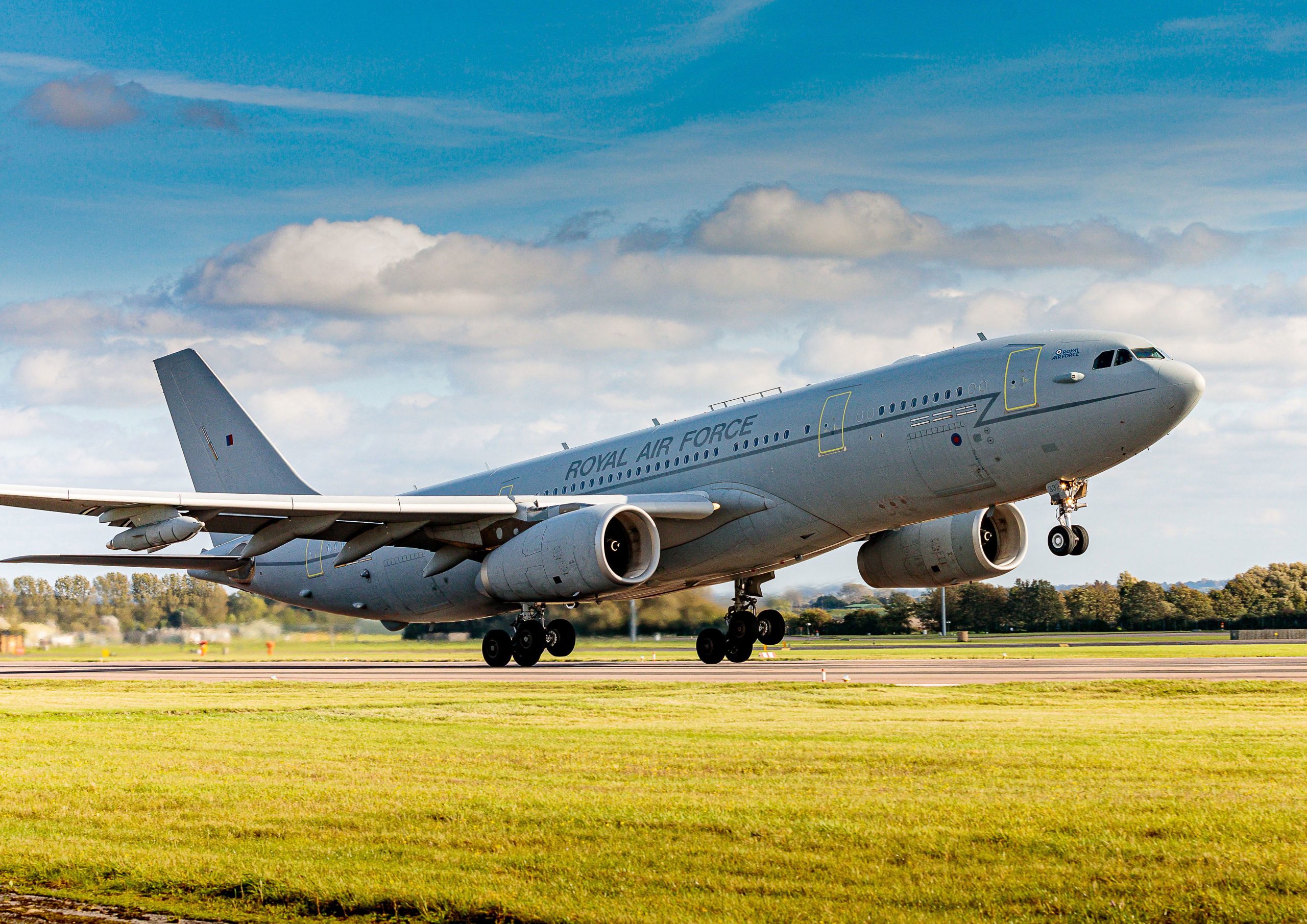
Arguably the rarest aircraft to visit Mildenhall during the year was Botswana Defence Force Lockheed C-130H serial OM4, which arrived from Alverca, Portugal, on May 20, following a lengthy period of storage. Formerly USAF serial 74-1675, the aircraft was supplied to the Afghan Air Force in September 2013, but was repossessed by the USA when the Taliban assumed power in the country in 2021. OGMA at Alverca stored the Hercules prior to refurbishing it under the USAF’s Excess Defense Articles programme. The gifted aircraft was on its delivery flight from Portugal to Botswana, with the circuitous route being necessary as the official transfer of ownership from the US to the new customer was required to take place at a US military air base.

On January 4, the 430th Expeditionary Electronic Communications Squadron (ECS) Bombardier E-11A serial 11-9001 departed Riyadh for the US, with a refueling stop at Mildenhall. These military Global Express aircraft are not uncommon, but the routing from Saudi Arabia to the UK, as presented on ADSB, was extremely interesting, as the flight was shown to have tracked over Simferopol in Ukraine before resuming a conventional course to Mildenhall. It would have been impossible for a sophisticated USAF command and control asset to traverse Russian territory during the present conflict, so why the tracking showed this route is a mystery.
Although Exercise Cobra Warrior 24-1 in the spring was cancelled, Mildenhall hosted fighter aircraft for CW 24-2. It played host again to USAFE fighter aircraft with eight 31st FW F-16Cs of the 555th FS from Aviano AB, Italy, arriving on September 6. The exercise did not begin until September 16, with the preceding week allowing crews to familiarise themselves with northern Europe’s congested airspace. The three-week exercise was divided into two weeks of daytime flying and a third devoted to evening/night operations.
The tail art on F-16C 87-0350 was particularly interesting, being a black and pale yellow design with red stars. On the port side was the legend ‘Operation Bolo’, while ‘Rolling Thunder’ was inscribed on the starboard. The seven red stars on the tail signified the number of North Vietnamese Mikoyan MiG-21s shot down by McDonnell F-4C Phantoms on January 2, 1967 , during Operation Bolo (named after an agricultural machete that doubles as a Filipino weapon).
A small deployment of four F-16Cs of the 119th FS, 177th FW New Jersey ANG flew from Atlantic City to Aviano for Operation Pegasus Dawn on October 18-25. The operation was designed as an agile combat employment (ACE) training mission to assist the 108th Wing’s transition from the KC-135 to the KC-46A. At the completion of the operation, the F-16s flew to Mildenhall, where they remained overnight before flying home the next day. Despite the 108th Wing converting to the KC-46, the flight home was supported by a pair of 305th AMW KC-46s; although it is possible they were crewed by New Jersey ANG personnel.


Overseas visitors at Mildenhall are considerably less common than they were a decade or two ago. A French Air Force Casa CN235M delivered ground crew on May 29, to support a pair of Dassault Rafales. One of the pair, 146, was the 2024 Rafale Solo display aircraft and was resplendent in a very colourful red, white and blue design. The aircraft was temporarily at Mildenhall for Duxford’s May airshow. The technicians were collected on June 3 by a Luftwaffe C-130J-30, making the maiden appearance by a German Hercules at Mildenhall. The Australian KC-30A mentioned earlier was not the only Antipodean visitor this year, as a C-17A arrived on July 14, possibly to deliver cargo for the USAF.
Two Qatari F-15QAs were delivered from the US to Lakenheath on July 10, followed by two more to Mildenhall on July 13. These four then bounced between Lakenheath and Mildenhall to enable them to participate at the Farnborough and Fairford airshows, before continuing their journey to Qatar some weeks later. A straggler from the October delivery remained at Lakenheath and was still there at the end of the year.
AMC traffic changed little compared to previous years. Boeing C-17s were the most common airlifter to visit Mildenhall, along with the occasional Lockheed C-5M Galaxy, although the latter numbered less than 30 throughout the year. Of these, 87-0030 on July 24 brought Army Air Corps AH-64Es ZM738, ZM739 and ZM740 as airfreight, followed on October 7 by 84-0061 containing ZM741, ZM742 and ZM743. In both instances, the dismantled Apache helicopters were towed to a hangar, where they were inspected and loaded onto trailers for the road journey to RAF Wattisham.
A small number of AMC aircraft were devoid of all markings and serial numbers. This policy was introduced by the previous AMC commander for operational security reasons and has been a gradual process that appears to be continuing, although there has not been any announcement since the new commander took office in September 2024.
Civilian traffic at Mildenhall is usually confined to larger Airbus and Boeing airliners ferrying personnel and cargo from the US. However, on June 28, Douglas A-26C Invader N26BP/4139359 Million Airess owned by Marine Aviation Museum Inc arrived while flying in for various UK airshows, including Fairford and Duxford. The highly polished, natural metal Invader had earlier flown over Normandy during the 80th anniversary of D-Day in early June. After a very sporty departure, the A-26 returned to Duxford before flying to Wick Airport in Scotland and Reykjavik in Iceland on the lengthy journey back to Houston, Texas.
Read more about Major aircraft collection under threat Supersonic salute at Edwards AFB
This is a premium article and requires an active Key.Aero subscription to view.
I’m an existing member, sign me in!Premium Key Aero subscribers get access to read all our magazines online as soon as they leave the editor’s desk.










 Sign In








 23rd June 2025