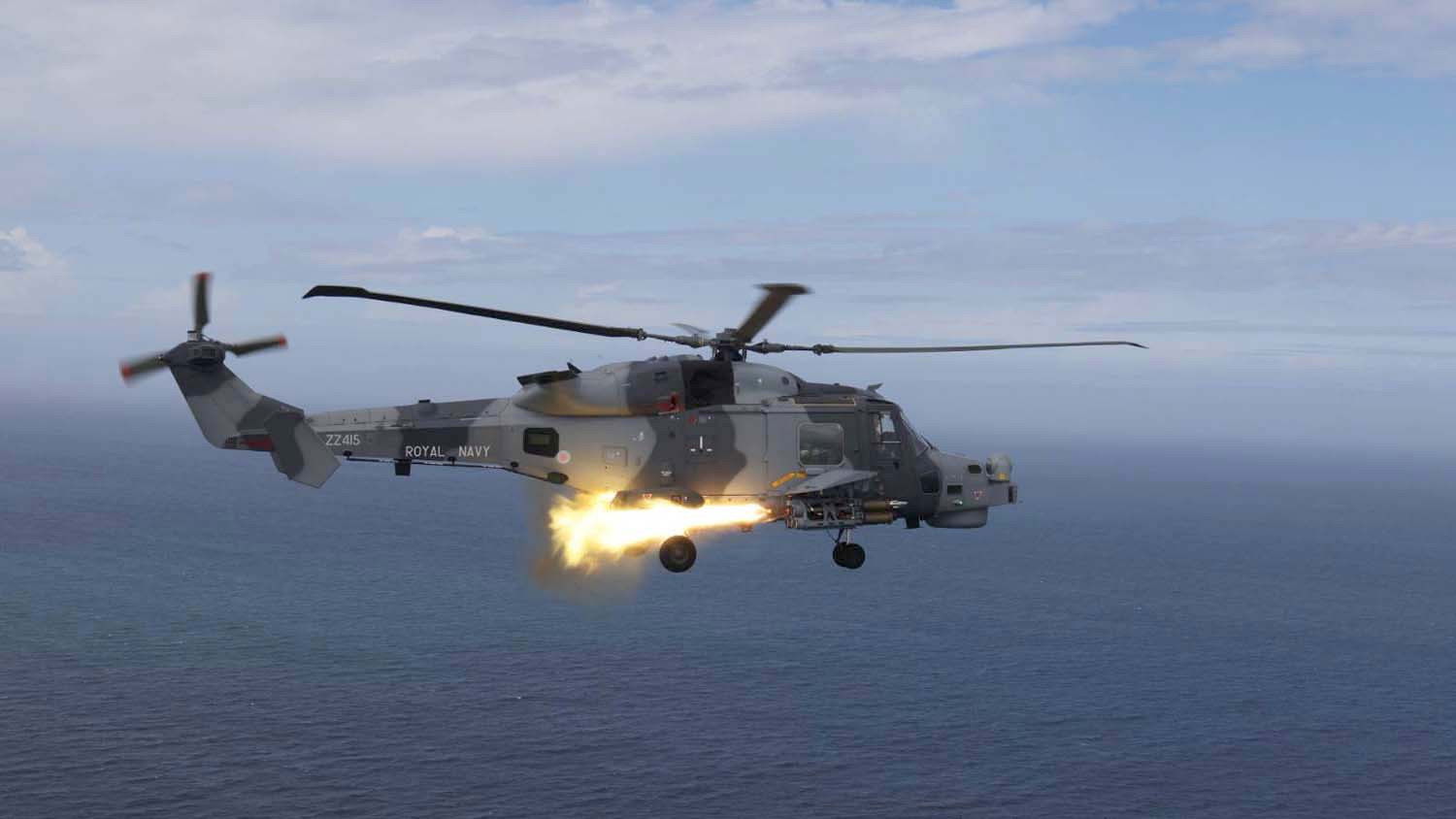
In a recent series of trials a Leonardo Helicopters AW159 Wildcat HMA2 multi-mission maritime helicopter from the Royal Navy Fleet Air Arm’s 815 Naval Air Squadron (NAS) at RNAS Yeovilton, Somerset, carried out the first successful test firing of a Martlet lightweight multi-role missile against an aerial target.
Led by the Operational Advantage Centre (Maritime Warfare) – the Royal Navy’s lead organisation on tactical development – in conjunction with industry partners, Thales and QinetiQ, this latest round of extensive live-fire testing – known as Triton’s Arrow III – was conducted over a two-week period on the UK Ministry of Defence’s (MOD’s) Aberporth range in Wales. The activity, which the Navy announced had been completed on July 21, aimed to extensively test the boundaries of the Martlet’s capabilities and culminated with the first successful air-to-air firing of the missile from a Wildcat HMA2 against a Banshee unmanned aerial target.

According to the Royal Navy, this milestone test has proved that Martlet can be effectively employed in a counter-UAS role. Based on Thales’ laser-guided Lightweight Multirole Missile (LMM) and acquired by the UK MOD to fulfil the Royal Navy’s Future Anti Surface Guided Weapon (Light) – FASGW(L) – requirement, the Martlet weapon system is carried by the Wildcat HMA2 fleet and is primarily designed to neutralise small, fast-moving naval vessels and airborne threats, such as UAVs. In total, 20 Martlet missiles can be loaded onto a single Wildcat HMA2, with each munition able to detach from the helicopter within 0.3 seconds, before it accelerates towards the target at one-and-a-half times the speed of sound.
Commenting on the recent trials, Lt Michael Vivian – a Wildcat HMA2 pilot who flew one of the live-fire test sorties – said: “It was an incredible experience to be involved in the planning and execution of what is now a new capability for the Maritime Wildcat Force and for Defence. The ability to protect a warship such as HMS Queen Elizabeth from fast-moving surface and now air targets make the Wildcat HMA2 a world-leading capability.”
Cmdr Stuart Crombie, the officer commanding 815 NAS, added: “The Martlet firings conducted by an 815 NAS Wildcat during the Triton’s Arrow trial have proven the devastating air-to-air lethality that the Wildcat offers. This capability places us in a unique position amongst the UK’s – and the world’s – military helicopters. Maritime Strike – on, under and now above the waves – is at our core and 815 stands ready to defend our carriers and their strike groups day and night.”
Read more about EasyJet unveils its first airport lounge Paris Air Show 2025 participating aircraft
This is a premium article and requires an active Key.Aero subscription to view.
I’m an existing member, sign me in!Premium Key Aero subscribers get access to read all our magazines online as soon as they leave the editor’s desk.










 Sign In








 23rd June 2025