Initially revealed earlier this year, the Aviation Force Design Update (FDU) will better support the US Army of 2030. It is designed to refocus US Army Aviation from counterinsurgency (COIN) and counterterrorism (CT) operations to large scale combat operations against technologically-capable adversaries.
The FDU will restructure the service’s active component Combat Aviation Brigades (CABs), moving away from the modular construct that had supported rotations in Iraq and Afghanistan. Under this modular concept, each CAB was designed with the same structure and supported by so-called ‘plug-and-play’ operations. This allowed the Army to rotate units, while providing the same capability with each deployment.

Going forward, the redesigned CABs will return to a purpose-structured model that better aligns them with the mission assigned to their aligned division or theatre. The FDU addresses gaps in Army Aviation’s attack, reconnaissance, air assault and lift capacity by adding a further two attack helicopter battalions and additional lift capacity to Light and Air Assault CABs.
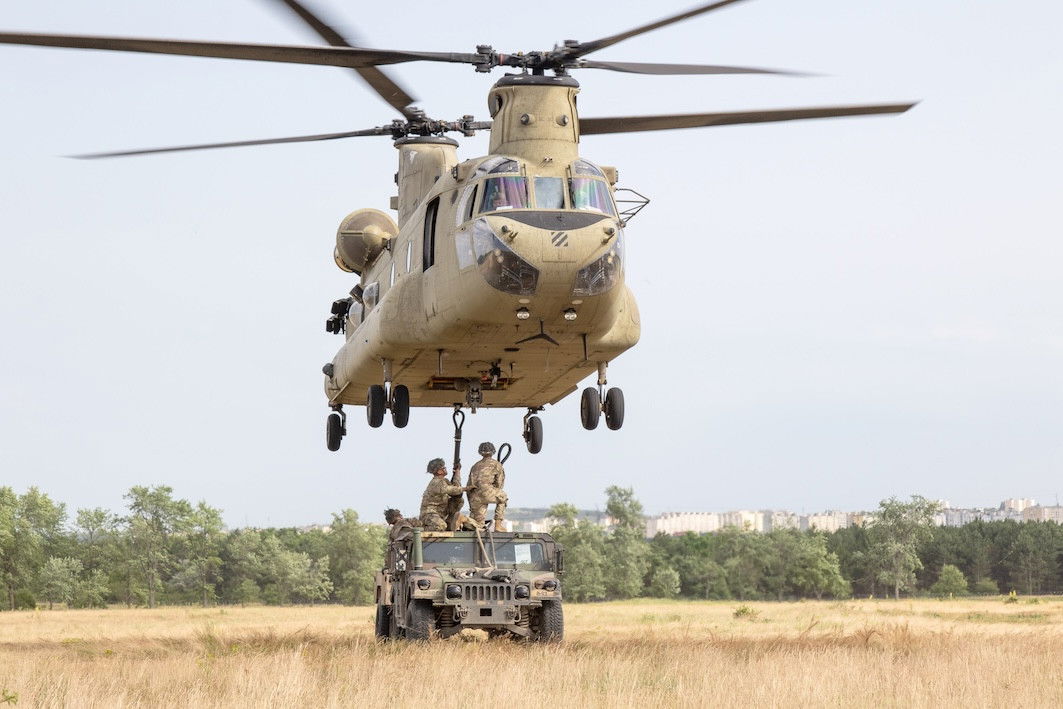
As a light infantry division is more reliant on air mobility than a heavy division, the FDU will provide them with additional UH-60 Black Hawk utility helicopters, which will be drawn from heavy divisions and replaced in the latter by more CH-47 Chinook heavy-lift tactical transport helicopters. The Army currently fields 11 fully-equipped CABs and the Europe-based 12th CAB, which is not fully resourced. The FDU will provide the additional assets required to establish a full-size brigade in Europe.

The FDU changes will be implemented across the Army’s 12 CABs between FY25 and FY29, with the majority of aircraft movements taking place in FY27. In fact, such changes began in June 2021, when the 101st Airborne Division’s CAB gained a second heavy-lift CH-47F company. This CAB will eventually field a full battalion of 32 Chinooks to better enable its Air Assault mission.
Under the new design, the Army plans to field six Heavy-Lift CABs, three Light CABs, one Air Assault CAB and two ‘Theater-Enabling’ CABs that will focus on rapid deployments.
The Army Aviation branch is also currently reviewing plans to restructure eight Army National Guard (ARNG) and two US Army Reserve (USAR) CABs. However, the Chief of the National Guard Bureau had previously revealed plans to reorganize the ARNG’s division-aligned CABs as closely as possible to the active-duty component’s designs “to meet warfighting demands”.
Those plans include the fielding of two Heavy-Lift CAB formations with attack battalions, air cavalry squadrons and MQ-1C Gray Eagle-equipped unmanned aerial vehicle (UAV) companies; one Light CAB with a heavy-lift battalion to provide air assault capacity and capability; five Light CABs and three ‘Theater-Enabling’ CABs that are designed to support Corps-level operations.
Read more about La RAF desvela el esquema de colores de la cola de cuña Alemania enumera la aportación de armas a las fuerzas ucranianas
This is a premium article and requires an active Key.Aero subscription to view.
I’m an existing member, sign me in!Premium Key Aero subscribers get access to read all our magazines online as soon as they leave the editor’s desk.










 Sign In








 23rd June 2025