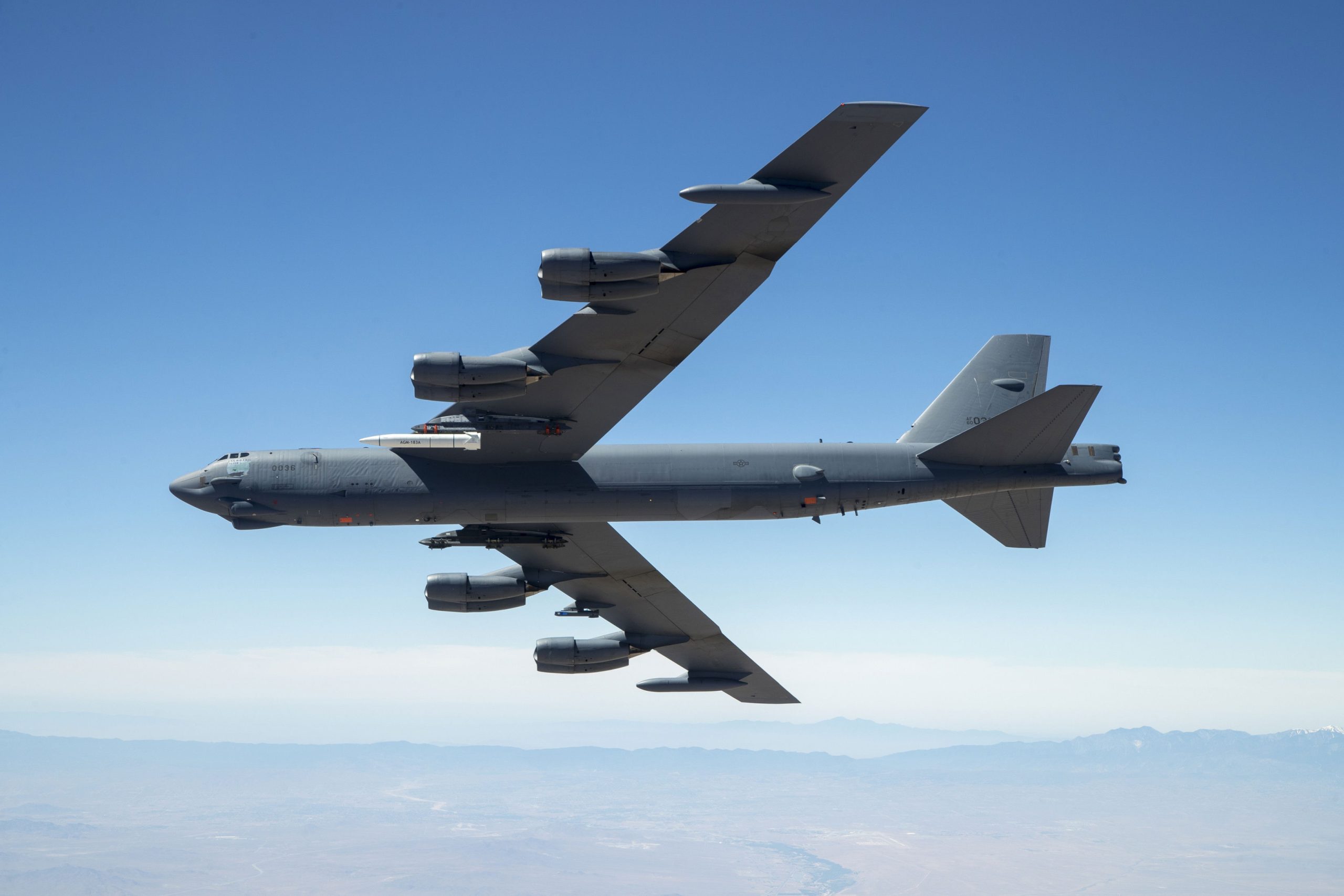
A US Air Force (USAF)-operated Boeing B-52H Stratofortress has successfully released the first All-Up-Round (AUR) AGM-183A Air-launched Rapid Response Weapon (ARRW) during an operational test off the coast of Southern California on December 9.
While previous test events focused on proving the munition’s booster performance this latest ARRW test marked the first launch of a full prototype for the air-launched, hypersonic boost-glide ballistic missile that is currently being developed by the USAF and Lockheed Martin, the weapon’s original equipment manufacturer (OEM). This milestone test was executed by a B-52H and personnel assigned to the 412th Test Wing at Edwards Air Force Base (AFB) in California.

According to the USAF, following the ARRW’s separation from the Stratofortress, it reached hypersonic speeds greater than Mach 5 – more than 3,806mph (6,126km/h) or five times the speed of sound – before completing its chartered flight path and detonating in the terminal area. “Indications show that all objectives were met,” the USAF said in a press release. The USAF is expected to declare Early Operational Capability (EOC) for the AGM-183A ARRW in 2023.
Commenting on the success of the ARRW team, Brig Gen Jason Bartolomei – program executive officer for the USAF’s Armament Directorate – said: “The ARRW team successfully designed and tested an air-launched hypersonic missile in five years. I am immensely proud of the tenacity and dedication this team has shown to provide a vital capability to our warfighter.”

With Russia and China already fielding hypersonic-capable munitions, the West is racing to rapidly develop its own such weapons. The AGM-183A ARRW has been designed to enhance the US military’s ability to destroy high-value and time-sensitive targets. It will also allow the US to execute rapid response strikes against heavily defended land-based targets in enemy territory and highly contested environments.
In recent years, both Russia and China have enhanced their respective hypersonic missile capabilities, which offer the potential to defeat contemporary missile defence systems. Moscow has used its nuclear-capable Kh-47M2 Kinzhal (Dagger) hypersonic ballistic missile against a number of key military and infrastructure targets in its ongoing war with Ukraine, which began on February 24, 2022. Meanwhile, Beijing continues to test its hypersonic ‘carrier-killer’, the YJ-21 anti-ship ballistic missile, in naval exercises. An export version of this munition, dubbed the YJ-21E, was showcased at Airshow China 2022.

While development of the AGM-183A ARRW has progressed well of late, the programme has not been without its challenges and struggles. For instance, during the munition’s second flight test at the Point Mugu Sea Range in July 2021, a test vehicle’s rocket motor failed to ignite after being dropped from a B-52H. Following this, the weapon again failed to launch during its third test flight on December 15, that year.
These back-to-back failures left the future of the ARRW programme in doubt and the munition’s eventual procurement at risk. On March 9, 2022, the US Congress halved the funding for ARRW and transferred the remaining balance to ARRW’s research and development account to allow for further testing. However, on May 14, 2022, the 412th Test Wing and Global Power Bomber Combined Test Force at Edwards carried out the first successful ARRW test off the coast of Southern California. Another successful test flight occurred on July 12. Taking into account this latest successful test launch, it seems that the USAF’s ARRW programme is back on the right trajectory.
Read more about £1 million project to research the Cold War in museums Imagen de la semana del FlyPast
This is a premium article and requires an active Key.Aero subscription to view.
I’m an existing member, sign me in!Premium Key Aero subscribers get access to read all our magazines online as soon as they leave the editor’s desk.










 Sign In








 23rd June 2025