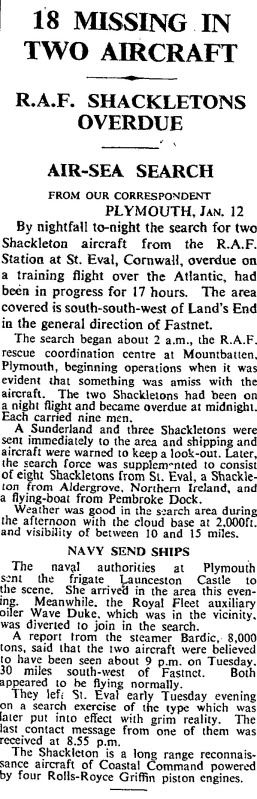
I was a crew member of HMS Launceston Castle and was aboard during the search for the crew members of the two missing Shackleton s.
On the 11th Jan we were designated Emergency Destroyer moored in Portland Harbor and received the order to search, we left Portland in a force 9 gale, at Plymouth it blew 10-11, as we rounded the Lizard
it went 12-13 and then off scale as we neared the Irish Sea. The ship had difficulties with the conditions and had to go to X Stations, we lost the Radar and Wireless mast so lost all shore communication.
We rode the storm out for about the next 18-20 hours until it abated and we could go on deck to physically see the damage to the ship and the sea condition. From horizon to horizon the sea was covered in Pit Props
apparently loosed from some tramp steamers which had jettisoned their deck cargoes to maintain their sea worthiness in the storm.
No one could have survived in that sea especially with the added hazard of those great wooden timbers.
At Biggin Hill in the early 1950’s it was the custom for a variety of RAF, RN and USAF aircraft to be flown in so the Royal Observer Corps and the Army Anti-Aircraft Command (then an integral part of the UK’s air defences) could examine up close on the ground the friendly aircraft they were expected to recognise in the air.
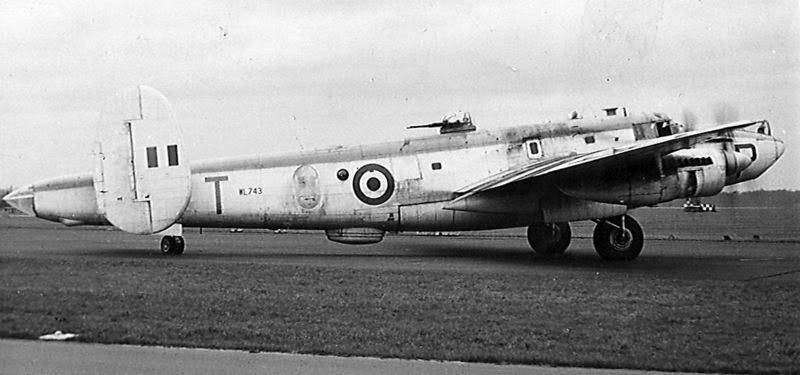
At the 1954 Recognition Day Shackleton WL743 of No.42 Squadron was on show. Sadly this particular aircraft went missing on the night of 11 January 1955 and is assumed to have collided with WG531, also from 42 Sqn, south-west of Ireland. Both aircraft were declared Cat.5 (Missing) the same day. In total eighteen crew died, nine in each aircraft.
I was stationed at Biggin at the time and took this photo of a rather tatty looking WL743; all that low-level stuff with lot’s of sea spray I suppose.
And as reported in the press:


 Sign In







