Hi folks,
Your mission, should you choose to accept it, is to assist an aircraft modeller with a project!
I am in the process of restoring a very old FROG Airspeed Oxford to represent one of the unit’s aircraft which was lost in a midair collision with a Lancaster in 1944.
I’m therefore looking for any information relating to 1521 Beam Approach Training Flight, based at RAF Wymeswold, in particular photos of the aircraft belonging to that unit.
Further to the midair collision itself – An eyewitness described the Oxford as being “a yellow-painted aircraft”, although he did not state whether he was looking at the underside of the aircraft (plus we know how reliable eyewitness statements can be).
Thanking you in anticipation.
Don

By: TwinOtter23 - 9th November 2016 at 14:16
Presumably that relates to the incident that is commemorated by the Screveton memorial?
By: critter592 - 9th November 2016 at 12:42
I forgot to add that the model (along with the model of Lancaster W4103) will be on display in Flintham Village Hall on 13:11:2016.
By: avion ancien - 6th November 2016 at 11:25
With apologies for the quality (or lack of) of the photograph, this was MP425 at Hendon in 2008.
By: TwinOtter23 - 5th November 2016 at 18:13
Nice to see the finished model, which brings back fond memories of when MP425 was on loan at NAM.
By: critter592 - 5th November 2016 at 17:43
Apologies for dragging this one up from the depths, but I have an update… The model is complete!

The model’s appearance is based on a photo I found in a personal collection which shows a 1521 aircraft in this scheme.
Sadly, it is not possible to identify the aircraft.
By: TwinOtter23 - 13th February 2013 at 11:19
NAM’s Curator has very kindly let me have some scans this morning – is the best email address for you via the contact page on your signature / weblink?
If not PM me a good address and I’ll send them over!
By: critter592 - 13th February 2013 at 02:32
TO23,
No worries, and yes – I’m still interested in those scans. Thanks! 🙂
By: TwinOtter23 - 11th February 2013 at 12:25
Are you still interested in the colour scans of the RAFM Oxford @ NAM?
I didn’t get chance to check in the Archive last week 😮 – too many Vulcan punters!! 🙂
By: critter592 - 11th February 2013 at 12:05
Thanks chaps.
I think I should have enough material to make an educated guess as to the appearance of LB415.
Both models of the Oxford and the Lancaster will appear on my thread over on The Airfix Tribute Forum in due course (I post there under the name DonB).
Perhaps I should open a similar thread here? 😉
Kind Regards,
Don (Critter592)
By: Duggy - 6th February 2013 at 23:16
Is this of any use AIRSPEED. Oxford I, PG943-T, 1 Beam Appr. School, Watchfield, 1945, same aircraft as on the decal sheet.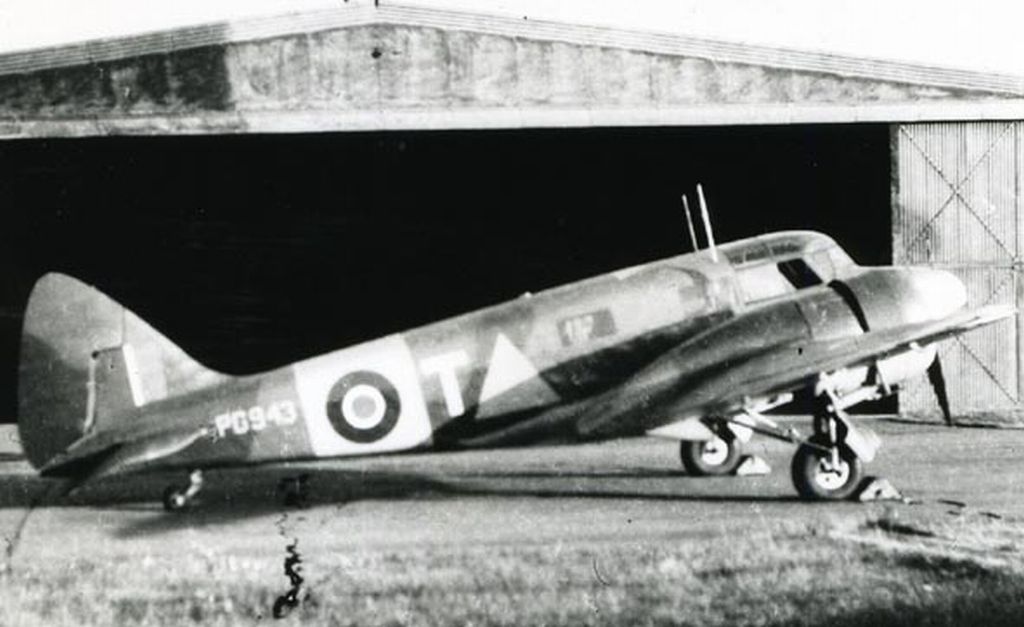
Regards Duggy
By: pagen01 - 6th February 2013 at 21:13
Isn’t the Oxford at Hendon in genuine BAT/RAT Flt colours? I know it’s a genuine BAT Flt survivor and the picture I have of it show the yellow triangles and overall colours scheme.
By: TwinOtter23 - 6th February 2013 at 20:48
Thanks TO23.
Yes, they would be most appreciated, if only to give me an idea of the size of the markings, positioning, etc.
It certainly is.
I am also working on a model of W4103; fortunately I do have a photo of this aircraft.
I have developed quite a close connection with this accident. I attend the memorial service every year, which is organised by a lady from the village.
There are always many relatives from both crews in attendance.
I have pages for both aircraft on my Website – Link is in my signature! 🙂Don
I’ve just looked through my own archive and most of my Oxford shots at NAM were taken on transparency!
I have a couple of shots taken at Cardington before the loan took place but they’re not brilliant. I’ll have a look in the NAM Archive to see what I can find for you.
By: Graham Boak - 6th February 2013 at 11:40
The one in the Xtradecal sheet is a good representation of the camouflage, but there needs to be some qualifications about the markings. The yellow fuselage band and the roundel style are postwar, although it still has the wartime finflash. Normally there would be yellow triangles on each side of the nose. Rereading of the text I have suggests that the upper wingtips would only have been yellow after May 1944, and the underwing black triangle after June 1944, so your aircraft would not have had these further embellishments.
The example shown has larger triangles on the side of the fuselage than suggested in Mike Bowyer’s drawings in the Airfix guide, made from his own observations. There may well have been some variation between the different flights, but this large one is correct for the unit at the time.
You don’t say how much work you intend to do the the rather elderly and basic Frog model – there is I believe a newer one from Pavla models. However there is not much in the way of publications to help you. There was Profile number 227, which does have good views of the underside which would help to improve the kit, and of the camouflage pattern. The only other one I have is Air Britain’s The Oxford. Consul and Envoy File, which would be overkill for you but does have some interior views and modelling tips such as bright metal engine crankcase covers with dark (black?) cylinders. It has a photo of the aircraft on the decal sheet, plus a view of 1518 BATF/G which also has a very small triangle on the very tip of its nose. If this was common, it would be very rarely seen in photographs! However, I don’t believe it is called for by the regulations.
By: critter592 - 6th February 2013 at 10:20
Denis, Graham Boak,
Thanks for that.
Would I be correct in saying that “my” Oxford would have had some camouflage, rather than being all-yellow?
I’m thinking that she would have been similar in appearance to PG943, as seen on this decal sheet from Hannants.
I have some colour pictures on file of the RAFM Oxford when it was displayed at NAM; IIRC it wore the BAT Flight markings from a unit at RAF Spittlegate near Grantham. Might these help?
Thanks TO23.
Yes, they would be most appreciated, if only to give me an idea of the size of the markings, positioning, etc.
Also, would I be correct to suggest that the Oxford you’re modelling is the one which is jointly commemorated at the Screveton memorial in Nottinghamshire?
It certainly is.
I am also working on a model of W4103; fortunately I do have a photo of this aircraft.
I have developed quite a close connection with this accident. I attend the memorial service every year, which is organised by a lady from the village.
There are always many relatives from both crews in attendance.
I have pages for both aircraft on my Website – Link is in my signature! 🙂
Don
By: Graham Boak - 5th February 2013 at 22:20
21 Blind Approach Training Flight (formed 10.41 at Stradishall) became 1521 Beam Approach Training Flight also 10.41. After various movement and links to other formations it became 1521 Radio Aids Flight after moving to Longtown 20.10.45. Disbanded 1.4.46. Aircraft included Oxford HN426/D, suggesting single codes were normal before the adoption of the code J6 used 1945/46.
Source Air Britain: RAF Flying Training and Support Units since 1912.
Photos of Oxfords in the BAT Flights, or indeed in any use anywhere, are pretty rare. There is a useful selection of their markings in Airfix magazine Guide 11: RAF Camouflage of WW2, which unfortunately does not use an example from 1521 Flight. Because of the dangers of collision, BATF Oxfords had yellow triangles on each side of the nose, on each side of the fuselage forward of the roundel, and sometimes on top of the fuselage aft of the mast. From June 1944 they would also have black triangles outboard of the underwing roundels. At this stage the camouflage went down the sides of the aircraft, but the wingtips were also painted yellow on the uppersurfaces.
The individual letter could be carried between the fuselage roundel and the yellow triangle in Sky or White (as on AT652/Z of 1507 BATF), or in black inside the yellow triangles on the fuselage (as in V4043/G of 1518 BATF), or sometimes a device such as a black cat was placed there.
By: TwinOtter23 - 5th February 2013 at 21:57
Critter,
I have some colour pictures on file of the RAFM Oxford when it was displayed at NAM; IIRC it wore the BAT Flight markings from a unit at RAF Spittlegate near Grantham. Might these help?
Also, would I be correct to suggest that the Oxford you’re modelling is the one which is jointly commemorated at the Screveton memorial in Nottinghamshire?
From the Aviation in Nottinghamshire booklet jointly published by NAM and Notts County Council:
“In the late afternoon of 14th April 1944 two aircraft were on separate training flights over Nottinghamshire when they suffered a mid-air collision, which resulted in the loss of eleven airmen.
Two were flying in Oxford LB415 from 1521 Beam Approach Training Flight at RAF Wymeswold, Leics; the other nine were flying in Lancaster W4103 from 5 Lancaster Finishing School at RAF Syerston. Eyewitnesses at the time of the crash reported that both pilots bravely steered their stricken aircraft away from the village of Screveton and into more open countryside, thereby reducing the risk of casualties on the ground.
Initial research into the mid-air collision was carried out by one of the schoolboy witnesses of the incident and the memorial was finally dedicated on 13th November 2005.”
By: Denis - 5th February 2013 at 21:57
I have the information that 1521 flight were a Radio Aid Training Flight (RAT) and not BAT (Beam Approach).
The codes listed were J6 in 1946, cant find any info on them prior to that at the moment. Yellow triangles on the fuselage with trainer yellow undersides and standard(?) camoflage


 Sign In








 February 5, 2013 at 9:41 pm