If only I had some spare cash!

By: buzzbeurling - 26th June 2012 at 16:13
Are the engines in reasonable shape? What other aircraft could they be put on? I guess a new front end would be required.
By: Al - 23rd June 2012 at 07:25
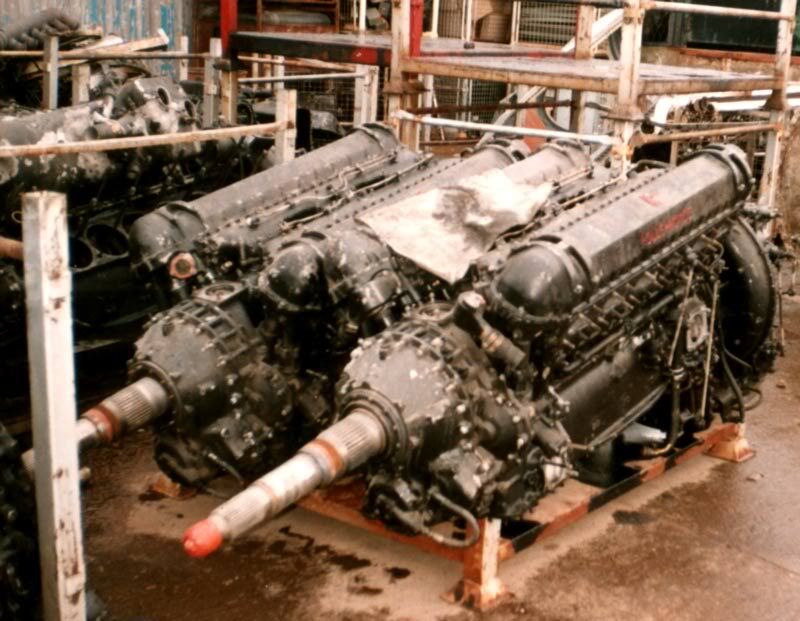
Outside Williamson’s scrapyard, Elgin, early 1990s….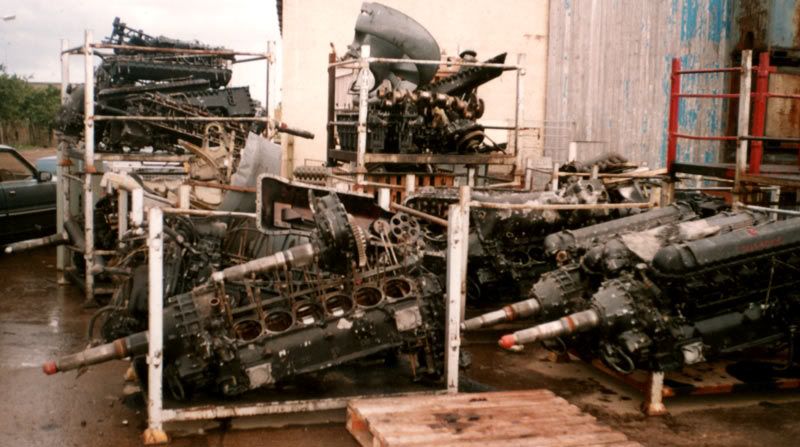
By: MerlinPete - 23rd June 2012 at 00:13
That’s a surprisingly high number; I’d assumed that the vast majority of Merlin (or any other) engine would simply be ‘lost-in-action’ long before it ever needed overhauling.
For example, the chances of a Bomber Command crew reaching the thirty operations required to complete a tour were quite slim, perhaps less than one-in-twenty. I’d have assumed that the chances of an individual aircraft completing thirty operations were even less. I wonder what was the average number of ‘hours’ flown by, say, a Lancaster before it was lost; maybe twenty operations of about eight hours each?
I know it will depend on a number of factors but is there a ‘standard’ number of hours that a Merlin will do before overhaul is required?
Yes, they started out at 200 and ended up at 500
Pete
By: Creaking Door - 22nd June 2012 at 23:39
About 30% of Merlins were overhauled at least once during WWII.
That’s a surprisingly high number; I’d assumed that the vast majority of Merlin (or any other) engine would simply be ‘lost-in-action’ long before it ever needed overhauling.
For example, the chances of a Bomber Command crew reaching the thirty operations required to complete a tour were quite slim, perhaps less than one-in-twenty. I’d have assumed that the chances of an individual aircraft completing thirty operations were even less. I wonder what was the average number of ‘hours’ flown by, say, a Lancaster before it was lost; maybe twenty operations of about eight hours each?
I know it will depend on a number of factors but is there a ‘standard’ number of hours that a Merlin will do before overhaul is required?
By: SimonR - 22nd June 2012 at 21:45
Thanks for the replies, chaps – v. interesting.
So which parts on the Griffon are are ‘lifed’? I’ve become a bit of an engine geek recently since rebuilding my MGB’s engine!
Also, is there any chance that these engines could be rebuilt for aircraft use – or are the days of complete Griffon rebuilds over?
Cheers…
By: pagen01 - 22nd June 2012 at 21:36
I know Griffons were overhaulled at St Athan, with tales of a dark, sooty, sweat shop type atmosphere being endured! The engine test-house (pre-war build) which was used into the late Shackleton AEW period still stands.
By: MerlinPete - 22nd June 2012 at 21:24
During WW2 engines were certainly returned for overhaul; I’ve got a book somewhere where ‘Bomber’ Harris states how unhappy he was with the standard of these overhauled engines, they proved (not surprisingly maybe) to be much less reliable than the new-build engines.
About 30% of Merlins were overhauled at least once during WWII.
Mostly by car manufacturers, Alvis was one of these.
Pete
By: Creaking Door - 22nd June 2012 at 21:10
During WW2 engines were certainly returned for overhaul; I’ve got a book somewhere where ‘Bomber’ Harris states how unhappy he was with the standard of these overhauled engines, they proved (not surprisingly maybe) to be much less reliable than the new-build engines.
By: MerlinPete - 22nd June 2012 at 20:49
Quick question: I notice that two of these engines have between 50 and 60 hours life left in them.
Does that mean that they’re basically junk, or could they just be rebuilt (if the parts were available) for use in another aircraft?
As an aside, I also wonder what happened during WWII – were engines taken out of bombers/fighters and remanufactured?
Apologies for ignorance!!
Yes, they can be rebuilt.
Griffons contain so-called ‘lifed’ parts, which have to be replaced when time expired, but the rest can be inspected for re use.
Merlins don’t contain any lifed parts as such, they rely on being within spec for re use.
Don’t apologise, ignorance is bliss!
Pete
By: SimonR - 22nd June 2012 at 20:37
Quick question: I notice that two of these engines have between 50 and 60 hours life left in them.
Does that mean that they’re basically junk, or could they just be rebuilt (if the parts were available) for use in another aircraft?
As an aside, I also wonder what happened during WWII – were engines taken out of bombers/fighters and remanufactured?
Apologies for ignorance!!
By: G-ORDY - 22nd June 2012 at 15:49
Does that mean I’ll have to revise Volume II (just working on the 20-series as we speak!)
By: TwinOtter23 - 22nd June 2012 at 11:29
By: VoyTech - 22nd June 2012 at 11:26
Griffon-powered Spitfires with two Viper engines and carrying nuclear depth-charges – that’s sounds like an exciting subject for a sequel with Daily Mail or another paper!
By: TwinOtter23 - 22nd June 2012 at 11:22
… plus don’t forget that certain variants had two Viper engines and were capable of carrying nuclear depth-charges! 😀
By: Creaking Door - 22nd June 2012 at 11:13
…less than 60 Griffon powered Spitfires still flying…
Isn’t that actually correct? 😀
By: Bruce - 22nd June 2012 at 11:13
The usual wonderfully accurate reporting from the ‘Fail’ I see.
MerlinPete will know what they are worth!
Bruce
By: Creaking Door - 22nd June 2012 at 11:12
Isn’t it amazing how many times it is possible to mention ‘Spitfire’ when writing an article about engines…
…from an Avro Shackleton! :rolleyes:
‘S-h-a-c-k-l-e-t-o-n?’ Apparently it’s some kind of Cold-War jet bomber…..that uses Spitfire engines! :diablo:
By: Pen Pusher - 22nd June 2012 at 11:08
Today just one Shackleton and fewer than 60 Spitfires originally fitted with one of these engines are still flying anywhere in the world.
There’s a Shackleton and less than 60 Griffon powered Spitfires still flying 😮 Where?
Good ole Maily Dail 😀
Brian


 Sign In








 June 22, 2012 at 10:48 am