Greetings. It’s been a while since i post a thing here.. bit boggled with some IRL issues. But well here i come.
So what i shared is, kinda small project of mine based on my interest toward radar.
The AESA Radar range calculator here is an excel spreadsheet, made based on several books like SKolnik’s 3rd Introduction to Radar system, Stimson’s 2nd Edition of Introduction Airborne Radar and others.
The calculator will attempt to predict radar ranges based on inputted variables and taking account of some important things that for some reason not considered by other calculators like pulse integration, scan sectors and most importantly the antenna weighting scheme.
As we know AESA Radar or perhaps even its Hybrid Array sibling like N011M Bars is capable of actually altering its radiation pattern, based on algorithms like Taylor, Cos, Hamming. etc. Even special algorithm has been developed for AESA. The change in radiation pattern allows reduction in sidelobe, beamwidth optimizations, or even total split of the aperture into several smaller one for search. In cost of efficiency and angular resolution.
This calculator however are still what you call as “Noise limited”, basically it’s not taking account things like ground clutter or weather. However i think for case like high altitude combat, it’s good.
It has simple interface and i believe quite easy to understand.
[ATTACH=JSON]{“alt”:”Click image for larger version Name:tesa_feature_by_stealthflanker-db04d9s.png Views:t1 Size:t116.2 KB ID:t3731792″,”data-align”:”none”,”data-attachmentid”:”3731792″,”data-size”:”custom”}[/ATTACH]
The download link.
critics and suggestion are welcome.

By: RALL - 27th July 2019 at 10:19
A question, is there some information about the range of the radar seeker of a typical air to air medium missile type Amraam or r77??
Ok i found it, R77 seeker rcs 5 m2 around 16 kms range.
I have interest now about Missiles of SAMs
By: panzerfeist1 - 7th July 2019 at 02:28
Got this information from here http://www.russiadefence.net/t2547p450-russian-radar-systems and if anyone knows about this radar or the name of it please let me know.
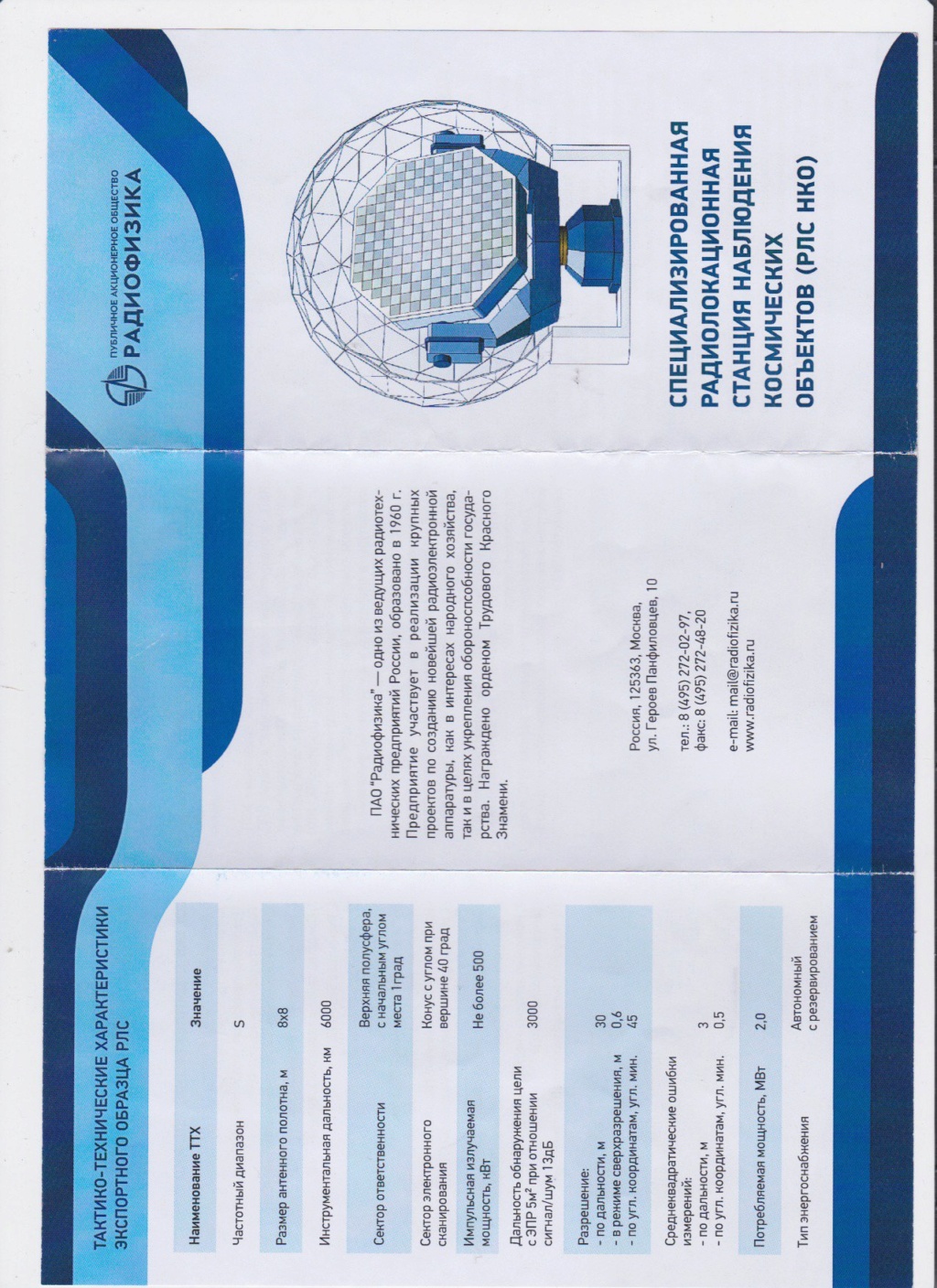
Band: S
Dimentions: 8x8m
Instrumental range: 6000km
Scan sector: +/- 20 degrees
Impulse power: 500kWt
Range vs 5m2: 3000km
Resolution: 0,6-30m in range, 45min angle
Errors: 3m range, 0,5min angle
Power consumption: 2MWt
Also if possible can any Russian speaker translate this whole thing(not just the specs)? Other information that I am assuming is that it has 196 t/r modules by counting them in that picture and assuming the dimensions are referring about the antenna size which is 8 by 8 meters the size would be 64 meters divided by 196 would mean each module would be 0.326 by .0326 meters so I am assuming each module size is 1ft by 1ft and dividing 2 megawatts by 196 each t/r module consumes 10.2 kilowatts although its the power consumption I am wondering if it is referring to max power consumption or not. This radar was presented in the 2019 forum.
By: PeeD - 2nd July 2019 at 19:13
Thanks! That case study gives good insight into the tools parameters.
I think we can be confident that the Gamma-DE has 3D beam forming capabilities to allow for sector-scan, starring mode, especially for ABM purpose (PESA 91N6E has it too by now). Observation modes are mentioned in the spec sheet further below. In that case the azimuth angle should be increased to >90°, right?
I would also like to know what would make sense for the “Fraction of time to search target” parameter. A portion of the aperture should be allocated to track beam functions, so what % parameter would make sense in this case? This is a main driving parameter which has dramatic impact on the results.
Another thing concerning the Gamma-DE is that photos without shroud show 560 elements at the 1 of 2 sub arrays. Based on this and your sub-tool for element count – frequency, I get 820 mhz. The paper says 1024 elements however, so could the rest be side-lobe cancelling elements or reserve ones?
Pulsewidth can be estimated from the range resolution which known to be 300 meters. Technical paper (which i would link below) about Gamma DE mentions compression ratio in excess of 100. Finding how much however is difficult. One way i sought is looking at AN/TPS-59 Radar as it seems Gamma DE have similar parameters.
The Pulsewidth is then can be “guessed” to be 1000 ms with 0.18 KHz (180 Hz) PRF. For 18% Duty cycle. The pulse compression ratio would then be 500 which appears reasonable with LFM (Linear Frequency Modulation) The LFM apparently the only pulse compression method where target velocity is not limited (Others like Polyphase etc are doppler sensitive and can only be used for target in Subsonic speed or less). The higher PRF and shorter pulsewidth could be exist too mainly to compensate for short range target detection. Transmitting at long pulsewidth and pulse compression solves resolution BUT not the minimum range.
So basically you selected the lower PRF number from the similar AN/TPS-59 to optimize the results for max. range – RCS performance. Pulsewidth came via duty cycle. But without that, what could we extract from the 300m range resolution and compression ratio of 100?
I would also like to know how much general practice those 20-40% safety reserves are? How do western and eastern radar schools handle this? Isn’t it redundant due to probability of detection parameter (just use e.g 95% to cover that margin)?
Fortunately you directly found the TRM power levels for this case, so we have become aware that there seems to be a 40% safety margin. Without that information, by using the tool to extract it, we would have got the wrong numbers.
The smaller 0.13 Sqm Yield range of about 301 Km or about 16% more than what is available in the export literature for the radar. This case would show overestimate of the sheet which might result from the limitation of the scenario (sector scan mode)
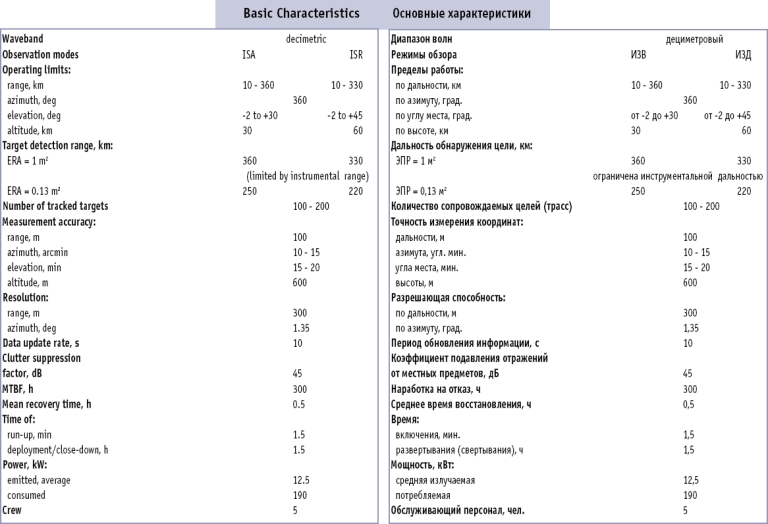
301km for a 0,13m² target would represent a 16% safety margin, yes. I wonder whether we can use that 250km number as fix point to vary unknown key performance parameters such as “Fraction of time to search target”.
This is a Technical paper by I.Immoreev regarding the design and development of Soviet/Russia ground based AESA. It contain good information on design and considerations about Gamma-DE Radar.
Thanks that was quite interesting. I wonder if the Gamma-S series uses that new (back in th mid 2000’s) TRM technology mentioned, with 200W instead of Gamma-DE’s 55W and where they are now with the S-band AESA for Nebo-M and beyond.
By: stealthflanker - 2nd July 2019 at 02:43
How about benchmarking the tool on some representative applications.
If range against a specific RCS is known as other parameters details like element power output could be calculated.A example would be the Gamma-DE ground based L-band radar:
Element number and aperture size is known to determine operating band.
Range figures against two different RCS are also known.
Duty cycle can be approximated to get an idea about element power output.
If the numbers make sense, we can have increased confidence, specially if results make sense for some different applications (airborne, ground based early warning, ground based engagement radar)Most interesting would be to see how Russians, Chinese, Europeans, Israelis and Americans are doing in regards to the technology for their elements (which can be extracted if element power output is known via the tool).
Just duty cycle must be approximated somehow to get reasonable numbers for PRF and pulsewidth. But that may be quite accurately possible if general TRM power levels are known.
Regarding Gamma-DE tho. There are many unknowns, especially the exact frequency, the scan time (thus dwell time) and loss figure of the array. Plus as i mentioned before the sheet only works for non-rotating radar, so in this case the Gamma-DE must be on “sector scan” mode. Where the antenna is static and target search is purely electronic scan, the result will likely be overestimate. Another problem is whether Gamma-DE is actually capable or designed to perform such sector scan. In order to further reduce cost, an AESA radar for air surveillance purpose may not have horizontal scan capability, only vertical. The Gamma DE also limited by instrumented range, this is the range where the detection of approaching target is “allowed” to be announced by the radar instruments/devices. This is usually set to be 20-40% Lower than the “design range” where the radar can actually detect. Thus the range capability of the Gamma DE is, taking the 40% “excess” range would be about 504 Km. Sector scan however may allow longer dwell time which wouldnt possible with rotating scan (as longer dwell time means longer revisit and your target track updates may suffer) Thus more range.
The other numbers for input, one can work out by finding relevant literature. The Gamma-DE’s module appears to have following parameters :
Peak Power : 55 Watt
Average Power : about 10-12 Watt.
Duty Cycle : 10/55 = 0.18 or 18%
Frequency : This one is a guess of 1250 MHz.
Number of antenna elements : 1024
Pulsewidth can be estimated from the range resolution which known to be 300 meters. Technical paper (which i would link below) about Gamma DE mentions compression ratio in excess of 100. Finding how much however is difficult. One way i sought is looking at AN/TPS-59 Radar as it seems Gamma DE have similar parameters.
The AN/TPS-59 have following data :
[ATTACH=JSON]{“data-align”:”none”,”data-size”:”full”,”data-attachmentid”:3866917}[/ATTACH]
The Pulsewidth is then can be “guessed” to be 1000 ms with 0.18 KHz (180 Hz) PRF. For 18% Duty cycle. The pulse compression ratio would then be 500 which appears reasonable with LFM (Linear Frequency Modulation) The LFM apparently the only pulse compression method where target velocity is not limited (Others like Polyphase etc are doppler sensitive and can only be used for target in Subsonic speed or less). The higher PRF and shorter pulsewidth could be exist too mainly to compensate for short range target detection. Transmitting at long pulsewidth and pulse compression solves resolution BUT not the minimum range.
The scanning limit is 30-45 degrees which i think is the electronic scanning, Which i input only on vertical. so the radar is a standstill and scan vertically.
So plugging in the number will yield following result for GAMMA-DE :
[ATTACH=JSON]{“data-align”:”none”,”data-size”:”full”,”data-attachmentid”:3866918}[/ATTACH]
[ATTACH=JSON]{“data-align”:”none”,”data-size”:”full”,”data-attachmentid”:3866919}[/ATTACH]
The dwell time is selected based on received pulse number which looks “reasonable” as Signal processing requires at least 1-3 pulses for 1-3 pulse canceller MTI processing and based on the expected design range. Longer dwell time which is 0.3 seconds available from the sheet yields 656 Km range.
The smaller 0.13 Sqm Yield range of about 301 Km or about 16% more than what is available in the export literature for the radar. This case would show overestimate of the sheet which might result from the limitation of the scenario (sector scan mode)
As seen the result looks quite close to the “40% design range” at 90% detection probability margin for 1 sqm RCS with 16% overestimate for 0.13 sqm. There of course horizon limit for low flying target Further verification however requires other calculations and perhaps better literature especially regarding the losses and other variables. I would also need to incorporate the “rotating” radar mode to allow prediction of range of air surveillance radar which only scans electronically at elevation.
This is a Technical paper by I.Immoreev regarding the design and development of Soviet/Russia ground based AESA. It contain good information on design and considerations about Gamma-DE Radar.
https://id.scribd.com/document/415262162/Immoreev-I-Active-Transmitting-Phased-Antenna-Arrays
@Moonlight
This might be interesting for you.
https://id.scribd.com/document/415262324/Schleher-D-C-LPI-Radar-Fact-or-Fiction
By: PeeD - 1st July 2019 at 16:21
How about benchmarking the tool on some representative applications.
If range against a specific RCS is known as other parameters details like element power output could be calculated.
A example would be the Gamma-DE ground based L-band radar:
Element number and aperture size is known to determine operating band.
Range figures against two different RCS are also known.
Duty cycle can be approximated to get an idea about element power output.
If the numbers make sense, we can have increased confidence, specially if results make sense for some different applications (airborne, ground based early warning, ground based engagement radar)
Most interesting would be to see how Russians, Chinese, Europeans, Israelis and Americans are doing in regards to the technology for their elements (which can be extracted if element power output is known via the tool).
Just duty cycle must be approximated somehow to get reasonable numbers for PRF and pulsewidth. But that may be quite accurately possible if general TRM power levels are known.
By: stealthflanker - 28th May 2019 at 10:58
I meant even one with alleged LPI such as APG-79, APG-81 still got higher average output than 1 W, far higher in fact
They are. But are they any easier to detect remains a question.
So if you are the one getting painted, ESM effectively beaten LPI radar?
Maybe, but remember that being painted by radar means you are being detected and maybe locked and fired upon. The LPI designer can claim that too as their success. as the ESM failed to detect sidelobe and only able to warn you when you are being fired upon.
Your first task here is to find a good definition on what is the measure of merit of being LPI. Then from there we can work who have the advantage in the race between radar and ESM. Simply asking question and attempt to answer it without further clarification only at best confusing and at worst infuriating.
By: moon_light - 28th May 2019 at 10:44
Then they are not made to be LPI. Clearly ESM will have advantage.
I meant even one with alleged LPI such as APG-79, APG-81 still got higher average output than 1 W, far higher in fact
Or presented with low sidelobe that the only one who detect it is the one getting painted.
So if you are the one getting painted, ESM effectively beaten LPI radar?
By: stealthflanker - 28th May 2019 at 09:04
But normal output of air and ground radar are much higher than 1 W, right?
Then they are not made to be LPI. Clearly ESM will have advantage.
Or their LPI design feature does not involve such low power. Remember that RHAWS or ESM gear may not always have radar in view (scan to scan problem) Or presented with low sidelobe that the only one who detect it is the one getting painted.
and except for bombers, i would say fighter RCS are much lower than 100 m2
Can you be always sure that the target will always be presenting its lowest RCS side to radar ? Plus Pilot MK2 is a surface scan radar. It is designed for surface scan mission. The intended target is ships and boat. They will definitely have 100 sqm RCS.
By: moon_light - 28th May 2019 at 08:49
But the 1 W radar detects the target at 28 Km. One can also say Radar win.
But normal output of air and ground radar are much higher than 1 W, right?
and except for bombers, i would say fighter RCS are much lower than 100 m2
By: stealthflanker - 28th May 2019 at 07:25
Radar with 1W output can be detected from 25 km
any 10Kw can be detected from 2500 km
Doesn’t that show ESM won the race?
But the 1 W radar detects the target at 28 Km. One can also say Radar win. Plus it does not say anything on sidelobe intercepts.
By: moon_light - 28th May 2019 at 06:05
No real consensus as there isnt even official metric being adopted as a measure of merit of being LPI.
Many, ranged from managing and trading between power vs dwell time. Low sidelobes, or make the signal unrecognizable (say random PRF etc)
Countering these techniques are possible but it is hard to tell which is “easier” to counter than the other.
Radar with 1W output can be detected from 25 km
any 10Kw can be detected from 2500 km
Doesn’t that show ESM won the race?
https://apps.dtic.mil/dtic/tr/fulltext/u2/a456960.pdf
[ATTACH=JSON]{“data-align”:”none”,”data-size”:”large”,”data-attachmentid”:3863476}[/ATTACH]
By: stealthflanker - 27th May 2019 at 12:56
Could it be LPI?
Do you you think the race between LPI radar and ESM has been won decisively by ESM system?
No real consensus as there isnt even official metric being adopted as a measure of merit of being LPI.
What are some LPI techniques ? are they all easily counter?
Many, ranged from managing and trading between power vs dwell time. Low sidelobes, or make the signal unrecognizable (say random PRF etc)
Countering these techniques are possible but it is hard to tell which is “easier” to counter than the other.
By: moon_light - 27th May 2019 at 09:50
Overall however it is kinda hard to judge which parameter is better from the qualitative presentation.
Could it be LPI?
Do you you think the race between LPI radar and ESM has been won decisively by ESM system?
What are some LPI techniques ? are they all easily counter?
By: totoro - 27th May 2019 at 09:10
Did you perhaps mean fourth power in your formula, instead of fourth root?
By: stealthflanker - 26th May 2019 at 11:59
@mig31bm
Well we dont know what type of F-15E and C’s being discussed. Plus im kinda late in news, Im curious on how many C and E’s received the new APG-63V3/82’s.
Aperture wise it’s does look bigger, perhaps even better cooling especially the APG-82 Bird which receive cooling upgrades, might allow bit more powerful TRM to be used. Overall however it is kinda hard to judge which parameter is better from the qualitative presentation.
By: eagle - 25th May 2019 at 17:26
pilot rate F-35 radar better than F-15C but worse than F-15E
Basically, APG-63 v3 < APG-81 < APG-82
But since APG-63v3 aperture is so much bigger than APG-81, shouldn’t it is also better than Apg-81?
That is based on the opinions of 2, in words two F-15C pilots. And it doesn’t say if they compared APG-63 (V)1, (V)2 or (V)3.
Maybe they were simply impressed with A/G modes, easy feat.
7 F-15E pilots without info on the radar aswell. I wouldn’t read too much into it.
By: mig-31bm - 25th May 2019 at 16:28
[USER=”70376″]stealthflanker[/USER] what do you think about this
pilot rate F-35 radar better than F-15C but worse than F-15E
Basically, APG-63 v3 < APG-81 < APG-82
But since APG-63v3 aperture is so much bigger than APG-81, shouldn’t it is also better than Apg-81?
[ATTACH=JSON]{“alt”:”Click image for larger version Name:t29E4B218-DF51-4AAD-A15E-ED3660CC8199.png Views:t0 Size:t279.0 KB ID:t3863238″,”data-align”:”none”,”data-attachmentid”:”3863238″,”data-size”:”full”}[/ATTACH]
By: RALL - 25th May 2019 at 10:53
ok, how you want.
By: panzerfeist1 - 25th May 2019 at 08:10
Rall you are a great help but I will take stealth flankers calculation response. Thank you guys for being great resources.
By: stealthflanker - 24th May 2019 at 20:34
just put it on google drive or some other filehosting service.


 Sign In








 March 20, 2017 at 3:29 am