
By: swerve - 19th December 2016 at 18:04
Yes, but for the same number of elements/power/weight you should get longer range before you start generating others, you don’t always need maximum range, & you always have the option of a single beam if you want maximum range.
It’s an advantage however you look at it.
By: xena - 19th December 2016 at 00:31
Dividing the array in many sub arrays means less power for one of the sub beams and so less range. This is the disadvantage of multiple beams. The full range can be achieved by the use of all modules only.
By: garryA - 18th December 2016 at 21:56
And which might those be ? I was under impression PESA(non hybrid) could do everything that AESA does.
In AESA design ,the low noise amplifier is put near the receiver before the lossy components, thus AESA radar can achieve better signal to noise ratio compared to PESA (better signal to noise ratio will improve radar detection range). AESA design is approximately 2.79 dB better than PESA design in that aspect ( or about 47% better )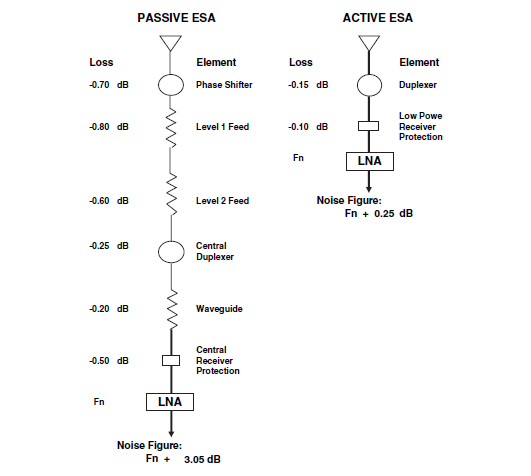
Furthermore , since individuals T/R modules on AESA do not rely on a single high power amplifier, they can transmit signal at different frequencies at the same time. As a result, an AESA can form several independent beams at different frequencies simultaneously by dividing the array into a few smaller sub-array, that improves its multitasking capabilities.
By: swerve - 18th December 2016 at 20:20
Multiple beams?
By: El_Indigo - 18th December 2016 at 17:30
so to allow them to make use of certain operative modes that were considered an exclusive of just the latter ones.
And which might those be ? I was under impression PESA(non hybrid) could do everything that AESA does.
By: Marcellogo - 15th December 2016 at 02:16
Go to wikipedia for them first.
https://en.wikipedia.org/wiki/Passive_electronically_scanned_array
https://en.wikipedia.org/wiki/Active_electronically_scanned_array
Let’s say first that they are both ESA i.e. they can steer their radar beam without phisically moving their own antennas.
They are both composed by an an array of small antennas , up to several hundreds to even thousands elements, each one provided of a phase shifter https://en.wikipedia.org/wiki/Phase_shift_module that allow to slighty differentiate the time of their respective emissions so to made them superpose and form an angled plane wave in the desired direction.
They can so scan their own F.o.W. with a way greater velocity than a mechanical steered one.
Phase shifter allows also to emit separate beams in several direction and to tone it for different tasks as fine tracking or missile guidance.
The difference between the two is just in the fact that in PESA the radio waves are given by a single emission source to all antennas in the same time while in the more sophisticated AESA there is a single miniaturized emitter module for any antenna.
You would find many sources pumping up to the max the advantage of the second solution toward the first one but in reality the great performance gap is between them both and the precedent mechanically scanned ones , also because more modern Pesa radars are actually an hybrid with AESA ones ( i.e. they have a separate receiver for each of their antenna elements) so to allow them to make use of certain operative modes that were considered an exclusive of just the latter ones.
By: moon_light - 15th December 2016 at 01:37
You can read about different kind of radar here : https://basicsaboutaerodynamicsandavionics.wordpress.com/2016/08/11/radar-fundamentals-part-ii/


 Sign In








 December 15, 2016 at 12:53 am