Surfing the web, I’ve seen that AIM-120C-7 and AIM-120D range estimates vary from 110 to 180 and even 200+ km. What are the most realistic numbers? An article in the french “Air & Cosmos” was very conservative, mentioning a 50 km range for the -D. I guess that would be the range for the A version of the AMRAAM…

By: blackadam - 26th March 2015 at 06:10
AIM-120A/B: 48-55km
AIM-120C5/6: 70km
AIM-120C7: 50-80-88km
AIM-120D: 72-105km (no ramjet)
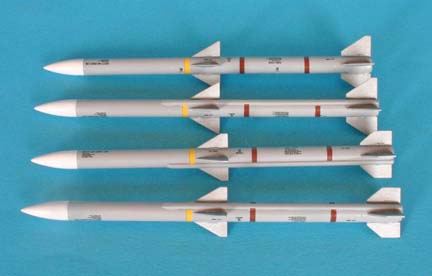
AIM-120 + ramjet (aka AIM-120C-8)
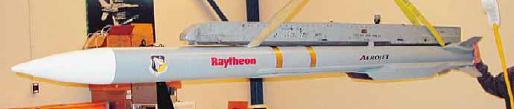
There are currently four main variants of AMRAAM, all in service with the United States Air Force, United States Navy, and the United States Marine Corps. The AIM-120A is no longer in production and shares the enlarged wings and fins with the successor AIM-120B. The AIM-120C has smaller “clipped” aerosurfaces to enable internal carriage on the USAF F-22 Raptor. AIM-120B deliveries began in 1994.
The AIM-120C deliveries began in 1996. The C-variant has been steadily upgraded since it was introduced. The AIM-120C-6 contained an improved fuse (Target Detection Device) compared to its predecessor. The AIM-120C-7 development began in 1998 and included improvements in homing and greater range (actual amount of improvement unspecified). It was successfully tested in 2003 and is currently being produced for both domestic and foreign customers. It helped the U.S. Navy replace the F-14 Tomcats with F/A-18E/F Super Hornets – the loss of the F-14’s long-range AIM-54 Phoenix missiles (already retired) is offset with a longer-range AMRAAM-D. The lighter weight of the advanced AMRAAM enables a hornet pilot greater bring-back weight upon carrier landings.
The AIM-120D is an upgraded version of the AMRAAM with improvements in almost all areas, including 50% greater range (than the already-extended range AIM-120C-7) and better guidance over its entire flight envelope yielding an improved kill probability (Pk). Raytheon began testing the D model on 5 August 2008, the company reported that an AIM-120D launched from an F/A-18F Super Hornet passed within lethal distance of a QF-4 target drone at the White Sands Missile Range.
The AIM-120D (P3I Phase 4, formerly known as AIM-120C-8) is a development of the AIM-120C with a two-way data link, more accurate navigation using a GPS-enhanced IMU, an expanded no-escape envelope, improved HOBS (High-Angle Off-Boresight) capability, and a 50% increase in range. The AIM-120D is a joint USAF/USN project, and is currently in the testing phase. The USN will field it from 2014, and AIM-120D will be carried by all Pacific carrier groups by 2020, although the 2013 sequestration cuts could push back this later date to 2022.
There are also plans for Raytheon to develop a ramjet-powered derivative of the AMRAAM, the Future Medium Range Air-Air Missile (FMRAAM). It is not known whether the FMRAAM will be produced since the target market, the British Ministry of Defence, has chosen the Meteor missile over the FMRAAM for a BVR missile for the Eurofighter Typhoon aircraft.
Raytheon is also working with the Missile Defense Agency to develop the Network Centric Airborne Defense Element (NCADE), an anti-ballistic missile derived from the AIM-120. This weapon will be equipped with a Ramjet engine and an IR seeker derived from the Sidewinder missile. In place of a proximity-fused warhead, the NCADE will use a kinetic energy hit-to-kill vehicle based on the one used in the Navy’s RIM-161 Standard Missile 3
The −120A and −120B models are currently nearing the end of their service life while the −120D variant has just entered full production. AMRAAM was due to be replaced by the USAF, the U.S. Navy, and the U.S. Marine Corps after 2020 by the Joint Dual Role Air Dominance Missile (JDRADM). This was unexpectedly terminated in the 2013 budget plan, and so the future replacement is uncertain.
AIM-120A
Initial model with solid-propellant rocket motor in a WPU-6/B propulsion section. The AMRAAM is fired in the general direction of the target, the WGU-16/B guidance unit bringing it to a (by the aircraft determined) point, using mid-course information from a data-link. In the final stage, the AMRAAM activates its own active radar seeker for terminal homing. Warhead is a 23 kg (50 lb) WDU-33/B fragmentation type with proximity and an impact fuze. Typical range is 50 km (30 miles) to 70 km (45 miles). The CATM-120A is a captive-carry training missile, the DATM-120A is used for ground-handling training and the JAIM-120A is equipped with telemetry electronics for test and evaluation purposes.
AIM-120BDelivered in 1994, the AIM-120B has a new WGU-41/B guidance section, reprogrammable EPROM modules, a new digital processor and other electronics updates. Model CATM-120B is captive-carry and JAIM-120B test and evaluation missiles.
AIM-120CA three-phase Pre-planned Product Improvement Program (P3I) has brought the AIM-120C missile version into inventory use. The AIM-120C-2 is programmable in the field and has ECCM improvements. In Phase 1, the AIM-120C-3, introduced in 1996, has clipped wings and fins to fit in the internal weapons bays of the F-22 Raptor. Moreover, the guidance unit is upgraded to WGU-44/B standard. Phase 2 includes the AIM-120C-4 (first delivered in 1999, with improved WDU-41/B warhead), AIM-120C-5 (introduced July 2000, with a slightly larger motor in the new WPU-16/B propulsion section and a new shorter WCU-28/B control section with compressed electronics and ECCM upgrades) and AIM-120C-6 (Target Detection Device). Phase 3 covers the AIM-120C-7, with improved ECCM with jamming detection, an upgraded seeker, and longer range. Training and development rounds are designated CATM-120C and JAIM-120C.
AIM-120DFormerly known as AIM-120C-8, the AIM-120D has a two-way data link, more accurate navigation using a GPS-enhanced IMU, an expanded no-escape envelope, improved HOBS (High-Angle Off-Boresight) capability, and a 50% increase in range, bring it to the 180 km class. The AIM-120D is a joint US Air Force/US Navy project.
MIM-120ACompany designation of a ground-launched application, developed by Norway as the NASAMS (Norwegian Advanced Surface-to-Air Missile System). The NASAMS, which became operational in 1995, carries AMRAAM missiles from a six-round box launcher.
There are two basic upgrade approaches to increase the range of the AMRAAM, of especial concern since the AIM-54 Phoenix. Actually, both can be implemented as incremental upgrades. Future medium range air-to-air missile (FMRAAM) is the high end, which replaces the existing engine with a ramjet using a high-energy rocket fuel. ERAAM would upgrade to a dual pulse rocket motor, and is estimated to give 80% of the capability of FMRAAM for 50% of the cost.
Competitors
Missiles comparable to the AMRAAM include the Russian Vympel R-77/NATO: AA-12 Adder. Competing against EMRAAM/FMRAAM would be the European Matra-Bae Meteor, which combines a ramject with the radar from the Matra-Bae MICA AAM, or a ramjet derivative of the R-77.
https://mikimiki248.wordpress.com/2014/06/07/aim-120-amraam/
http://wiki.scramble.nl/index.php/Raytheon_%28Hughes%29_AIM-120_AMRAAM
http://en.citizendium.org/wiki/AIM-120_AMRAAM
https://books.google.com.vn/books?id=dccE7YOi-54C&pg=PA142&lpg=PA142&dq=AIM-120C7+80+km&source=bl&ots=0j2gd0kGp5&sig=LYBgHExnqglX5sX3GyPhyFlKEFE&hl=vi&sa=X&ei=GqITVfbrOY_poATS3oHwDQ&redir_esc=y#v=onepage&q=AIM-120C7%2080%20km&f=false
http://www.deagel.com/Air-to-Air-Missiles/AIM-120D-AMRAAM_a001164006.aspx
http://www.pmulcahy.com/aams/us_aams.htm
http://www.deagel.com/Air-to-Air-Missiles/AIM-120C-AMRAAM_a001164003.aspx
By: halloweene - 27th January 2014 at 22:56
Rafel three pulse motor could be a potential solution for the Aim-9x Blk III ….The USAF and DARPA however are funding ramjet propulsion for the T3, so i guess as far as BVR weapons go, that path is all but certain
http://www.aviationweek.com/Article.aspx?id=/article-xml/awx_06_19_2013_p0-589808.xml
There’s similar project for mica NG, extended range and dual pulse engine.
By: obligatory - 27th January 2014 at 14:09
In space, it has infinite range, but also infinitely low hit probability,
while in water it has no range vs an escaping target, -the range is dependent on launch parameters, as well as agility of target.
Here you can compare with Astra
http://forum.keypublishing.com/showthread.php?113735-missile-flight-theory
By: blackadam - 27th January 2014 at 13:49
What range of AIM-120C-7 and AIM-120D
By: halloweene - 23rd June 2013 at 19:36
Anti Fox-3 tactics rely on shoot the AAM within NEZ then turn away, another fighter 20km behind shooter will guide BVRAAM by his own radar
Exactly what is intending to do french airforce using aesa equipped Rafale as “mini awacs”.
By: ff1987 - 23rd June 2013 at 19:17
another interesting info about AMRAAM effective range:
The improvements planned for, but at the time of writing (2000) cancelled, future versions of AMRAAM include the ability to engage 9G manouevring targets at 30 km, which will let it engage non-agile targets at more than 60 km, which gives a good idea of the range difference depending on type of target.
To take one example, the Vympel R-77 has a stated range of 100 km against a head-on target at high altitude, but only 25 km in a stern chase. At low altitude it can fire at head-on targets at 20 km, from which we can guess range in a stern chase is 5 km.
And this is presumably against targets that don’t try to evade.
http://www.x-plane.org/home/urf/aviation/text/missiles/aam.html
some AMRAAM firing range:
-1992 F-16 against MiG-25 – 6km (col.North)
-1994 F-16 against Jastreb – over a dozen of kilometers
from ‘Allied Force’ against MiG-29 (shooter F-15C) :
25km Rodriguez
10km Shower
25km Hwang
10km Hwang
HAF pilot in exercises shoot AMRAAM from 10 miles (see post #30 this thread)
AIM-7M shoot were even from further range 27, 32, 35 km, but the target didn’t evade the missiles and turn away.
Anti Fox-3 tactics rely on shoot the AAM within NEZ then turn away, another fighter 20km behind shooter will guide BVRAAM by his own radar ( I read about that tactics in Lotnictwo magazine 11/2011 – Polish Air Force F-16 pilot col.Malinowski said about that tactics. Also I read in Lotnictwo 01/2011 in Erwan de cherisey article when Rafale use the same tactics with link-16).
We can also give conclusion from red flag ~20 miles for the F-22 AMRAAM shoot against EF…
By: Tu22m - 23rd June 2013 at 18:02
Quick calc using some Lift and Drag coefficient graphs I found in an article from the world academy of science, engineering and technology. The object was wind tunnel tested from various AoA’s and they also used 2 separate prediction techniques to develop the graphs. I made an assumption the graphs would be linear and expanded them up to 26 degrees AoA.
Object was a cone nosed cylinder (the context of much of the document is missiles). Haven’t triple checked the formulas yet, but its coming along. When I get back from hols will tweak it with built in tables so I don’t have to refer to the ones on the right and will add the ability to predict G’s needed to intercept throughout the flight while the target is manoeuvring using augmented proportional navigation formulas to predict missile turns.Model only considers body lift and cross sectional area only, no wing lift. Will add that later. If everything’s working ok and even remotely accurate, then 40G capability is most certainly a structural limit at low altitude, but a lot depends on control surface deflection angle and maximum AoA.
Excellent, this is how a hypothesis is tested and how an argument should be done! I hope the fanboys can read this and learn.
I don’t understand turn rate. Is it fraction of the full circle/sec or just a coefficient?
Here is a quick table with the most common numbers.
| width: 600 | ||||
|---|---|---|---|---|
| [tr] [TD]Turn rate | deg/s[/TD] [TD]G-force[/TD] [TD]Velocity | m/s[/TD] [TD]Turn radius km[/TD] [TD]r= (v^2)/(G*9 | 8)[/TD] [/tr] | |
| [tr] [TD]18 | 7[/TD] [TD]40[/TD] [TD]1200[/TD] [TD]3 | 7[/TD] [TD]Missile | max G[/TD] [/tr] | |
| [tr] [TD]14 | 0[/TD] [TD]30[/TD] [TD]1200[/TD] [TD]4 | 9[/TD] [TD][/TD] [/tr] | ||
| [tr] [TD]9 | 4[/TD] [TD]20[/TD] [TD]1200[/TD] [TD]7 | 3[/TD] [TD]Missile | baseline inst turn rate after burnout from Patriot[/TD] [/tr] | |
| [tr] [TD]4 | 7[/TD] [TD]10[/TD] [TD]1200[/TD] [TD]14 | 7[/TD] [TD][/TD] [/tr] | ||
| [tr] [TD]2 | 3[/TD] [TD]5[/TD] [TD]1200[/TD] [TD]29 | 4[/TD] [TD][/TD] [/tr] | ||
| [tr] [TD]25 | 0[/TD] [TD]40[/TD] [TD]900[/TD] [TD]2 | 1[/TD] [TD]Missile | max G at “low” speed | possibly low alt[/TD] [/tr] |
| [tr] [TD]18 | 7[/TD] [TD]30[/TD] [TD]900[/TD] [TD]2 | 8[/TD] [TD]Missile[/TD] [/tr] | ||
| [tr] [TD]12 | 5[/TD] [TD]20[/TD] [TD]900[/TD] [TD]4 | 1[/TD] [TD]Missile | baseline inst turn rate after 25% velocity loss[/TD] [/tr] | |
| [tr] [TD]6 | 2[/TD] [TD]10[/TD] [TD]900[/TD] [TD]8 | 3[/TD] [TD][/TD] [/tr] | ||
| [tr] [TD]3 | 1[/TD] [TD]5[/TD] [TD]900[/TD] [TD]16 | 5[/TD] [TD][/TD] [/tr] | ||
| [tr] [TD]8 | 4[/TD] [TD]9[/TD] [TD]600[/TD] [TD]4 | 1[/TD] [TD]Aircraft[/TD] [/tr] | ||
| [tr] [TD]11 | 2[/TD] [TD]9[/TD] [TD]450[/TD] [TD]2 | 3[/TD] [TD]Aircraft[/TD] [/tr] | ||
| [tr] [TD]14 | 4[/TD] [TD]9[/TD] [TD]350[/TD] [TD]1 | 4[/TD] [TD]Aircraft <– break point for my assumptions[/TD] [/tr] | ||
| [tr] [TD]16 | 8[/TD] [TD]9[/TD] [TD]300[/TD] [TD]1 | 0[/TD] [TD]Aircraft[/TD] [/tr] | ||
| [tr] [TD]20 | 2[/TD] [TD]9[/TD] [TD]250[/TD] [TD]0 | 7[/TD] [TD]Aircraft | close to cornerspeed | lower lower lift from wings is not accounted for[/TD] [/tr] |
We know speed isnt everything, if that would have been the case the best dogfighter would have been MiG 31… but it’s not.
As stated before. Astra (a similar missile family) can pull it’s 40G near seal level, the PAC 3 missile can pull up to 30G once @mach 5 meaning 19G @ mach 4. I think its reasonable to assume similar performance on the Aim120 as on the Pac 3 after burnout and that the numbers we get are calculated in a similar manner as the Astra.
By: bring_it_on - 23rd June 2013 at 13:38
The ATK press release talks about “multi-pulse propulsion”. This could imply that both two and three-pulse designs will be studied. Rafael is reported to have stated that the use of three pulses is a viable alternative to ramjet propulsion.
The provision of the extra hardware needed for multipulse operation will reduce the performance gain that results from improved propellant, casing, and nozzle.
Rafel three pulse motor could be a potential solution for the Aim-9x Blk III ….The USAF and DARPA however are funding ramjet propulsion for the T3, so i guess as far as BVR weapons go, that path is all but certain
http://www.aviationweek.com/Article.aspx?id=/article-xml/awx_06_19_2013_p0-589808.xml
By: ff1987 - 23rd June 2013 at 13:03
I think that this thread is much better place to discuss AMRAAM range than F-35 Debate thread.
I read some interesting thing from CAM 01/2010 page 36, so I decided to post it here.
http://ebookee.org/Combat-Aircraft-Vol-11-No-01-2010-01-_462179.html
Greek F-16 pilot fire 3 AMRAAM from 10 miles to the enemy fighters at 26 k ft.
The hostile aircraft chance of survival are limited – the missiles ARs are within their engagement parameters (‘Pit Bull’).
The Greek F-16C/D blk 52+ fire AIM-120C-5/7 to the fighter target in standard HAF exercises from 10 miles.
This is probably within AMRAAM NEZ, and pilot preffer to get closer than shoot from further range to improve missiles Pk.
This is realistic example from real exercises.
By: halloweene - 9th June 2013 at 09:48
MBDA also studuing dual pulse for an improved mica.
By: Mercurius - 15th May 2013 at 16:57
The ATK press release talks about “multi-pulse propulsion”. This could imply that both two and three-pulse designs will be studied. Rafael is reported to have stated that the use of three pulses is a viable alternative to ramjet propulsion.
The provision of the extra hardware needed for multipulse operation will reduce the performance gain that results from improved propellant, casing, and nozzle.
By: SpudmanWP - 15th May 2013 at 03:58
There is only one motor for the AIM-120D and it is the same one that has been installed in every AMRAAM since the C5 increase (due to electronics shrinkage).
http://www.atk.com/products-services/amraam-pep-propulsion-system/
The only range improvements that have come since C5 have been due to better flight profiles. Increased accuracy of the IMU and the new GPS guidance package of the -120D is what accounts for its increase over the C7.
ATK has been working on a new motor which if combined with another round of electronics shrinkage should add a decent amount of range.
By: Mercurius - 14th May 2013 at 18:39
The reason i put them as plausible is because I need to compare the test results with my own input to see whether or not it is likely or not. If the actual tests would have been inplausible by using my numbers it would have been clear that there is a mistake somewhere.
I do the same when studying the range performance of ballistic missiles. If the calculated performance of obsolete missiles whose detailed parameters are known matches the actual range these are known to have achieved, this gives confidence in the process. Inevitably, while most of this historical missiles give a good match, a few do not. Such is life.
When it comes to the AIM120D it wont be able to fit a lot more fuel than the Aim120C and I believe we will see a burn time cap at around 10-12 seconds.
Since the –120D was designed to use the extended +5 motor, it seems logical to assume that the new powerplant will be the same size, so the only increase the propellant volume will be whatever is made possible by an improved casing. If the reported 6 sec burn time of the +5 motor is correct, it might be stretching things a bit to postulate that improved propellant will give a 10-12 second burn time.
Against the same target, at the same altitude at the same subsonic speed (only different vector) the Aim120A/B;s effective range is in the 15-55km span (as seen in the chart).
I doubt if the Russians have been briefed on the AIM-120, so I would have little faith in their claimed performance values for the missile. From experience, I do not even trust them to be truthful about their own missiles.
By: Tu22m - 14th May 2013 at 12:52
Until some official pronouncement is made on AIM-120D range, I remain highly suspicious of all figures appearing on the internet.
So would I.
But we have some physical limitations and from that we can extrapolate a reasonable performance span.
The reason i put them as plausible is because I need to compare the test results with my own input to see whether or not it is likely or not. If the actual tests would have been inplausible by using my numbers it would have been clear that there is a mistake somewhere.
And with a throttlable output and chosen cruise speed on the Meteor a lot changes.
Just look at the drag force difference @40kft. Mach 5 = 4,4KN, mach 4 = 2,8 KN and mach 3 = 1,6KN…
When it comes to the AIM120D it wont be able to fit a lot more fuel than the Aim120C and I believe we will see a burn time cap at around 10-12 seconds. It is possible that there might be a special BVR-high alt edition that has a lower burn speed in the sustainer part and lower ΔV in the beginning. That will make it better in high alt BVR-engagements but lower the performance at lower altitudes where the enemy is more likely to be operating.
And as displayed earlier. Kinematic performance of the launch platform, air density and maneuvering does make huge differences. Not to mention target direction. Against the same target, at the same altitude at the same subsonic speed (only different vector) the Aim120A/B;s effective range is in the 15-55km span (as seen in the chart).
By: Mercurius - 14th May 2013 at 11:08
Bacause of sound and movements.
But as I have already explained, we know that the ramjet burned for only 15 seconds during this trial.
So if missile contrailling is an indication that the powerplant is thrusting, it looks like the video is slower than real time, which would infer that the ‘cockpit sound’ heard in the recording is of a lower pitch that its true value.
This i your exact words:
“Meteor has flown at more than Mach 3 for several minutes during a test conducted at more than 40,000 ft.”
Assuming 60kft with normal velocity boost…
You are reading too much into my words “more than 40,000 ft”. The actual altitude was around 43,000 ft. But it is nice to know that your calculations show a trial that actually happened (GF5) is “very plausible”. (Just for the record, GF5 was the designation of the trial, not the target type.)
I am not sure why you are citing a powered range of only 25 and 30 km in your calculations. To the best of my knowledge, the ramjet burn lasts all the way to the target. (Strictly speaking, the Meteor powerplant it is not a ramjet but a ducted rocket.)
But the original poster wanted to know the likely maximum range of the AIM-120D.
Arka_Voltchek suggested a range of “120km for the -D in good configuration. In this same configuration, the -A go to 60km”.
Sferrin wrote “I’ve read 180km useful flight range for an AIM-120D with a dual-pulse motor.”
However, the AIM-120D does not have a dual-pulse motor. This has been discussed in an earlier thread. It uses the same motor as the AIM-120C-5 and C-7, and the extended range is the result of improved energy management. In 2006, AIM-120D programme director had that the new missile achieves a “substantial” but undisclosed increase in range due to the use of new software algorithms combined with guidance data provided by the GPS/INU and a longer battery life.
Until some official pronouncement is made on AIM-120D range, I remain highly suspicious of all figures appearing on the internet.
By: Tu22m - 14th May 2013 at 00:57
How do you know that the post-release sequence was being shown in real time?
Bacause of sound and movements.
20 or 25 seconds can’t be right – we know that the ramjet burned for only 15 seconds during this trial.
In the case I cited of the missile flying at Mach 3 plus for several minutes (= 120 seconds or more), we have no evidence that this was a lofted-trajectory shot. If we assume it was made at constant altitude, and accept Cola’s ‘rule of thumb’ table (although we do not know its origin), then the velocity loss after burnout would have been 25 per cent every 25 seconds.
This i your exact words:
“Meteor has flown at more than Mach 3 for several minutes during a test conducted at more than 40,000 ft.”
Assuming 60kft with normal velocity boost you will have about 25 sec burn at up to 1500m/s, 75 sec ~1125m/s and another 65 seconds over mach 3. Or a total of 165 seconds over mach 3 at an altitude that is more than 40kft.
So I can’t see the conflict of the information here. What you said is plausible without any need to modify the calculations and values.
You said it hit a GF5 target at 48kft at more than 100km.
Lets just count the performance here.
V(max) = 1200 m/s
Powered range = ~30km
Glide range, vg speed ~1100m/s = 25s = 28 km
Glide range, vg speed ~790m/s = 25s = 20km
Glide range, vg speed ~590m/s = 25s = 15km
V(min = 506 m/s)
So in a straight line, 8kft lower with a subsonic launch the calculations give us a supersonic range, at which it can still hit targets, of 90km.
If we lower the drag accordingly to air density at the higher altitude, adjust for higher launch speed and count on a lofted shot it gets prety clear that the 100km+ range vs a target drone is very plausible.
Just look at how altitude is key to range from this chart.
[ATTACH=CONFIG]216497[/ATTACH]
But with throttlable power the range is even better since not all fuel is wasted on accelleration, and with a higher launch speed it needs less fuel to reach V(max) and the rest can be used to have a pretty economical powered cruise.
By: Mercurius - 13th May 2013 at 14:49
The release of the missile was in slow motion, the rest wasnt
How do you know that the post-release sequence was being shown in real time?
If we estimate that the cutscene at 2:38 is about 5 sec after launch (i miscounted in my first post) because of the distance to the missile and contrail. That gives us roughly 20 seconds (24km) of powered flight (maybe even 25 seconds if we use Obligatorys measurement ->30km).
20 or 25 seconds can’t be right – we know that the ramjet burned for only 15 seconds during this trial.
In the case I cited of the missile flying at Mach 3 plus for several minutes (= 120 seconds or more), we have no evidence that this was a lofted-trajectory shot. If we assume it was made at constant altitude, and accept Cola’s ‘rule of thumb’ table (although we do not know its origin), then the velocity loss after burnout would have been 25 per cent every 25 seconds.
Assuming a Mach 4 peak velocity (which I suspect is a combination of launch speed + missile speed), then this would fall to Mach 3 after 25 seconds, so the total ramjet burn time would have been 120+ seconds minus 25 seconds = 100 seconds or more.
Since Mach 3 at 40,000 ft is 3 x 295 m/sec, then a missile that flew under power at such a speed for more than two minutes would travel a distance of more than 100 km.
In practice, the Meteor ramjet is throttleable, so there is no standard burn time. Apparently the goal is to keep the missile under powered flight all the way to the target, and to have most of the propellant consumed by the time of final interception.
By: Tu22m - 13th May 2013 at 11:53
Given that the video sequence you linked to does not show the entire flight, and there are no clues as to whether the video is in real time, I am not sure how you obtained that burn time. But is correct for that particular trial, but perhaps not for Meteor in general. There has been only a single test Meteor test shot from a Typhoon, and this was a separation trial in which the powerplant burned for 15 seconds. I have not seen a figure for the maximum burn time in ramjet mode, but in practice, Meteor has flown at more than Mach 3 for several minutes during a test conducted at more than 40,000 ft.
At an altitude of 10,000 m, Mach 1 corresponds to 300 m/sec, so 1,200 k/s is Mach 4. This sounds a bit high for an average cruise speed for Meteor. It is more likely to be representative of the missile�s peak velocity.
In a long-range lofted shot (GF5 from a Tornado F3 at the Hebrides range), a Meteor missile engaged a target flying at 48,000 ft at a range of more than 100 km.
The release of the missile was in slow motion, the rest wasnt. If we estimate that the cutscene at 2:38 is about 5 sec after launch (i miscounted in my first post) because of the distance to the missile and contrail. That gives us roughly 20 seconds (24km) of powered flight (maybe even 25 seconds if we use Obligatorys measurement ->30km).
If we take your example of a launch @40k ft we get 24-30km of powered range @ mach 4 and another 25 seconds (29km) before it reaches mach 3. That is some 55-60 km in mach 3 or more.
If we assume a high speed launch that adds 25% to the V(max) we get 30-37,5km + 1325m/s*25s + 1075m/s*20s = 30-37,5 + 33 + 35,5km = 98-106
km at mach 3 or higher with a total flight time of 65-70 seconds in that speed.
But I know this is a bit of a stretch.
Just look at totoros/obligatorys post earlier. @60kft it takes 75 seconds for it to lose 25% of its velocity. Assuming V(max) of mach 5 (1500m/s) and 25 sec burn time gives us 100 seconds over 1’125m/s and another 60-70 seconds over 900m/s.
So what you are saying is quite plausible.
EDIT: V(max) is a statement related to the speed of the launch platform. IE, if the Meteor has a maximum speed around mach 4 when launched in mach 0,8 or 0,9 it is likely that it will have a top speed around mach 5 when launched at mach 1,8-1,9. Thus V(max) is increased from m4 to m5 simply by the carriers speed. (just to make it clear what terms i use and how i use them)
By: Mercurius - 13th May 2013 at 10:54
It seems like it detonates when the fuel is up (no contrail the last bit). This means about 15-16 seconds of burn time, with an average speed of 1200m/s that means a powered flight range of a staggering 18-19,2 km!
Given that the video sequence you linked to does not show the entire flight, and there are no clues as to whether the video is in real time, I am not sure how you obtained that burn time. But is correct for that particular trial, but perhaps not for Meteor in general. There has been only a single test Meteor test shot from a Typhoon, and this was a separation trial in which the powerplant burned for 15 seconds. I have not seen a figure for the maximum burn time in ramjet mode, but in practice, Meteor has flown at more than Mach 3 for several minutes during a test conducted at more than 40,000 ft.
At an altitude of 10,000 m, Mach 1 corresponds to 300 m/sec, so 1,200 k/s is Mach 4. This sounds a bit high for an average cruise speed for Meteor. It is more likely to be representative of the missile’s peak velocity.
In a long-range lofted shot (GF5 from a Tornado F3 at the Hebrides range), a Meteor missile engaged a target flying at 48,000 ft at a range of more than 100 km.
By: obligatory - 12th May 2013 at 06:09
Wow ! That is great info, thanks @Tu22m,
tho i thought i saw 25 sec for Meteor and 8 sec for Amraam C,
translating in ~3 times longer NEZ vs the Amraam


 Sign In








 February 15, 2010 at 10:29 am