I know that both the Soviets and the Yanks worked on anti-satellite weapons to be launched from fighter aircraft but I actually know nothing specific about any of the projects.
I would, as a result, be enormously grateful for any information on any of the projects from either the Soviets or the Americans.
Thanks in advance guys.

By: Blackcat - 12th November 2004 at 15:06
Chinese into this stuff?? and India possibly? I think India had something like SATI (I’m guessing the name..dont remember)? ..like it’ll shoot powerfull beam of energy from here to up there…
yes here it is, its a pre-2000 article …… it will mould into any of the following, anti-satellite system, anti-aircraft system and even anti-ballistic missile system provided the foolproof tracking and early warning is there.
——————————————————–
India Building Beam Weapon
Mumbai, Aug 15: The Bhabha Atomic research Center (BARC) here is in the final stages of assembling a powerful electron accelerating machine named ‘Kali-5000’ which, its scientists say, can potentially be used as a beam weapon.
Bursts of microwaves packed with gigawatts of power (one gigawatt is 1000 million watts) produced by this machine, when aimed at enemy missiles and aircrafts will cripple their electronics systems and computer chips and bring them down. According to scientists, “soft killing” by high power microwaves has advantages over the so-called laser weapons which destroys by drilling holes through metal.
‘Kali-5000’ will be ready for tests by the year end according to P H Ron, Head, Accelerator and pulse Power Division at BARC and chief designer of India’s first ‘star wars’ weapon. Howerever , in the present form India’s beam weapon is too bulky- it weighs 26 tonnes including tanks containing 12,000 litres of oil .Ron said some “compacting” was possible.
He said ‘Kali (Kilo-ampere linear injector) was developed for industrial applications and that the defence use was a recent spin off. He however, declined to elaborate.
Describing it as a machine “bordering on basic research”, Atomic Energy Commission Chairman Rajagopalan Chidambaram admitted in an interview that it has military potential. “There are some technologies we have to be in touch with because they may become useful (later)”, he said. Development of ‘Kali’ was mooted in 1985 by Chidambaram, then director of BARC, but work earnestly began in 1989.
Ron said the machine essentially generated pulses of highly energetic electrons. Other components in the machine down the line converted the electrons into flash X-rays (for ultra high-speed photography) or microwaves. The electron beam itself can be used for welding. The Defence Ballistic Research Institute in Chandigarh is already using an X-Ray version of ‘Kali’ to study speed of projectiles.
Another defence institute in Bangalore is using a microwave-producing version of kali which the scientists use for testing the vulnerability of the electronic systems going into the Light Combat Aircraft under development and designing electrostatic shields to protect them from microwave attacks by the enemy.
According to BARC scientists, ‘Kali’ has for the first time provided India a way to “harden” the electronic systems used in satellites and missiles against the deadly electromagnetic impulses (EMI) generated by nuclear weapons. EMI wreaks havoc by creating intense electric fields of several thousands volts per centimeter. The electronic components currently used in missiles can withstand fields of just 300 volts per centimeter.
While ‘Kali’ systems built so far are single shot pulse power systems (they produce one burst of microwaves and the next bursts comes much later), ‘Kali-5000’ is a rapid fire device and hence it’s potential as a beam weapon.
According to BARC reports the machine will shoot several thousand bursts of microwaves, each burst lasting for just 60 billionths of a second and packed with a power of about four gigawatts.The high power microwave pulses travel in a straight line and do not dissipate their energy if the frequency falls between three and ten gigahertz. According to BARC scientists, a microwave power of 150 megawatts has already been demonstrated in earlier ‘Kali’.
By: Arabella-Cox - 27th October 2004 at 09:30
and you dont actualy have the data of your enemy coming in, these kind of predictions/models are very accurate (can be few cm) but any other orbit which u “passivly” track is not so accurate,
As far as I know a piece of debris from the US will damage a satellite just as much a a similar piece of USSR debris. Models are certainly accurate enough to prevent collisions they should be good enough to get an anti satellite weapon within sensor range of a target. (Note IIR and active radar were both suggested for ASAT weapons.
By: edisonone - 25th October 2004 at 15:27
US Could Shoot Down Euro GPS Satellites…
😮
 Holy Mackerals!!!
US Could Shoot Down Euro GPS
http://www.spacedaily.com/news/milspace-04zc.html
Satellites If Used By China In Wartime
Shish!!!!
Why the evilizing when there is no need for such ill-willed and
negative retorics? Why not some positive remarks on how people the world over can
agree to come together instead for a change? How they can arrive at a solution to put down their
arms instead?? Or, how each should mind each others own busnesses instead of…
“thinking of smart and creative ways of incinerating each other???”
No wonder the Soviets and other countries, too, of course had to
discover and devise ways and means of protecting themselves with every means they can
dream up possible in the 60’s, 70’s, and 80’s, and beyond of course!!!
Man!!! The animal-instincts…
the psyches of the human mind… it looks here as if we humans are not quite
out of our beastly woods yet!!!!
Sad!!! Really sad!!!!!
😮
By: Arshad - 25th October 2004 at 05:45
Garry you are right about that orbits are very predictable, but that is for your own satellites ,equiped with gps, laser mirriors and other tracking equipement etc and you dont actualy have the data of your enemy coming in, these kind of predictions/models are very accurate (can be few cm) but any other orbit which u “passivly” track is not so accurate, the ratio (fault/actual height) is perhaps small enough but with this “passive” tracking the order can be several km. Also when using such an Anti satellite missile i presumme that you want to predict the orbit a bit ahead (intercept) perhaps and then you have to moddel the orbit which is also very difficult and timeconsuming (computers). The debris tracked have often a error of couple hundred meters.
two of the things which have an quite big influance on the orbit of a satellite.
– The gravity field of the earth, which is not overal the same, also the mass shifting inside/ouside earth etc. In the image (down) you can see a model of the gravity
– The Drag (especially in the low orbit regions to +-500 km its still very disturbing), depends on solar activity, properties of the athmosphere
There are other (many) factors to , planets, solar radiation pressure etc. You can understand why its even more difficult to do this for classified satellites (of the enemy). Also i was talkin in the beginning about the past methods. It was centred more to the the unknown enemy satellites. obviously nowadays satellites designed to be tracked etc, like gps satellites orbits can have an accuracy of less then one cm to few mm.
offtopic but Perhaps interesting to see a picture, have an idea of some debris around the planes being tracked

By: Srbin - 25th October 2004 at 03:21
Everyone these days in US arsenal depends on Satellites, from communications, weapons(big one), and just about everything. You knock out those satellite and you knock them blind and disable quite a lot of things.
What would be the best way to destroy those US satellites? Maneuvering ballistic missiles? My knowledge of this topic is rather limited.
Also how effective can GPS jammers be? AFAIR i read somewhere Iraqis tried using those, and the irony is that that the vehicle was knocked out by a JDAM lol.
By: Arabella-Cox - 22nd October 2004 at 09:44
unless it uses fuel to change its orbit or hits a part of the bulging atmosphere the orbits and decay of objects in orbit are VERY predictible and also very closely monitored. Putting a new object in space requires that there is nothing already in that orbit or a counter orbit. Things like MIR that were up for a long time in a relatively low orbit regularly used fuel to maintain station/orbit. The variable state of the atmosphere means that things in low earth orbit sometimes encounter escaping gas which acts as drag to slow the object and lower its orbit… if its orbit is lowered to a point where it encounters gas more often then its orbit will decay rapidly and it will fall to earth. Fuel is used to regain lost speed… which increases height.
(Note when something in orbit like the Shuttle wants to come back to earth it doens’t just point its nose at the ground and fire its engines for a few seconds… it actually points its engines forward and fires them to reduce its speed which makes it descend back to earth… gas or material clouds or even collisions can do the same on a much smaller scale to other objects in space in earth orbit.
By: Arshad - 21st October 2004 at 21:20
Gurry you are right many debry is checked nowadays by norad and other agencys. I meant u need to track a orbit carefully to determining its orbit, which changes the whole time. The chance of missing is very high, especially because the orbits are not very accurate for most of the objects (especially military sats of your enemey). You have to consider that a low orbit satt have mostly a speed in the range of +- 7 km/s. Also in those days the errors were in the order of several hundred to kilometer range. So i am interested in how it (ASAT missile engagement) actually was done in those days.
By: phrozenflame - 21st October 2004 at 08:33
Chinese into this stuff?? and India possibly? I think India had something like SATI (I’m guessing the name..dont remember)? ..like it’ll shoot powerfull beam of energy from here to up there…
By: Arabella-Cox - 21st October 2004 at 07:40
The Russians pretty much weren’t greatly interested in an air launched ASAT weapon because all the strategic US satellites they wanted to destroy are in very high orbits and really require very large interceptor missiles to reach them… or ground based lasers.
The US was more interested in tactical satellites that fly much lower, as well as satellites like RORSAT etc.
you have to know if you are targeting the right satellite and then track it for some time to predict its orbit good enough.
The location and identity of pretty much everything in earth orbit larger than a finger nail sized piece of paint chip is already being tracked and monitored. Launching a weapon into an opposite orbit can be done very quickly and easily and even if you miss the first time every 90 minutes or so you get another chance… and another, and another. As Arthur C CLarke once said even a bucket of nails would be effective as every 90 minutes it has a chance of colliding and every time it misses the expanding cloud becomes more and more likely to hit… orbital speed is roughly mach 26 and an object moving in the opposite orbit has a closing speed of double that… a single nail would do the job…
The Main reason the US agreed to kill it was because the same rules that stop space based weapons or weapons that destroy satellites in orbit also stop orbit based nuclear “mines”. Tests have already shown one small nuclear blast above the atmosphere over the US would “turn off” all electronic devices and also block radio communications for over half an hour… plenty of time for a nuclear strike…
Equally as the US has become rather dependant upon satellites they are the last ones to want ASAT weapons to become widely available.
By: Arshad - 20th October 2004 at 21:56
hmmm i doubt that it would be much effetive in those days, i mean there are thousands of satellites (debry and usefull) the ones defence related are on “classified orbits”. you have to know if you are targeting the right satellite and then track it for some time to predict its orbit good enough. and then be lucky that it wasnt any other satellite (communication/scientific etc). costly mistake. russian way is perhaps to time consuming there killer satellite has to be in a kind of collision trajectory as i read !?.
By: SOC - 18th October 2004 at 19:28
USAF ASAT: http://www.designation-systems.net/dusrm/m-135.html
Vympel’s ASAT was carried aloft by a MiG-31D aircraft.
By: Arshad - 16th October 2004 at 22:53
Found this article for you
The Soviet Anti-Satellite System – ASAT
(IS Satellites, IS – Istrebitel (killer) of Satellites).Even today, there everything is still not known about this system. During the test period there were two types of the satellites used in the system – active – real killers (a.k.a. Istrebitel which means killer), and passive – targets. The first test of the IS – under the name of “Polyot-1” and “Polyot-2” were conducted in 1963 and 1964. The main purpose of those launches was to test the feasibility of on the orbital maneuvers and multiple ignitions of the engines. Subsequently there were 19 “target” tests and 22 IS (Killer) tests. These lasted until June 18, 1982. The system was “accepted” as “standard” in 1972. The actual system was comprised not only of ISs and “targets” but also on-ground radar systems for “Space environment Control”, targeting on-ground centers, Command and control and so on. These were all constructed by 1972.
On March 23,1983 Secretary General Of Communist Party Politburo Yuri Andropov announced that ASAT system design and construction in the Soviet Union would cease. This was a show of good faith for then President Reagan who had just started SDI – But SDI proceeded none the lessen – so the Soviet government stopped “the moratorium” in September 1986. The USA ceased SDI program in 1988.
There have been no tests of the Soviet ASAT system since June 1982 – however, in April 1991 there was a Russian Government Decree “to accept for the exploitation a complex of anti-space defense – IS”. The ISs tested in the 70’s were ready for launch within 90 minutes (using a Tsiklon booster), and could approach an enemy “target” within 40- 50 minutes and hit with an accuracy of approximately 1 kilometer.
All IS tests, beyond the first two, were under the name of “Cosmos” satellites (## 217, 248, 249, 252, 291, 316, 373, 374, 375, 394, 397, 404, 459, 462, 521, 803, 804, 814, 839, 843, 880, 909, 910, 918, 959, 961, 967, 970, 1169, 1174, 1241, 1243, 1258, 1379)
The Kosmos-1379 IS successfully “hit” a target that was a mock-up of a “Transit” – an American communication satellite!

IS 2
By: Arshad - 16th October 2004 at 22:28
Now this is a large picture

Air launched ASAT missile. This two-stage missile is tipped with a Miniature Homing Vehicle with infrared seekers and 64 small solid-fuel rocket motors. The missile destroyed the target with kinetic energy (it didn’t explode, it just hit it real hard) The maximum intercept altitude was at least 350 miles (560 km) Five of these missiles were flight tested. During one test the missile sucessfully destroyed an orbiting American satellite. The program was cancelled in the late 1980’s
Photo taken by user Lorax and placed under the GFDL.
Here on a F-15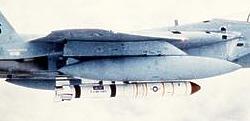


By: SteveO - 16th October 2004 at 17:37
American programs detailed here
http://www.fas.org/spp/military/program/asat/
By: Jai - 16th October 2004 at 17:20
In the late 1970s, even before the advent of the Strategic Defense Initiative (SDI), an anti-satellite (ASAT) mission evolved for the F-15 Eagle.
The goal of ASAT weapons is the neutralization of enemy military satellites in the event of war, particularly low-orbiting reconnaissance, ELINT, and ocean surveillance satellites.
The American equivalent involved the arming of an F-15 Eagle with a missile which would be launched against an orbiting satellite from a zoom climb at an altitude of 80,000 feet.
In 1979, a contract was issued to Vought for an air-launched low Earth-orbit antisatellite vehicle. The Vought ASM-135A that emerged was a two-stage rocket, with a first stage derived from the AGM-69 SRAM-A and a second stage derived from the Altair III rocket. The ASM-135A weighed about 2700 pounds at launch and was 18 feet long. The payload of the ASM-135A consisted of a miniature kinetic kill vehicle which used an infrared seeker to home in on the target satellite, destroying it by impact. No explosive warhead was to be needed.
F-15A 76-0086 was modified for trials with the Vought ASM-135A. The ASM-135A was carried on the centerline station of the F-15. The aircraft had to be specially wired to accommodate the ASM-135A missile, and had to be provided with backup battery, microprocessor, and datalink for midcourse guidance.
Beginning in the early 1980s, captive flights were made with the missile in place, the aircraft zoom climbing to altitudes as high as 80,000 feet. The first actual launch of an ASM-135A from an F-15 took place in January 1984, the missile being aimed at a predetermined point in space. Subsequently, three launches of the ASM-135A were made against celestial infrared sources.
The first and only ASM-135A launch against an actual target satellite took place on September 13, 1985, when F-15A 77-0084 of the 6512th Test Squadron stationed at Edwards AFB took off from Vandenberg AFB and zoom-climbed up to 80,000 feet and then launched the ASAT against the Solwind P78-1, a gamma ray spectroscopy satellite that had been launched in February of 1979. Both the first and second stages fired successfully, and the miniature kinetic kill vehicle separated and homed in on the satellite, destroying it upon impact.
However, Congress was unwilling to permit any further testing of the system, and the ASAT program was officially terminated in 1988
By: Srbin - 16th October 2004 at 15:46
I know Soviets developed some, and a Mig-31 was converted to use them but I never actually got any names for the missile.
However the Americans have converted a few F-15s to launch their ASATs. It’s a lot easier finding info on ASATs than anything Soviet.


 Sign In








 October 16, 2004 at 2:33 pm