This is interesting. From the New Zealand Herald, 23 May 1931:
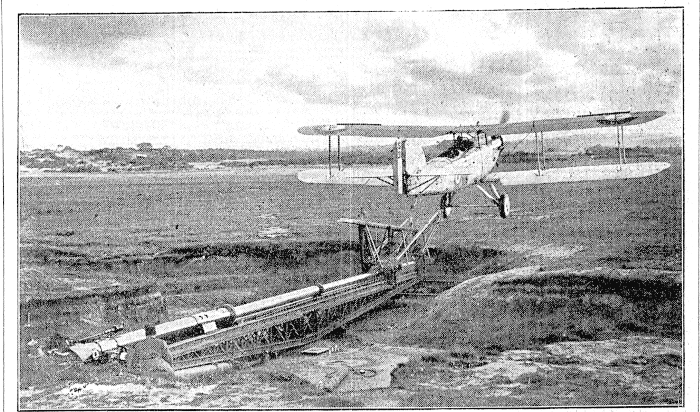
REMARKABLE BRITISH DEVICE FOR LAUNCHING AEROPLANES INTO THE AIR WITHIN A CONFINED: SPACE. A twin-engined Vickers Virginia bombing aeroplane, weighing 9 tons, was successfully catapulted into the air by new mechanism designed at the Royal Air Force experimental station, Farnborough. This photograph shows a single-engined machine making a test take-off from the apparatus, which dispenses with the takeoff run at present necessary for the launching of aircraft.

By: Mothminor - 5th November 2024 at 20:33
Interesting articles and great to see the manufacturer is still going! Thanks, FarlamAirframes 🙂
By: FarlamAirframes - 4th November 2024 at 10:33
Just been looking on Seawings and there are several articles as follow ups to the 1930 article – with details on the catapult design and details and an Edinburgh manufacturer who is still in business
https://www.mactag.com/the-company/our-history
https://www.seawings.co.uk/images/Catapult%20References/Catapult%20Arti…
Other articles are included if you go to Ships Gallery and go to bottom of page.
By: adrian_gray - 28th October 2024 at 09:54
… and the tops of the motors do look a bit like cushions!
By: Dave Homewood - 28th October 2024 at 08:46
Good stuff.
By: Mothminor - 27th October 2024 at 19:44
Good one, Dave 🙂 Here is a video of the contraption in action –
https://www.youtube.com/watch?v=Fm0jqrmS6jk
And a few close-up pics –
By: Dave Homewood - 27th October 2024 at 01:57
Nice find. The chair cushions example is getting a bit too technical though, could he not have simplified it? Hahaha
By: Mothminor - 24th October 2024 at 14:33
By chance, while hunting Pterodactyls, I came across this description of catapult-launching at the 1931 RAF Display written by Major Oliver Stewart –
Among the novelties will be the launching of the twin-engined night-bombing aeroplane….The catapult launching is most impressive; the two tiny compressed air engines of the catapult, like a couple of round chair cushions, can develop more than 8000h.p. and are able to throw the nine ton aeroplane into the air as if it were no heavier or cumbersome than a cricket ball.
By: bazv - 17th October 2024 at 07:44
Funny you should mention that P&P – we were in Norway recently and visited the museum at Bodo – where they have a Dyak Avro 504 (replica/part replica) 🙂

By: powerandpassion - 17th October 2024 at 05:02
I was just blowing hot air too, it seems! Inventor probably got the inspiration while pulling Dyak darts out of his back in deepest, dark Borneo. If it was a Sunbeam Dyak Avro 504k….
By: pogno - 16th October 2024 at 13:56
This image appears on page 64 of the book ‘Farnborough and the Fleet Air Arm’ the caption says its Fairey IIIF S1713 leaving the RAE Mk1 catapult on the Jersey Brow launcher site 1930. Compressed air powered and capable of launching aircraft up to 7,000lb at a speed of 45mph in 34ft at 2g.
By: bazv - 16th October 2024 at 09:52
The picture posted by Dave is probably of a catapult operated by either cordite or high pressure air though (just to clarify).
By: powerandpassion - 16th October 2024 at 05:14
A very interesting technology, when you appreciate that 1 m3 of water becomes 1,700 m3 of steam, representing a very large dynamic force, still in use to launch jets today. The capacity of a ship to generate the power to convert water to steam was the matching element. It is an obtuse reference to the current challenge of generating enough electricity to power a laser with sufficient energy to melt a missile at distance. Only a ship with a massive energy generating capacity can support this, as distinct to a land based, mobile system. Perhaps the only land based system that can support, and should have lasers, is a nuclear power plant, to deal with drone threats. All that from 1931 catapult trials at Farnborough, when the British Lion absolutely roared with innovation. Nevil Shute’s ‘Sliderule’ says the Lion was slayed by Estate taxes, so eccentric folks like Lady Houston lost the means to back eccentric effort.


 Sign In








 October 16, 2024 at 1:37 am